 By DSP Staff
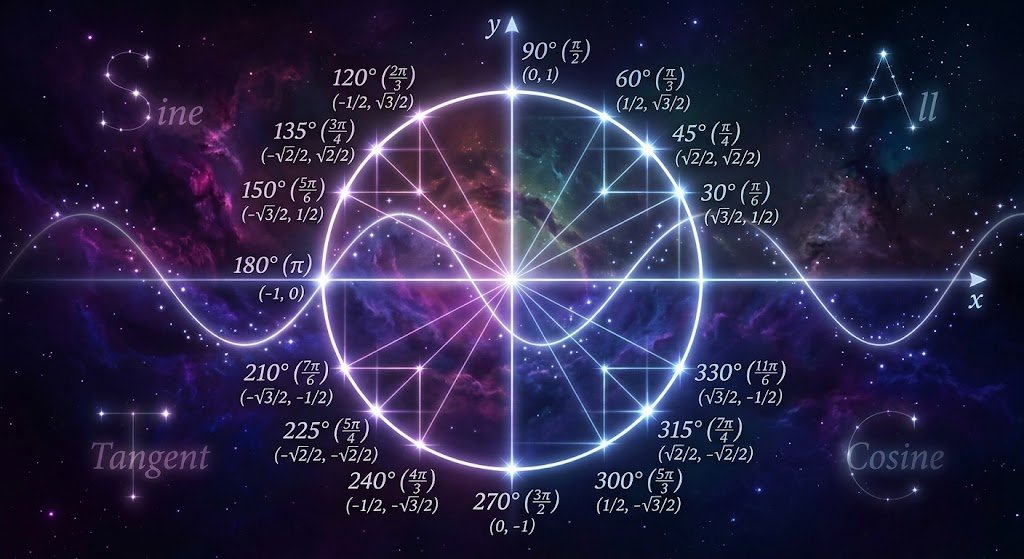
The unit circle is one of the most useful tools in trigonometry. This guide covers what it is, how it works, how to memorize it, and how to practice it.
What Defines a Unit Circle?
A unit circle is a circle with a radius of exactly 1, centered at the origin (0, 0) of a coordinate plane. Its equation is x² + y² = 1. Every point (x, y) on the circle is exactly one unit from the center.
Because the radius is fixed at 1, the coordinates of any point on the circle can be read directly as trigonometric values. If a point is reached by rotating an angle θ counterclockwise from the positive x-axis, its coordinates are (cos θ, sin θ).
Sin, Cos, and Tan on the Circle
The unit circle gives each trig function a clear meaning:
- Cosine is the x-coordinate of the point.
- Sine is the y-coordinate of the point.
- Tangent is sine divided by cosine, which equals y/x. Geometrically, it is the slope of the line from the origin to the point.
So if the point at 60° is (1/2, √3/2), then cos 60° = 1/2, sin 60° = √3/2, and tan 60° = (√3/2) ÷ (1/2) = √3.
Tangent is undefined wherever x = 0, which happens at 90° and 270°, because you cannot divide by zero.
Radians on the Unit Circle
Radians measure angles by arc length. One radian is the angle that cuts off an arc equal in length to the radius. Since the radius is 1 on the unit circle, the arc length and the angle are numerically the same.
A full revolution is 2π radians, which equals 360°. So:
- 180° = π radians
- 90° = π/2 radians
- 60° = π/3 radians
- 45° = π/4 radians
- 30° = π/6 radians
To convert degrees to radians, multiply by π/180. To convert radians to degrees, multiply by 180/π. Radians are standard in calculus and higher math because formulas like the derivative of sin x = cos x only work cleanly in radians.
Quadrants and Signs
The circle is divided into four quadrants, and the signs of the coordinates depend on the quadrant:
- Quadrant I (0° to 90°): x and y are both positive. Sine, cosine, and tangent are all positive.
- Quadrant II (90° to 180°): x is negative, y is positive. Sine is positive.
- Quadrant III (180° to 270°): x and y are both negative. Tangent is positive.
- Quadrant IV (270° to 360°): x is positive, y is negative. Cosine is positive.
A helpful memory aid is “All Students Take Calculus” (All, Sine, Tangent, Cosine), which lists the functions that are positive in Quadrants I, II, III, and IV in order.
The Special Angles
Most unit circle work uses a small set of angles. Learn these and you can reconstruct the rest:
| Angle (degrees) | Radians | Coordinates (cos, sin) |
|---|---|---|
| 0° | 0 | (1, 0) |
| 30° | π/6 | (√3/2, 1/2) |
| 45° | π/4 | (√2/2, √2/2) |
| 60° | π/3 | (1/2, √3/2) |
| 90° | π/2 | (0, 1) |
| 180° | π | (−1, 0) |
| 270° | 3π/2 | (0, −1) |
| 360° | 2π | (1, 0) |
Every other angle in the first quadrant uses the same values, and the other quadrants change only the signs.
How to Memorize the Unit Circle
Most people try to memorize all 16 or so common points at once, which is hard. Break it into steps:
- Learn the first quadrant only. Memorize the three values for sine: 0, 1/2, √2/2, √3/2, and 1 for the angles 0°, 30°, 45°, 60°, and 90°. The cosine values are the same list in reverse order.
- Use the pattern for sine. Write the values as √0/2, √1/2, √2/2, √3/2, √4/2. This pattern makes the numbers easier to remember.
- Apply the quadrant signs. Once you know Quadrant I, use the sign rules to fill in the other quadrants.
- Practice by drawing. Sketch the circle by hand a few times a day. Writing it out is more effective than just reading it.
- Use mnemonics and repetition. Short phrases help, and so does quizzing yourself on random angles until the answers come quickly.
Is the Unit Circle Hard?
The unit circle is not conceptually hard, but memorizing it can feel like a lot at first. The ideas are simple: a circle of radius 1, coordinates that give cosine and sine, and symmetry that does most of the work. Many students find it difficult because they try to memorize without understanding. Once you see why the coordinates work, the values become much easier to recall. Most students who practice for a few weeks find it manageable.
What Level of Math Is the Unit Circle?
The unit circle is usually taught in precalculus or high school trigonometry, typically in grades 10 to 11, depending on the curriculum. It is also a foundation for calculus, physics, engineering, and computer graphics. You should be comfortable with basic algebra, the Pythagorean theorem, and coordinate graphing before starting.
Unit Circle Chart and Blank Practice
A unit circle chart is a labeled diagram showing the angles in degrees and radians along with their coordinates. Students often study from one and then practice on a blank unit circle, a diagram with only the circle and axes. To practice, fill in the blank circle from memory, then check your answers against a completed chart. Repeat until you can complete it accurately and quickly. Many teachers also ask students to fill in the circle under timed conditions.
Unit Circle Games and Practice Tools
Games make memorization more engaging. Some effective options include:
- Flashcards: One side shows an angle, and the other shows the coordinates. Shuffle them and time yourself.
- Speed drills: Name the cosine and sine of random angles as fast as you can.
- Blank circle races: Fill in a blank circle against a timer, then try to beat your record.
- Quadrant sorting: Give yourself angles and sort them by which trig functions are positive.
- Online quizzes and apps: Many free unit circle games are available through educational websites and math apps.
Final Thoughts
The unit circle is a single circle that connects angles, coordinates, and trigonometric functions. Learn the first quadrant, understand the signs, practice with a blank chart, and use games to build speed. With consistent practice, what looks like a long list becomes a clear and useful picture.