 By DSP Staff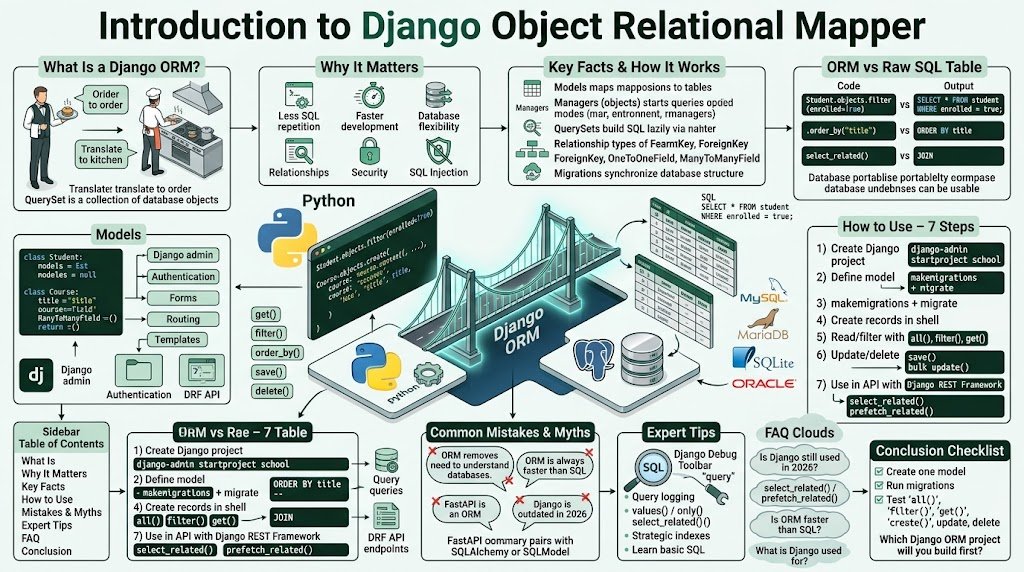
Introduction to Django Object Relational Mapper
What if you could work with a database without writing SQL for every task? The django object relational mapper lets you create, read, update, and delete database records with familiar Python code.
In this guide, you will learn what an object-relational mapper is, how Django ORM works, and why developers still use Django in 2026. You will also see a practical django object relational mapper example, compare ORM with raw SQL, and build a simple query step by step.
You will discover how models, QuerySets, managers, relationships, and migrations work together. We will also answer common questions such as “Is ORM faster than SQL?”, “Is FastAPI an ORM?”, and “What is Django used for?”
Whether you are learning django python, preparing for a class, or building an API with Django REST Framework, this tutorial gives you a clear starting point.
Table of Contents
-
Introduction to Django Object Relational Mapper
-
What Is a Django Object Relational Mapper?
-
Why Does the Django ORM Matter?
-
Django ORM Key Facts and How It Works
-
How to Use the Django Object Relational Mapper
-
Common Django ORM Mistakes and Myths
-
Expert Tips for Better Django ORM Results
-
Frequently Asked Questions
-
Conclusion
What Is a Django Object Relational Mapper?
A Django object relational mapper is a Python-based system that connects your Django models to tables in a relational database. Instead of writing SQL manually, you define Python classes and use methods such as filter(), get(), and create().
For example, a Student model can represent a students table. Each model object represents one database row, while each model field represents a column. Django translates your Python instructions into SQL that your database understands.
Imagine a restaurant. SQL is like speaking directly to the kitchen in a technical language. Django ORM is like giving your order to a helpful waiter who translates it correctly. You still control the order, but you do not need to manage every kitchen detail.
A QuerySet represents a collection of database objects. Django describes QuerySets as database queries that can be filtered, combined, and evaluated when needed.
Here is a simple model:
from django.db import models
class Student(models.Model):

    name = models.CharField(max_length=100)

    email = models.EmailField()

    enrolled = models.BooleanField(default=True)
Django can use this model to create database tables through migrations. You can then query students using Python:
students = Student.objects.filter(enrolled=True)Why Does the Django ORM Matter?
The Django ORM matters because it makes database work easier, safer, and more consistent for Python developers.
-
Less SQL repetition: You can perform common database operations with readable Python methods.
-
Faster development: Models, migrations, forms, and admin tools work together.
-
Database flexibility: Django supports databases such as PostgreSQL, MySQL, MariaDB, SQLite, and Oracle.
-
Readable code: A query such as
Student.objects.filter(enrolled=True)clearly shows your intention. -
Relationship support: Foreign keys, one-to-one relationships, and many-to-many relationships are built into the system.
-
Security help: ORM queries normally use parameter handling that reduces common SQL injection risks.
The official Django documentation explains that a QuerySet is similar to a SQL SELECT statement, while methods such as filter() apply conditions similar to WHERE or LIMIT.
Django also remains useful in 2026 because it provides much more than database access. It includes routing, authentication, an admin interface, templates, forms, and strong support for API development through Django REST Framework.
Django ORM Key Facts and How It Works
Models Map Python Objects to Tables
A Django model is a Python class that usually maps to a database table. Its attributes become table columns.
class Course(models.Model):

    title = models.CharField(max_length=150)

    price = models.DecimalField(max_digits=8, decimal_places=2)
Django reads this structure and creates the database design through migration files. You can update the model later and create new migrations instead of manually editing every database table.
Managers Start Database Queries
Most Django models use the objects manager:
Course.objects.all()

Course.objects.get(id=1)

Course.objects.filter(price__lt=100)
The manager provides access to QuerySets. QuerySets are lazy, which means Django often waits until your code needs the results before sending the query to the database.
QuerySets Build SQL
You can chain QuerySet methods:
courses = Course.objects.filter(price__lt=100).order_by("title")This code does not immediately fetch every course. Django builds a query and evaluates it when you loop through the results, convert it to a list, or otherwise request the data.
Relationships Connect Tables
Django supports common relationship types:
-
ForeignKeyfor many-to-one relationships. -
OneToOneFieldfor one-to-one relationships. -
ManyToManyFieldfor many-to-many relationships.
Django provides related-object accessors for these relationships, allowing you to move between connected records through Python attributes.
ORM and SQL Comparison
ORM code is usually easier to read and maintain. Raw SQL can offer greater control for special queries, complex reports, or database-specific performance tuning.
How to Use the Django Object Relational Mapper
1. Create a Django Project
Install Django and create a project:
python -m pip install django

django-admin startproject school

cd school

python manage.py startapp courses
Add the app to INSTALLED_APPS in your project settings. Confirm that your database settings match the database you want to use.
2. Define a Model
Open courses/models.py and add a model:
from django.db import models
class Course(models.Model):

    title = models.CharField(max_length=150)

    level = models.CharField(max_length=50)

    published = models.BooleanField(default=False)
    def __str__(self):

        return self.title
Keep field names clear and choose field types carefully. Good model design makes future queries easier.
3. Create and Apply Migrations
Run these commands:
python manage.py makemigrations

python manage.py migrate
The first command creates migration instructions. The second applies those instructions to your database and creates or updates the required tables.
4. Create Database Records
You can add a record in the Django shell:
python manage.py shellThen run:
from courses.models import Course
Course.objects.create(

    title="Python Basics",

    level="Beginner",

    published=True

)
The ORM converts this Python operation into an SQL INSERT statement.
5. Read and Filter Records
Use QuerySets to retrieve information:
Course.objects.all()

Course.objects.filter(published=True)

Course.objects.get(title="Python Basics")
Use get() only when you expect exactly one record. If no record exists or multiple records match, Django raises an exception.
6. Update and Delete Data
Update a record like this:
course = Course.objects.get(title="Python Basics")

course.level = "Intermediate"

course.save()
Delete it with:
course.delete()For bulk updates, use:
Course.objects.filter(published=False).update(level="Draft")Test update and delete queries carefully, especially when working with production data.
7. Use the ORM in an API
Django REST Framework can serialize ORM objects and return them through API endpoints. It supports relationship fields for ForeignKey, ManyToManyField, and OneToOneField models.
For advanced database optimization, Django provides methods such as select_related() and prefetch_related(). select_related() can fetch foreign-key data in a more efficient query instead of causing repeated database requests.
Common Django ORM Mistakes and Myths
-
“The ORM removes the need to understand databases.” You still need to understand tables, indexes, joins, relationships, and transactions. ORM knowledge works best when combined with basic SQL knowledge.
-
“ORM is always faster than SQL.” ORM is not automatically faster. It can produce efficient queries, but poorly designed QuerySets may create extra queries or retrieve too much data.
-
“Calling
get()is the same as callingfilter().”get()expects one result and raises an exception when the result count is wrong.filter()returns a QuerySet that may contain zero, one, or many objects. -
“FastAPI is an ORM.” FastAPI is a Python web framework for building APIs. It does not function as an ORM; developers commonly pair it with SQLAlchemy or SQLModel. FastAPI’s documentation describes SQLModel as being built on SQLAlchemy and Pydantic.
-
“Django is outdated in 2026.” Django is still used for content platforms, education systems, business applications, dashboards, and APIs. Its mature ecosystem remains valuable when you need many built-in features.
Expert Tips for Better Django ORM Results
-
Inspect generated SQL. Use Django Debug Toolbar or query logging to understand what your QuerySets send to the database.
-
Retrieve only needed fields. Use
values()oronly()when a page does not need every column from a large table. -
Prevent repeated relationship queries. Apply
select_related()for single-valued relationships andprefetch_related()for collections. -
Add indexes strategically. Index fields used regularly in filtering, sorting, or joins, but avoid adding indexes without a clear query benefit.
-
Learn basic SQL. Understanding SQL helps you identify slow queries, improve model design, and decide when raw SQL is appropriate.
Frequently Asked Questions
Is Django still used in 2026?
Yes. Django remains a practical Python web framework in 2026, especially for websites and applications that need authentication, an admin panel, forms, database models, and mature project structure. It also works with Django REST Framework for APIs. Choose Django when built-in features and development speed matter more than using the smallest possible framework.
Is ORM faster than SQL?
Usually, raw SQL can provide more direct control, but speed depends on the query, database design, indexes, and amount of returned data. A well-written Django ORM query can perform very well because it generates SQL for the database. A poorly written ORM query can become slow, especially when it causes repeated relationship lookups or retrieves unnecessary columns.
What is Django used for?
Django is used for blogs, learning platforms, content management systems, business dashboards, marketplaces, social applications, and API backends. Its model system helps developers manage relational data, while its authentication, admin interface, forms, routing, and security features reduce repeated development work. Django REST Framework adds tools for building structured web APIs.
Conclusion
The django object relational mapper connects Python models to relational database tables and lets you work with data through readable QuerySets. The three most important ideas are simple: models describe data, managers create queries, and migrations keep database structure synchronized with your code.
You also learned that ORM is not automatically faster than SQL, FastAPI is not an ORM, and Django remains useful in 2026 for full-featured web applications and APIs.
Start today by creating one model, running migrations, and testing all(), filter(), get(), create(), update(), and delete(). Which Django ORM project will you build first?