 By DSP Staff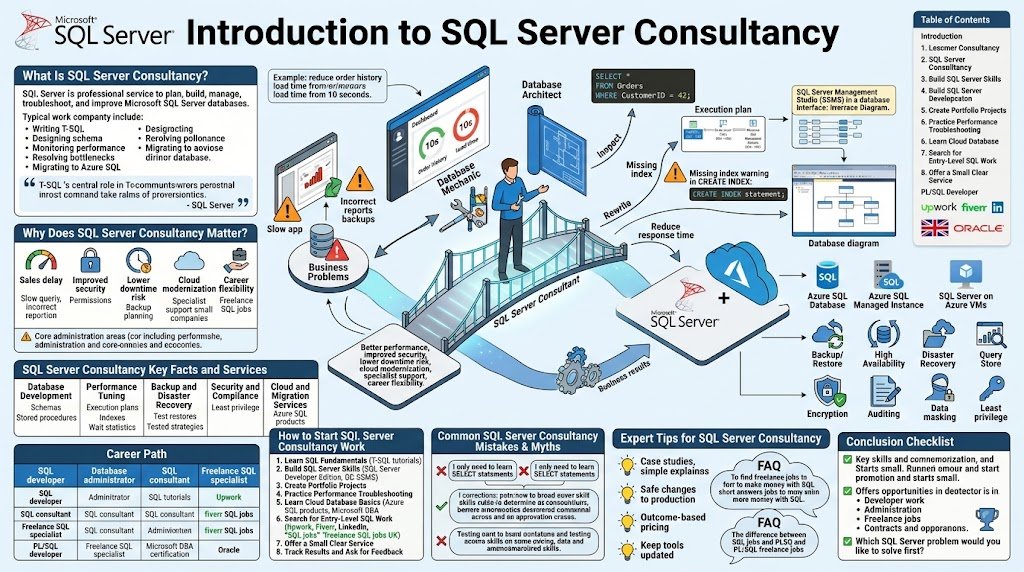
Introduction to SQL Server Consultancy
Could your SQL skills solve real business problems and become a paid career? SQL Server consultancy helps organizations manage, secure, improve, and modernize their databases.
A consultant does more than write SELECT statements. You may diagnose slow queries, design tables, plan backups, move a database to Azure, improve security, or teach a team how to use Microsoft SQL Server correctly.
This guide explains what SQL Server consulting involves and how students can prepare for it in 2026. You will learn the main services consultants provide, the skills employers and clients expect, and the difference between full-time roles, sql server freelance jobs, and short-term contracts.
You will also learn how to find sql jobs, build a portfolio, make money with SQL, and approach opportunities such as Fiverr SQL jobs, freelance SQL jobs in the UK, part-time SQL jobs, and PL/SQL freelance jobs.
By the end, you will have a practical roadmap for turning classroom knowledge into useful SQL work.
Table of Contents
-
What Is SQL Server Consultancy?
-
Why Does SQL Server Consultancy Matter?
-
SQL Server Consultancy Key Facts and Services
-
How to Start SQL Server Consultancy Work
-
Common SQL Server Consultancy Mistakes
-
Expert Tips for SQL Server Consultancy
-
Frequently Asked Questions
-
Conclusion
What Is SQL Server Consultancy?
SQL Server consultancy is a professional service that helps businesses plan, build, manage, troubleshoot, and improve Microsoft SQL Server databases.
A consultant acts like a database mechanic and architect. If a company’s application loads slowly, customer reports show incorrect totals, or backups fail, the consultant investigates the cause and recommends a practical solution.
Typical work includes:
-
Writing and optimizing Transact-SQL, also called T-SQL.
-
Designing tables, relationships, indexes, and stored procedures.
-
Monitoring database performance and resolving bottlenecks.
-
Creating backup, restore, security, and disaster recovery plans.
-
Migrating on-premises databases to Azure SQL.
-
Supporting developers, database administrators, and business teams.
Microsoft describes T-SQL as central to using SQL Server products and services because applications communicate with the database by sending T-SQL commands.
For example, imagine an online store that takes ten seconds to display an order history. A consultant might inspect the execution plan, find a missing index, rewrite the query, and reduce the response time. The client pays for the business result, not simply for typing SQL.
Why Does SQL Server Consultancy Matter?
Businesses depend on accurate and available data. A database problem can delay sales, interrupt reporting, or expose sensitive customer information.
-
Better performance: Consultants find slow queries, blocking, poor indexes, and inefficient database designs.
-
Improved security: They can review permissions, encryption, auditing, and access controls.
-
Lower downtime risk: Backup and recovery planning helps teams respond to failures.
-
Cloud modernization: Consultants help move SQL Server workloads to Azure SQL or hybrid environments.
-
Specialist support: Small companies can hire expertise without employing a full-time database team.
-
Career flexibility: Students can begin with internships, part-time SQL jobs, or freelance assignments.
Microsoft’s SQL Server documentation groups performance tuning, backup and restore, high availability, security, and monitoring among the platform’s core administration areas. That range explains why consultants can work across development, infrastructure, reporting, and cloud projects.
SQL Server Consultancy Key Facts and Services
Database Development
Database development includes creating schemas, tables, relationships, views, stored procedures, functions, and triggers. You may also write reports and queries that help managers understand business data.
A strong consultant avoids storing everything in one table. Instead, they design clear relationships and choose suitable data types, constraints, and indexes.
Performance Tuning
Performance tuning focuses on making queries and systems respond more efficiently. You may examine execution plans, wait statistics, indexes, blocking sessions, memory use, and disk activity.
The goal is not always to add hardware. Rewriting a query, updating statistics, or adding the correct index may solve the problem at a lower cost.
Backup and Disaster Recovery
Consultants create backup schedules and test whether the organization can restore data after a failure. SQL Server supports several high-availability and disaster-recovery options, but Microsoft states that these options do not replace a properly tested backup and restore strategy.
Security and Compliance
Security work includes reviewing user permissions, roles, encryption, auditing, data masking, and authentication. You must follow the principle of least privilege, which gives users only the access they need.
Cloud and Migration Services
Many organizations use Azure SQL Database, Azure SQL Managed Instance, or SQL Server on Azure virtual machines. Azure SQL is a family of cloud database products that includes these different deployment choices.
Career Paths Compared
A consultant may perform several of these roles during one project. Your exact work depends on the client’s database size, industry, software, and budget.
How to Start SQL Server Consultancy Work
1. Learn SQL Fundamentals
Start with SELECT, WHERE, JOIN, GROUP BY, subqueries, transactions, constraints, and aggregate functions. You should understand why a query returns a result, not simply memorize its syntax.
Practice with realistic datasets such as orders, students, products, or hospital appointments. Microsoft provides tutorials for connecting to SQL Server and writing T-SQL statements.
2. Build SQL Server Skills
Install SQL Server Developer Edition or use a suitable learning environment. Practice with SQL Server Management Studio, database creation, views, stored procedures, indexes, backups, and user permissions.
Learn how SQL Server differs from MySQL, PostgreSQL, and Oracle. This knowledge helps you understand job descriptions and choose between SQL Server freelance jobs and PL/SQL freelance jobs.
3. Create Portfolio Projects
Build two or three projects that show practical ability. For example, create a school database with students, courses, teachers, grades, reports, and role-based access.
Document your schema, sample queries, indexes, backup plan, and performance improvements. A clear case study often proves more than a list of completed courses.
4. Practice Performance Troubleshooting
Create a slow query on purpose, inspect its execution plan, and test an improvement. Compare the original and revised versions using logical reads, execution time, and query-plan changes.
Learn to identify table scans, missing indexes, blocking, excessive joins, and unnecessary columns. Record your testing process in your portfolio.
5. Learn Cloud Database Basics
Study Azure SQL Database, Azure SQL Managed Instance, and SQL Server on Azure virtual machines. Learn how authentication, networking, backups, scaling, monitoring, and costs differ across deployment models.
Cloud knowledge can expand your opportunities because many businesses now operate hybrid or cloud-based systems. Microsoft’s database administrator certification includes management, availability, security, performance optimization, automation, and disaster recovery.
6. Search for Entry-Level SQL Work
Search for terms such as SQL developer, database support analyst, junior database administrator, reporting analyst, and SQL consultant trainee. Do not search only for “consultant,” because entry-level roles may use different titles.
For freelance work, explore platforms such as Upwork, Fiverr, LinkedIn, and specialist job boards. Search phrases including fiverr SQL jobs, freelance SQL jobs UK, and part-time SQL job can reveal different client needs.
7. Offer a Small, Clear Service
Start with a focused offer such as “I will optimize five SQL Server queries,” “I will design a small relational database,” or “I will review your backup plan.”
Define the deliverables, deadline, assumptions, and price before beginning. Clear communication protects both you and the client.
8. Track Results and Ask for Feedback
After completing work, record measurable outcomes such as reduced query time, fewer errors, improved report speed, or successful backup restoration. Ask clients or supervisors for permission to turn non-confidential results into portfolio case studies.
Common SQL Server Consultancy Mistakes
-
“I only need to learn SELECT statements.” Real SQL work also includes data modeling, transactions, security, backups, performance, testing, and communication.
-
“I can promise a fixed result before inspecting the database.” You should inspect the schema, workload, environment, and constraints before estimating time or savings.
-
“Adding indexes always makes SQL Server faster.” Indexes can speed up reads but slow inserts, updates, and deletes. Test each index against real workloads.
-
“Freelancing means accepting every project.” Poorly defined projects create stress and disputes. Choose work that matches your skills, access level, and available time.
-
“A certificate replaces practical experience.” Certifications show structured learning, but employers and clients also want working demos, troubleshooting examples, and clear explanations.
Expert Tips for SQL Server Consultancy
-
Write short case studies. Explain the problem, investigation, solution, testing method, and measurable result in one page.
-
Learn to explain technical issues simply. A client may understand sales and operations better than execution plans or locking.
-
Never change production data casually. Confirm backups, test scripts in a safe environment, and obtain approval before destructive actions.
-
Price outcomes carefully. Consider project complexity, access requirements, meetings, documentation, testing, and support time—not only query-writing hours.
-
Keep learning Microsoft tools. Review official documentation for Query Store, Azure SQL, backup systems, security features, and high-availability options.
Frequently Asked Questions
How can I find SQL Server freelance jobs?
Build a portfolio with database design, query optimization, reporting, and backup examples. Search LinkedIn, Upwork, Fiverr, and local job boards using terms such as SQL Server developer, database administrator, SQL consultant, and T-SQL specialist. Start with small, clearly defined assignments, request reviews, and avoid claiming experience you do not yet have.
Can I make money with SQL?
Yes, you can make money with SQL through full-time employment, consulting, freelance database development, reporting, data cleaning, teaching, and technical support. Your income depends on skill level, location, communication, specialization, and the value of the problem you solve. Start by mastering SQL fundamentals and creating portfolio projects that demonstrate measurable results.
What is the difference between SQL jobs and PL/SQL freelance jobs?
SQL jobs may involve several database platforms, including SQL Server, PostgreSQL, and MySQL. PL/SQL freelance jobs usually focus on Oracle’s procedural language and database ecosystem. The skills overlap, but tools, syntax, administration features, and client requirements differ. Read each project description carefully and identify the database platform before applying.
Conclusion
SQL Server consultancy combines database knowledge, troubleshooting, communication, and business judgment. The three most important skills are writing accurate T-SQL, improving database performance and reliability, and explaining technical decisions clearly.
You can begin with a small portfolio, practical SQL Server projects, and entry-level roles before seeking larger consulting assignments. Opportunities may include SQL developer work, database administration, sql server freelance jobs, and part-time contracts.
Start today by creating one project, documenting a performance improvement, and publishing your work safely. Which SQL Server problem would you like to solve first?