 By DSP Staff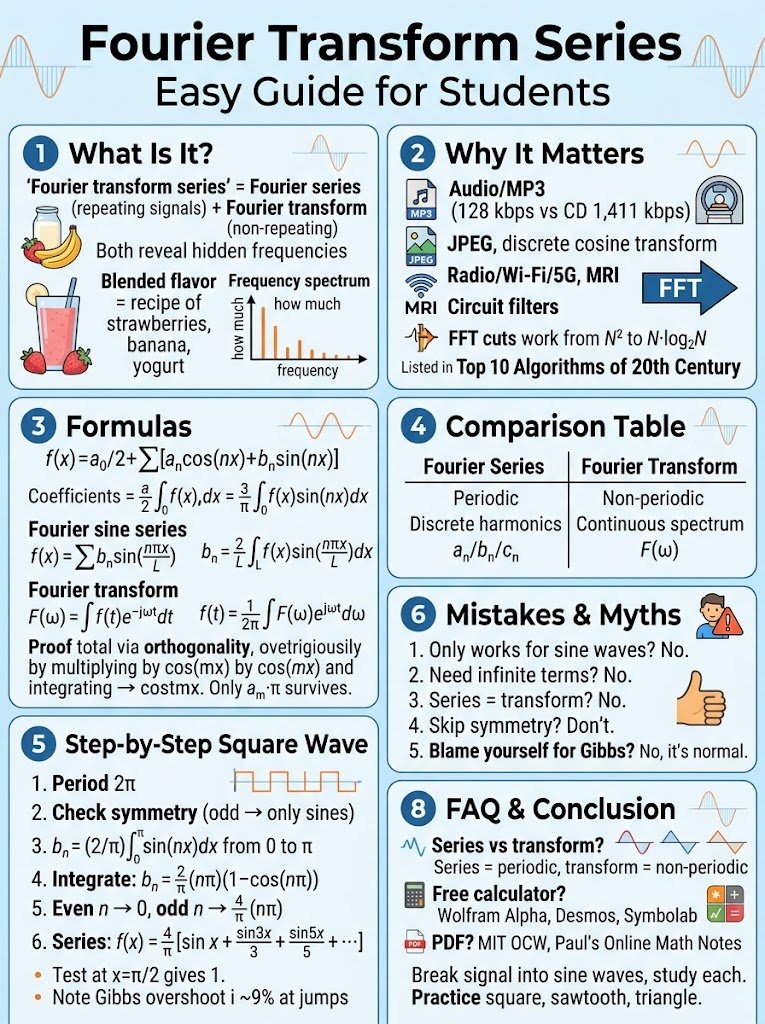
Introduction
Your phone can pick out one voice in a noisy café, and the math behind that trick is the Fourier transform series. Every signal you record, from a guitar note to a Wi-Fi carrier, is a stack of simple sine and cosine waves. Once you can see that stack, hard problems turn into easy ones.
Students search for “fourier transform series” because two ideas travel together in most courses. The Fourier series handles repeating signals, and the Fourier transform handles everything else. They look alike but solve different problems.
In this guide, you will learn:
- what each tool means in plain language
- the key Fourier series formula and the Fourier sine series
- a short proof of where the coefficients come from
- a step-by-step example you can copy
- common mistakes and study tips that save hours
Let’s start with the big picture.
Table of Contents
- What Is the Fourier Transform Series?
- Why Does the Fourier Transform Series Matter?
- Fourier Series, Sine Series and Transform: Formulas and How They Work
- How to Use the Fourier Transform Series: Step by Step
- Common Fourier Series Mistakes and Myths
- Expert Tips for Learning Fourier Series Faster
- Frequently Asked Questions
- Conclusion
What Is the Fourier Transform Series?
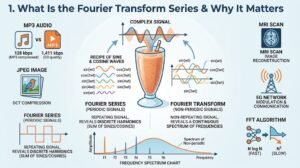
“Fourier transform series” is not one official term. It is the everyday name for the family of tools built by Joseph Fourier: the Fourier series and the Fourier transform. Both answer one question: which frequencies are hiding inside this signal?
Think of a smoothie. You taste one blended flavor, but the recipe lists strawberries, banana, and yogurt. A Fourier series is the recipe. It tells you how much of each pure sine wave went into the blend.
A Fourier series writes a repeating signal as a sum of sines and cosines at whole-number multiples of a base frequency. A Fourier transform does the same job for signals that never repeat, like one clap or one spoken word.
The result is a frequency spectrum, a chart of “how much” at each frequency. Engineers read spectrums the way doctors read X-rays: they reveal what the raw signal hides.
Why Does the Fourier Transform Series Matter?
Frequency is one of the most useful ways to look at data. Here is where it pays off:
- Audio and music: Equalizers, synthesizers, and MP3 compression all work on frequencies. A CD stores about 1,411 kbps, while a typical MP3 uses 128 kbps by dropping frequencies you can barely hear.
- Images and video: JPEG uses a close cousin, the discrete cosine transform, to keep the important low frequencies and discard the rest.
- Communications: Radio, Wi-Fi, and 5G shape signals in the frequency domain.
- Medicine: MRI scanners collect data in frequency space, then use Fourier methods to build the picture.
- Circuit analysis: Filters and amplifiers respond to each frequency separately, so splitting a signal makes the math simple.
The Fast Fourier Transform (FFT) is the reason all this runs in real time. It cuts the work from about N² operations to N·log₂N, and it made the list of the “Top 10 Algorithms of the 20th Century” in Computing in Science & Engineering (2000). For one million samples, that is roughly 50,000 times less work.
Fourier Series, Sine Series and Transform: Formulas and How They Work
Each tool has its own job. Here are the Fourier transform series formulas you need most.
The Fourier Series
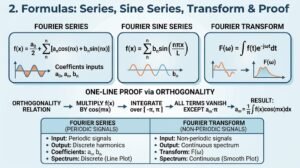
For a signal f(x) with period 2π:
f(x) = a₀/2 + Σ [ aₙ·cos(nx) + bₙ·sin(nx) ]     (n = 1 to ∞)

a₀ = (1/π) ∫ f(x) dx
aₙ = (1/π) ∫ f(x)·cos(nx) dx
bₙ = (1/π) ∫ f(x)·sin(nx) dx      (all integrals from −π to π)
The term a₀/2 is the average value. The n = 1 term is the fundamental, and higher n gives the harmonics.
The Fourier Sine Series
Sometimes a function exists only on (0, L), like a plucked string held at both ends. Extend it as an odd function, and only sines remain:
f(x) = Σ bₙ·sin(nπx/L)
bₙ = (2/L) ∫ f(x)·sin(nπx/L) dx      (from 0 to L)
The Fourier Transform
For non-repeating signals:
F(ω) = ∫ f(t)·e^(−jωt) dt          (from −∞ to ∞)
f(t) = (1/2π) ∫ F(ω)·e^(jωt) dω
Proof in One Minute
The Fourier series proof relies on orthogonality: over one period, ∫ cos(mx)·cos(nx) dx equals π when m = n and 0 otherwise. Multiply the series by cos(mx) and integrate. Every term vanishes except aₘ·π, so aₘ = (1/π) ∫ f(x)·cos(mx) dx. The same move with sin(mx) gives bₘ.
Quick Comparison
| Feature | Fourier Series | Fourier Transform |
|---|---|---|
| Signal type | Periodic | Non-periodic |
| Output | Discrete harmonics | Continuous spectrum |
| Example | Square-wave clock | Single pulse |
| Coefficients | aₙ, bₙ or cₙ | F(ω) |
How to Use the Fourier Transform Series: Step by Step
Follow these steps to build a Fourier series by hand. The example is a square wave: f(x) = −1 on (−π, 0) and +1 on (0, π).
- Find the period. Here it is 2π. Write down the interval you will integrate over.
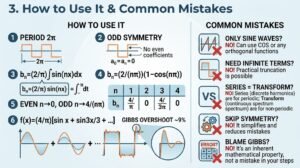
- Check for symmetry. Even functions have only cosine terms, and odd functions have only sine terms. The square wave is odd, so a₀ = 0 and aₙ = 0.
- Set up the coefficient integral. For an odd function, bₙ = (2/π) ∫ sin(nx) dx from 0 to π. This is much shorter than the full formula.
- Integrate and simplify. You get bₙ = (2/(nπ))(1 − cos(nπ)). Use cos(nπ) = (−1)ⁿ to simplify further.
- Sort even and odd n. For even n, bₙ = 0. For odd n, bₙ = 4/(nπ).
- Write the series. f(x) = (4/π)[sin x + sin(3x)/3 + sin(5x)/5 + …].
- Test your answer. At x = π/2 the series becomes (4/π)(1 − 1/3 + 1/5 − …). That sum equals π/4, so the total is exactly 1, matching f(π/2).
Then check your work with a Fourier series calculator such as Wolfram Alpha, Desmos, or Symbolab. Compare the plots of your partial sums with the original wave.
You will notice a small overshoot near each jump, about 9% of the jump height. This is the Gibbs phenomenon, and it is normal.
Fourier Transform Series DSP-Academy
Common Fourier Series Mistakes and Myths
Mistake 1: Thinking it only works for sine waves. The series works for almost any periodic signal. Sines and cosines are the building blocks, not the target.
Mistake 2: Believing you need infinite terms. Real work uses a partial sum. Smooth signals need only a handful of terms, while sharp edges need more.
Mistake 3: Mixing up the series and the transform. The series is for repeating signals and gives discrete harmonics. The transform is for non-repeating signals and gives a continuous spectrum.
Mistake 4: Skipping the symmetry check. Even and odd functions can wipe out half your integrals. Always look before you integrate.
Mistake 5: Blaming yourself for Gibbs overshoot. The 9% ripple at a jump does not mean your algebra is wrong. It happens for every square-wave series, no matter how many terms you add.
Expert Tips for Learning Fourier Series Faster
- Sketch first. Draw the signal and its repeats before writing any formula, because you will spot symmetry and jumps immediately.
- Memorize three facts. Remember sin(nπ) = 0, cos(nπ) = (−1)ⁿ, and cos(2nπ) = 1, since they simplify nearly every problem.
- Read the decay rate. Coefficients that shrink like 1/n mean the signal has jumps, and 1/n² means it has corners.
- Plot partial sums. Watching one, three, then ten sine waves build a square wave teaches more than any textbook page.
- Build your own cheat sheet. A one-page summary you write yourself beats a downloaded Fourier series PDF, because writing it locks the formulas in.

Fourier Transform Series – DSP-Academy
Frequently Asked Questions
What is the difference between a Fourier series and a Fourier transform?
A Fourier series describes a periodic signal as a sum of sines and cosines at discrete frequencies. A Fourier transform describes a non-periodic signal using a continuous range of frequencies. Think of the transform as the series when the period grows to infinity. Use the series for repeating waves like AC power, and the transform for one-time events like a single pulse.
Is there a free Fourier series calculator?
Yes. Wolfram Alpha computes coefficients and full series, Desmos plots partial sums with a slider, and Symbolab shows integration steps. You can also write a short Python script with NumPy and Matplotlib. Use these tools to check your work, not replace it, because exams usually ban calculators and the real skill is understanding each step.
Where can I find a Fourier transform series PDF?
University course pages are your best bet. MIT OpenCourseWare and Lamar University’s Paul’s Online Math Notes offer free PDF notes with formulas, proofs, and worked examples. Look for notes that cover orthogonality, symmetry shortcuts, and the sine series. Then condense them into a one-page summary of your own for quick review before exams.
Conclusion
The Fourier transform series is one idea in two forms: break a signal into sine waves, then study each wave on its own. Here are the three points to remember:
- The Fourier series handles repeating signals, and the Fourier transform handles non-repeating ones.
- The coefficient formulas come from orthogonality, so multiplying by a sine or cosine picks out one frequency at a time.
- Symmetry checks and a quick plot save time and catch mistakes.
Start today. Pick the square wave, derive its series without peeking, and plot five partial sums on Desmos or in Python. Then move on to the sawtooth and triangle waves.
Which part of the Fourier transform series still feels confusing to you? Leave a comment below, and we will cover it in a future DSP-Academy.com guide.