 By DSP Staff
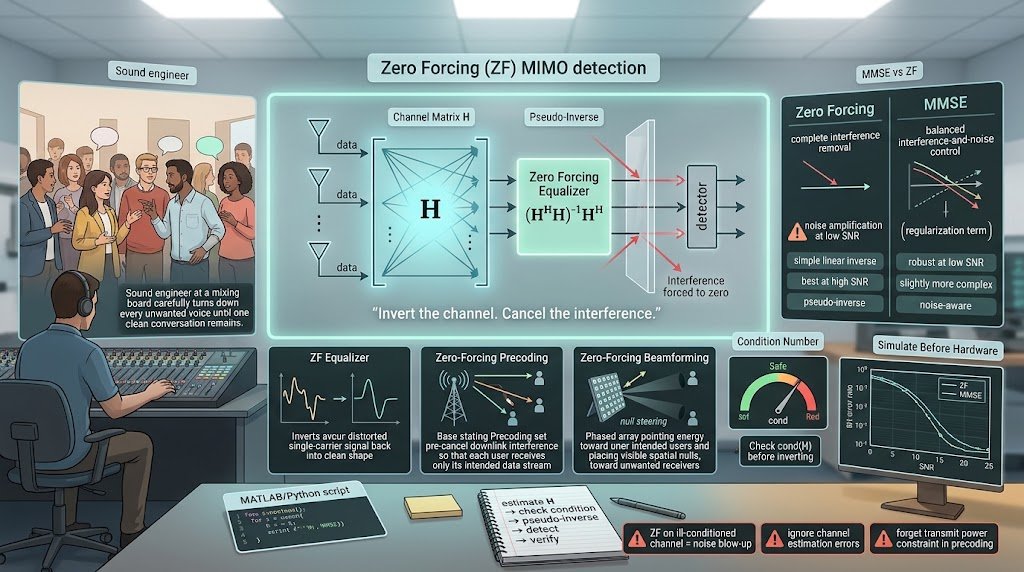
Table of Contents
- What Is Zero Forcing?
- Why Does Zero Forcing Matter?
- Zero Forcing — Key Facts and Types
- How to Use Zero Forcing in Your Designs
- Common Mistakes and Myths to Avoid
- Expert Tips for Best Results
- Frequently Asked Questions
Imagine two people talking in a noisy room, and each one is shouting at a different friend across the table. Their voices blend into a mess, and neither friend hears clearly. Wireless systems face this exact problem when several signals share the same air, and a zero forcing equalizer is one of the most widely taught tools for untangling them.
This guide explains what zero forcing means, why it matters in wireless communication, and how it works in zero forcing mimo and zero-forcing beamforming. You will see the core math in plain language, compare it with the MMSE equalizer, and learn how null steering beamforming relates to the same idea. You will also get a step-by-step method, common mistakes to avoid, and practical tips. By the end, you will know when zero forcing is the right choice for your system.
What Is Zero Forcing?
Zero forcing (ZF) is a linear signal processing technique that removes interference by forcing it to zero at the receiver or transmitter. Think of it like a sound engineer who turns down every instrument except the one you want to hear. The engineer does not fix the song itself. Instead, the engineer adjusts the mix so the unwanted parts cancel out.
In a wireless system, several data streams often travel through multiple antennas at once. Each receive antenna picks up a blend of all streams. A zero forcing equalizer multiplies the received signal by the inverse of the channel matrix, so each stream is separated from the others. Once the interference is cancelled, the desired symbol appears clean for detection.
The trade-off is simple to remember. Zero forcing gives you perfect interference removal, but it can amplify background noise when the channel is weak.
Why Does Zero Forcing Matter?
Engineers use zero forcing because it is easy to understand, easy to implement, and effective when the channel is well conditioned. Here are the main benefits:
- Complete interference removal: The method eliminates inter-stream interference in theory, so each data stream reaches the detector clean.
- Simple linear structure: You only need a matrix inverse or pseudo-inverse, which keeps the hardware manageable.
- Strong multi-user performance: Base stations can serve several users at once by nulling interference between them.
- Easy to analyze: The math is transparent, so you can predict performance before building anything.
- Good baseline for research: Most advanced MIMO papers compare their results against zero forcing first.
- Works with massive MIMO: Large antenna arrays make the channel matrix more orthogonal, which helps the method perform well.
According to the 3GPP technical specifications for 5G New Radio, MIMO precoding and multi-user spatial processing are core features of the standard, which shows how central linear methods like zero forcing remain to modern networks.
Zero Forcing — Key Facts and Types
Before you choose a method, you should know how zero forcing compares with its closest alternative, the MMSE equalizer. The table below summarizes the main contrasts.
| Feature | Zero Forcing (ZF) | MMSE |
|---|---|---|
| Interference removal | Complete (forces to zero) | Partial (balances with noise) |
| Noise handling | Can amplify noise | Controls noise amplification |
| Performance at low SNR | Weaker | Stronger |
| Performance at high SNR | Close to optimal | Close to optimal |
| Implementation | Simpler | Slightly more complex |
Zero Forcing Equalizer
A zero forcing equalizer inverts the channel response to undo distortion on a single link. It is common in single-carrier systems and older communication receivers. You apply the inverse filter, and the distorted signal returns to its original shape.
Zero-Forcing Precoding
Zero-forcing precoding works at the transmitter instead of the receiver. The base station pre-cancels interference before sending, so each user receives only its own stream. This approach shines in downlink multi-user systems, where users cannot easily cooperate.
Zero-Forcing Beamforming
Zero-forcing beamforming shapes the transmitted signal so that it points energy toward intended users and places nulls toward others. The result is a spatial “dead zone” around unwanted receivers. Null steering beamforming uses the same principle for a single direction of interference.
How to Use Zero Forcing in Your Designs
Follow these steps to apply zero forcing in a MIMO or beamforming system.
- Estimate the channel matrix. Send known pilot symbols and measure the response between every transmit and receive antenna. Store the result as a matrix H.
- Check the matrix condition. Compute the condition number of H, because a large value means the matrix is nearly singular. Treat values above your chosen threshold as a warning sign.
- Compute the zero forcing matrix. Calculate the pseudo-inverse of H, usually as (HᴴH)⁻¹Hᴴ. This matrix is your equalizer or precoder.
- Apply the matrix to the received signal. Multiply the received vector by the zero forcing matrix to separate each stream. Pass the result to your symbol detector.
- Verify the output with a test signal. Send a known sequence and compare the recovered symbols with the originals. Check the error rate across several signal-to-noise levels.
- Switch methods if noise dominates. If your error rate is high at low SNR, compare against an MMSE equalizer and select the better option for your link.
Common Mistakes and Myths to Avoid
Mistake: Using zero forcing on ill-conditioned channels. Weak or correlated channels make the inverse blow up noise. The truth is that you should check the condition number first and switch to MMSE when it is poor.
Mistake: Ignoring channel estimation errors. A wrong estimate of H produces a wrong inverse. The truth is that you must train your estimator carefully and refresh it as the channel changes.
Myth: Zero forcing always gives the best performance. It is optimal only at high signal-to-noise ratio, and it can lose to MMSE at low SNR. The truth is that the best choice depends on your operating point.
Myth: Zero forcing needs as many antennas as users. You need at least as many receive antennas as streams to separate them cleanly. The truth is that extra antennas improve conditioning and reduce noise enhancement.
Mistake: Forgetting the power constraint in precoding. Nulling interference can raise transmit power dramatically. The truth is that you must normalize the precoder to respect your power budget.
Expert Tips for Best Results
Measure the condition number early. Check it before you build the receiver, because a poorly conditioned channel will hurt every later stage.
Add receive antennas when you can. Extra antennas give the inverse more room to work and reduce noise enhancement.
Combine with regularization. Adding a small term to the inverse, as in MMSE, keeps the output stable when the channel is weak.
Simulate with MATLAB or Python first. A quick script shows the error rate across SNR levels, which saves hardware testing time.
Refresh the channel estimate often. Mobile channels change quickly, so update H at a rate that matches the Doppler spread of your environment.
Frequently Asked Questions
What is a zero forcing equalizer and how is it used in wireless communication?
A zero forcing equalizer is a receiver filter that inverts the wireless channel to remove distortion and interference. It multiplies the received signal by the inverse of the channel matrix, so each transmitted stream becomes easier to detect. Wireless systems use it in MIMO receivers, where several streams share the same frequency. It works best when the channel is strong and well separated. When the channel is weak, engineers often switch to an MMSE equalizer to control noise.
How do I write zero forcing equalizer MATLAB code?
You can write a zero forcing equalizer in MATLAB by creating a random channel matrix, adding noise, and applying the pseudo-inverse. Use the pinv function on the channel matrix, multiply it by the received vector, and then detect the symbols. Plot the bit error rate across several SNR values to see the performance. This short script gives you a working baseline you can extend.
What is the difference between zero forcing and MMSE?
Zero forcing removes interference completely, while MMSE balances interference removal against noise. Zero forcing can amplify noise on weak channels, which hurts performance at low signal-to-noise ratio. MMSE adds a small regularization term that keeps the noise under control. At high signal-to-noise ratio, the two methods perform almost the same. Pick zero forcing for simplicity and MMSE for robustness.
Conclusion
Zero forcing removes interference by inverting the channel, and it does so with a simple, transparent structure. Remember three key points: a zero forcing equalizer cancels inter-stream interference, zero-forcing beamforming places nulls toward unwanted users, and the method can amplify noise when the channel is weak. Choose between zero forcing and MMSE based on your signal-to-noise level.
Start today by estimating a channel matrix from a simulated MIMO link, then compute its pseudo-inverse and check the condition number. Try this now in MATLAB or Python, and you will see the trade-off with your own eyes. Which wireless system are you designing, and where does interference hurt your results most? Share it in the comments below.