 By DSP Staff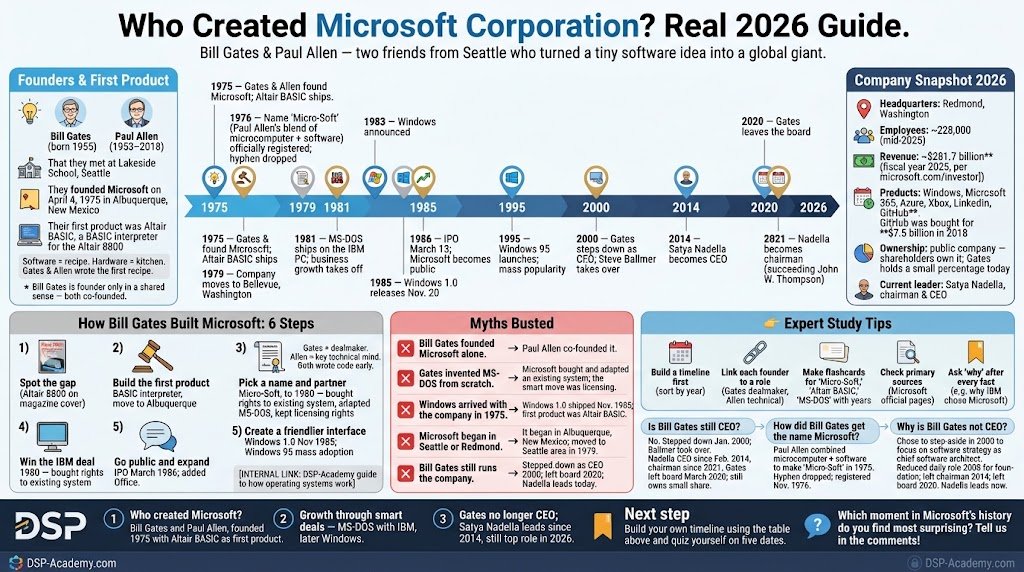
Here’s a surprising fact: Microsoft started in 1975 with two friends, a small office in Albuquerque, and one product that shipped on paper tape. So who created Microsoft Corporation? The answer is Bill Gates and Paul Allen, two friends from Seattle who turned a tiny software idea into one of the most valuable companies on Earth.
In this guide, you’ll learn the founding story in simple terms. You’ll see how Microsoft got its name, what the Microsoft first product was, and how Bill Gates built Microsoft step by step. You’ll also find out why Bill Gates is not CEO of Microsoft anymore and who runs the company in 2026.
Along the way, you’ll get a clear Microsoft history timeline, common myths to avoid, and study tips that make the facts stick.
Whether you’re writing a school report or just curious, you’ll find the answers in one place. Let’s start at the beginning.
Table of Contents
- Who Created Microsoft Corporation? A Simple Definition
- Why Does Microsoft History Matter? Key Benefits
- Microsoft History Timeline: Key Facts and How It Works
- How Bill Gates Built Microsoft: Step by Step
- Common Mistakes and Myths About the Microsoft Founder
- Expert Tips for Studying Microsoft Company History
- Frequently Asked Questions About Microsoft’s Founders
Who Created Microsoft Corporation? A Simple Definition
Microsoft Corporation is an American technology company that makes software, cloud services, and devices, including Windows, Office, Azure, and Xbox. Bill Gates and Paul Allen founded it on April 4, 1975, in Albuquerque, New Mexico. The two had met as students at Lakeside School in Seattle.
So who created Microsoft Corporation, exactly? Two co-founders did it together, which means Bill Gates is the founder of Microsoft only in a shared sense. Both men wrote code in the early days, and Gates took the lead on business deals.
Here’s a simple way to picture it. Software is like a recipe, and computer hardware is like a kitchen. In 1975, hobbyists were building new kitchens, but almost nobody sold recipes for them.
Gates and Allen wrote the first recipe: a version of the BASIC programming language for the Altair 8800 computer. That became the Microsoft first product, and it started everything that followed.
Why Does Microsoft History Matter? Key Benefits
Learning Microsoft history pays off in several ways:
- It explains modern computing. Windows and Office shaped how billions of people work, study, and communicate every day.
- It shows how small ideas grow. Two young founders and one modest product became a global company.
- It teaches real business lessons. Smart partnerships and licensing deals mattered as much as writing code.
- It helps with school and career goals. Reports, interviews, and quizzes often ask about tech pioneers and their choices.
- It connects to today’s news. Cloud computing and AI at Microsoft build on decisions made decades ago.
The numbers show the scale. For fiscal year 2025, Microsoft reported roughly $281.7 billion in revenue, according to its annual report (source: [ microsoft.com/investor]). That growth started with one small product for hobbyists.
Once you see this pattern, you can spot the same steps in almost any tech company story.
Microsoft History Timeline: Key Facts and How It Works
Let’s break the story into parts you can remember.
Who Are the Founders and the Company Owner?
Bill Gates (born 1955) and Paul Allen (1953–2018) co-founded the company. Allen left his day-to-day role in 1983 after a cancer diagnosis, though he remained a major shareholder.
For Microsoft company owner questions, the answer is simple: Microsoft is a public company, so shareholders own it. Gates holds only a small percentage today. Satya Nadella is the chairman and CEO, having succeeded Steve Ballmer as CEO in 2014 and John W. Thompson as chairman in 2021. Wikipedia
Microsoft Company Details
Microsoft is headquartered in Redmond, Washington, and employed about 228,000 people in mid-2025. Its products include Windows, Microsoft 365, Azure, Xbox, LinkedIn, and GitHub. Microsoft bought GitHub for $7.5 billion in 2018.
When Did Microsoft Become Popular?
Microsoft grew popular in stages. MS-DOS on the IBM PC (1981) made it a household name among businesses. Windows 3.0 (1990) and Windows 95 (1995) then brought it into homes and schools.
Microsoft History Timeline at a Glance
| Year | Event | Why It Matters |
|---|---|---|
| 1975 | Gates and Allen found Microsoft; Altair BASIC ships | The company and its first product begin |
| 1976 | “Microsoft” name officially registered | The hyphen disappears from “Micro-Soft” |
| 1979 | Company moves to Bellevue, Washington | It returns to the founders’ home region |
| 1981 | MS-DOS ships on the IBM PC | Business growth takes off |
| 1985 | Windows 1.0 releases (Nov. 20) | The answer to “when was Microsoft Windows founded” |
| 1986 | Initial public offering (March 13) | Microsoft becomes a public company |
| 1995 | Windows 95 launches | Mass popularity arrives |
| 2000 | Gates steps down as CEO; Ballmer takes over | A major leadership change |
| 2014 | Satya Nadella becomes CEO | The cloud era begins |
| 2020 | Gates leaves the board | He focuses on philanthropy |
How Bill Gates Built Microsoft: Step by Step
Want to know how Bill Gates built Microsoft? Follow these six steps.
- Spot the gap. In 1975, Gates and Allen saw the Altair 8800 on a magazine cover. They realized personal computers needed software, and almost nobody was making it.
- Build the first product. They wrote a BASIC interpreter for the Altair and moved to Albuquerque to work with its maker. That product became the company’s foundation.
- Pick a name and a partner. Allen came up with “Micro-Soft,” a blend of microcomputer and software. The hyphen was dropped, and the name was officially registered in 1976.
- Win the IBM deal. In 1980, IBM needed an operating system for its new PC. Microsoft bought the rights to an existing system, adapted it into MS-DOS, and kept the right to license it to other computer makers.
- Create a friendlier interface. Microsoft announced Windows in 1983 and released Windows 1.0 in November 1985. Later versions, especially Windows 95, made computers easy for everyday users.
- Go public and expand. The company held its IPO in March 1986 and added products like Office. If you want to learn how these systems work, see Best DSP Book for Beginners: The Simple 2026 Guide.
Common Mistakes and Myths About the Microsoft Founder
Myth: Bill Gates founded Microsoft alone. Paul Allen co-founded it. Gates and Allen started the company together in 1975.
Myth: Gates invented MS-DOS from scratch. Microsoft bought and adapted an existing system for IBM. The smart move was the licensing deal, not the invention.
Myth: Windows arrived with the company in 1975. Windows 1.0 shipped in November 1985, a full decade later. Microsoft’s first product was Altair BASIC.
Myth: Microsoft began in Seattle or Redmond. It began in Albuquerque, New Mexico, and moved to the Seattle area in 1979.
Myth: Bill Gates still runs the company. He stepped down as CEO in 2000 and left the board in 2020. Nadella leads Microsoft today.
Expert Tips for Studying Microsoft Company History
- Build a timeline first. Sort events by year, then add people and products to each date.
- Link each founder to a role. Remember Gates as the dealmaker and Allen as a key technical mind, with both writing code early on.
- Make flashcards for names. Pair “Micro-Soft,” “Altair BASIC,” and “MS-DOS” with their years.
- Check primary sources. Use Microsoft’s official pages for dates, company details, and financial figures.
- Ask “why” after every fact. Understanding why IBM chose Microsoft helps you remember far more than dates alone.
Frequently Asked Questions About Microsoft’s Founders
Is Bill Gates still CEO of Microsoft?
No. Bill Gates stepped down as CEO in January 2000 and handed the role to Steve Ballmer. Satya Nadella became CEO in February 2014, and he has also served as chairman since 2021. Gates stayed on as chairman and adviser for years, then left Microsoft’s board in March 2020 to focus on philanthropy. He still owns a small share of the company.
How did Bill Gates get the name Microsoft?
The name came from Paul Allen, not Gates. Allen combined microcomputer and software to create “Micro-Soft” in 1975, and the two co-founders adopted it. The hyphen was dropped soon after, and the name “Microsoft” was officially registered in November 1976. The name described exactly what the company did: it made software for the new wave of microcomputers.
Why is Bill Gates not CEO of Microsoft?
Gates chose to step aside. In 2000, he gave the CEO title to Steve Ballmer so he could focus on software strategy as chief software architect. He later reduced his daily role in 2008 to devote more time to his foundation, left the chairman post in 2014, and left the board in 2020. Nadella now leads the company.
Final Takeaways: Start Learning Microsoft History Today
Let’s recap the three biggest points. First, the answer to who created Microsoft Corporation is Bill Gates and Paul Allen, who founded it in 1975 with Altair BASIC as their first product. Second, the company grew through smart deals, especially MS-DOS with IBM and later Windows.
Third, Gates is no longer CEO. Satya Nadella has led Microsoft since 2014, and he continues to hold the top role in 2026.
Start today: build your own timeline using the table above and quiz yourself on five dates. Which moment in Microsoft’s history do you find most surprising? Tell us in the comments!