 By DSP Staff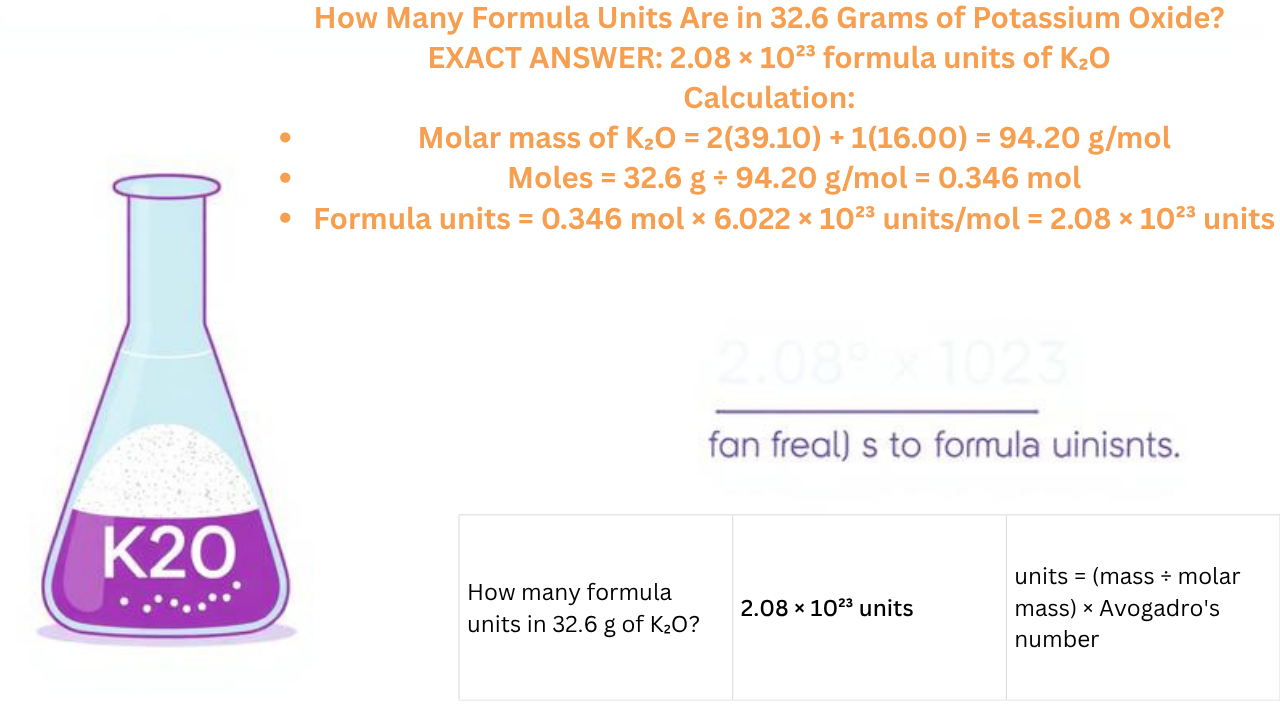
Introduction
Picture this: you’re staring at a chemistry problem that asks for the number of formula units in a specific mass of an ionic compound. It sounds intimidating, but it’s actually one of the most straightforward calculations you’ll master. So here’s the question: how many formula units are in 32.6 grams of potassium oxide?
This isn’t just a random homework question—it’s your opportunity to understand how chemists count particles in ionic compounds. In this guide, you’ll learn exactly how to convert grams of K₂O into formula units using a simple two-step process. You’ll discover what formula units actually mean, why they matter, and how to apply this skill to any ionic compound on your next exam. No fluff, just clear steps you can use right now. Let’s dive in.
Table of Contents
-
What Are Formula Units? Understanding Ionic Compounds
-
Why Formula Units Matter in Chemistry
-
Formula Units — Key Facts and How the Math Works
-
How to Calculate Formula Units From Grams — Step-by-Step
-
Common Mistakes and Myths About Formula Units
-
Expert Tips for Mastering Formula Unit Calculations
-
Frequently Asked Questions
What Are Formula Units? Understanding Ionic Compounds
A formula unit is the simplest whole-number ratio of ions in an ionic compound. Unlike molecules, which are neutral groups of atoms held together by covalent bonds, ionic compounds form crystal lattices of positively and negatively charged ions. You can’t point to a single “molecule” of table salt—instead, you have a repeating pattern of Na⁺ and Cl⁻ ions. The formula unit NaCl represents that ratio.
Think of it this way: if a molecule is like a single Lego castle built from interlocking bricks, a formula unit is like the instruction sheet showing the ratio of red to blue bricks in the entire castle. For potassium oxide (K₂O) , the formula unit tells you that for every two potassium ions (K⁺) , there is one oxide ion (O²⁻) . That’s the ratio that makes the compound electrically neutral.
The key difference: molecules apply to covalent compounds (like H₂O or CO₂), while formula units apply to ionic compounds (like NaCl, CaO, or K₂O). One mole of any substance—whether molecules or formula units—always contains Avogadro’s number (6.022 × 10²³) of those units. So when you ask how many formula units are in 32.6 grams of potassium oxide, you’re really asking: “How many K₂O ion ratios fit into this mass?”
Why Formula Units Matter in Chemistry
You might wonder why chemists don’t just use “molecules” for everything. The answer: ionic compounds don’t form discrete molecules—they form vast repeating structures. Here’s why mastering formula units is essential for any chemistry student:
-
Stoichiometry in ionic reactions: Every balanced chemical equation involving ionic compounds uses formula units to predict reactant and product amounts.
-
Real-world applications: Materials scientists use formula units to design ceramics, semiconductors, and battery materials. Pharmaceutical chemists use them to calculate drug salt formulations.
-
Foundation for advanced topics: Understanding formula units is critical for crystal structure analysis, solid-state chemistry, and materials science.
-
Essential exam skill: Converting between grams, moles, and formula units is tested on every major chemistry exam—from high school to college.
-
Universal counting: One mole of K₂O has the same number of formula units as one mole of NaCl—6.022 × 10²³—even though they have different masses.
According to the National Institute of Standards and Technology (NIST), the Avogadro constant is one of the seven SI base units that underpin all modern measurement. Without the mole and its applications to formula units, much of modern chemistry would literally fall apart.
Formula Units — Key Facts and How the Math Works
To answer how many formula units are in 32.6 grams of potassium oxide, you need to understand the central relationship. Here it is in plain English:
Formula units = (Mass in grams ÷ Molar mass) × Avogadro’s number
This is the golden rule for gram-to-formula-unit conversions. Let’s break down the key facts.
The Molar Mass of Potassium Oxide (K₂O)
Potassium’s atomic mass is approximately 39.10 g/mol, and oxygen’s is 16.00 g/mol. For K₂O:
Molar mass = 2(39.10) + 1(16.00) = 78.20 + 16.00 = 94.20 g/mol
More precisely, the molar mass is 94.196 g/mol, but 94.20 g/mol is sufficient for most calculations.
The Conversion Pathway
| Step | What You Have | What You Do | What You Get |
|---|---|---|---|
| 1 | Grams of ionic compound | Divide by molar mass (g/mol) | Moles |
| 2 | Moles of ionic compound | Multiply by Avogadro’s number (6.022 × 10²³) | Formula units |
Applying It to Potassium Oxide
Mass of K₂O = 32.6 g
Molar mass of K₂O = 94.20 g/mol
Avogadro’s number = 6.022 × 10²³ formula units/mol
Step 1: Find moles.
Moles of K₂O = 32.6 g ÷ 94.20 g/mol = 0.346 mol
Step 2: Find formula units.
Formula units = 0.346 mol × 6.022 × 10²³ units/mol = 2.08 × 10²³ formula units
So 32.6 grams of potassium oxide contains approximately 2.08 × 10²³ formula units. That’s 208 sextillion K₂O ion ratios—a number so large it’s hard to comprehend, yet it fits in a small sample.
A Quick Comparison Table
| Ionic Compound | Formula | Molar Mass (g/mol) | Formula Units in 32.6 g |
|---|---|---|---|
| Potassium oxide | K₂O | 94.20 | 2.08 × 10²³ |
| Sodium chloride | NaCl | 58.44 | 3.36 × 10²³ |
| Calcium oxide | CaO | 56.08 | 3.50 × 10²³ |
| Aluminum oxide | Al₂O₃ | 101.96 | 1.93 × 10²³ |
Notice how heavier formula units mean fewer units per gram. K₂O (94.20 g/mol) has fewer formula units per gram than NaCl (58.44 g/mol) because each K₂O unit is heavier.
How to Calculate Formula Units From Grams — Step-by-Step
Now it’s your turn. Here’s a foolproof, 5-step method to calculate how many formula units are in 32.6 grams of potassium oxide—or any ionic compound you’ll encounter.
Step 1: Identify the compound and write its correct formula.
For potassium oxide, the formula is K₂O. Potassium ions are K⁺ and oxide ions are O²⁻. The criss-cross method gives you K₂O. Write it down clearly.
Step 2: Calculate the molar mass.
Find each element’s atomic mass on the periodic table. Potassium = 39.10 g/mol, Oxygen = 16.00 g/mol. Multiply by the number of atoms: 2(39.10) + 1(16.00) = 94.20 g/mol.
Step 3: Convert grams to moles using the formula.
Use the golden rule: moles = mass ÷ molar mass. Write it as:
moles = 32.6 g ÷ 94.20 g/mol = 0.346 mol.
Step 4: Convert moles to formula units using Avogadro’s number.
Multiply your mole value by 6.022 × 10²³ units/mol:
formula units = 0.346 mol × 6.022 × 10²³ units/mol = 2.08 × 10²³ units.
Step 5: Double-check with a sanity check.
Does 2.08 × 10²³ formula units make sense? One mole of K₂O is 94.20 g, so 32.6 g is about 1/3 of a mole (0.346). One mole has 6.022 × 10²³ units, so 1/3 of that is roughly 2.0 × 10²³. Yes—your answer is perfectly reasonable.
That same 5-step process works for any ionic compound. Try it with 32.6 g of NaCl next: molar mass = 58.44 g/mol, so 32.6 ÷ 58.44 = 0.558 mol, then × 6.022 × 10²³ = 3.36 × 10²³ formula units. Different compound, same method.
Common Mistakes and Myths About Formula Units
Even smart students trip up on these problems. Here are the most common traps—and how to avoid them.
-
Mistake: Using “molecules” instead of “formula units” for ionic compounds.
Ionic compounds like K₂O don’t form discrete molecules—they form crystal lattices. Use formula units for ionic compounds and molecules for covalent compounds. They’re both counted the same way (using Avogadro’s number), but the terminology matters on exams. -
Mistake: Forgetting to multiply by subscripts when calculating molar mass.
K₂O has two potassium atoms. If you only use 39.10 instead of 78.20, your molar mass will be wrong. Always multiply each element’s atomic mass by its subscript in the formula. -
Myth: “One gram of any ionic compound contains the same number of formula units.”
False. Heavier formula units mean fewer units per gram. K₂O (94.20 g/mol) has fewer formula units per gram than NaCl (58.44 g/mol) because each K₂O unit is heavier. -
Mistake: Rounding too early.
Don’t round intermediate values. Keep at least 3–4 decimal places during the calculation, then round your final answer to the correct significant figures. Premature rounding can throw off your result. -
Mistake: Confusing the formula for potassium oxide.
Potassium forms a +1 ion (K⁺) and oxygen forms a -2 ion (O²⁻). To balance charges, you need two K⁺ for every one O²⁻, giving K₂O. Not KO, not K₂O₂—K₂O.
Expert Tips for Mastering Formula Unit Calculations
Want to get faster and more accurate? Here are 5 pro tips straight from chemistry tutors.
-
Memorize the conversion chain. Grams → moles → formula units. Write it as a single equation: formula units = (grams ÷ molar mass) × Avogadro’s number. This eliminates step-by-step errors.
-
Always write units in your calculations. Treat units like numbers—they cancel and multiply. If your units don’t cancel to give “formula units,” you’ve made a mistake.
-
Practice with common ionic compounds. Try NaCl, CaO, Al₂O₃, and MgCl₂. Each has a different molar mass, so you’ll build intuition for how mass affects unit counts.
-
Use dimensional analysis (factor-label method). Write every conversion as a fraction. For example: 32.6 g × (1 mol / 94.20 g) × (6.022 × 10²³ units / 1 mol) = 2.08 × 10²³ units. This almost eliminates errors.
-
Check your answer against a rough estimate. Before you calculate, guess: “Is it more or less than 1 mole of formula units?” For 32.6 g of K₂O, you know it’s less than 1 mole (since 32.6 < 94.20). So your answer should be less than 6.022 × 10²³. 2.08 × 10²³ fits perfectly.
Frequently Asked Questions
What is the formula unit for potassium oxide?
The formula unit for potassium oxide is K₂O. It represents the simplest whole-number ratio of potassium ions (K⁺) to oxide ions (O²⁻)—two potassium ions for every one oxide ion—that makes the compound electrically neutral.
How many grams are in K₂O?
One mole of K₂O has a mass of 94.20 grams (more precisely 94.196 g). This is the molar mass, calculated by adding 2 × 39.10 g/mol (potassium) + 1 × 16.00 g/mol (oxygen).
What is the formula for K⁺ and O²⁻?
The ions K⁺ (potassium) and O²⁻ (oxide) combine in a 2:1 ratio to form K₂O. You need two +1 charges to balance one -2 charge, giving the neutral compound potassium oxide.
Conclusion
You came here asking how many formula units are in 32.6 grams of potassium oxide, and now you have the complete answer: 2.08 × 10²³ formula units. But more importantly, you now know how to get that answer—and how to apply the same method to any ionic compound. The three key takeaways: (1) formula units = (grams ÷ molar mass) × Avogadro’s number; (2) K₂O’s molar mass is 94.20 g/mol; (3) always double-check your subscripts and significant figures.
The formula unit is one of chemistry’s most powerful tools for counting particles in ionic compounds. Master it now, and you’ll breeze through stoichiometry, solution chemistry, and solid-state chemistry later on. So grab a periodic table, pick a random ionic compound, and practice the conversion today. You’ve got this.
What ionic compound will you try converting from grams to formula units next?