 By DSP Staff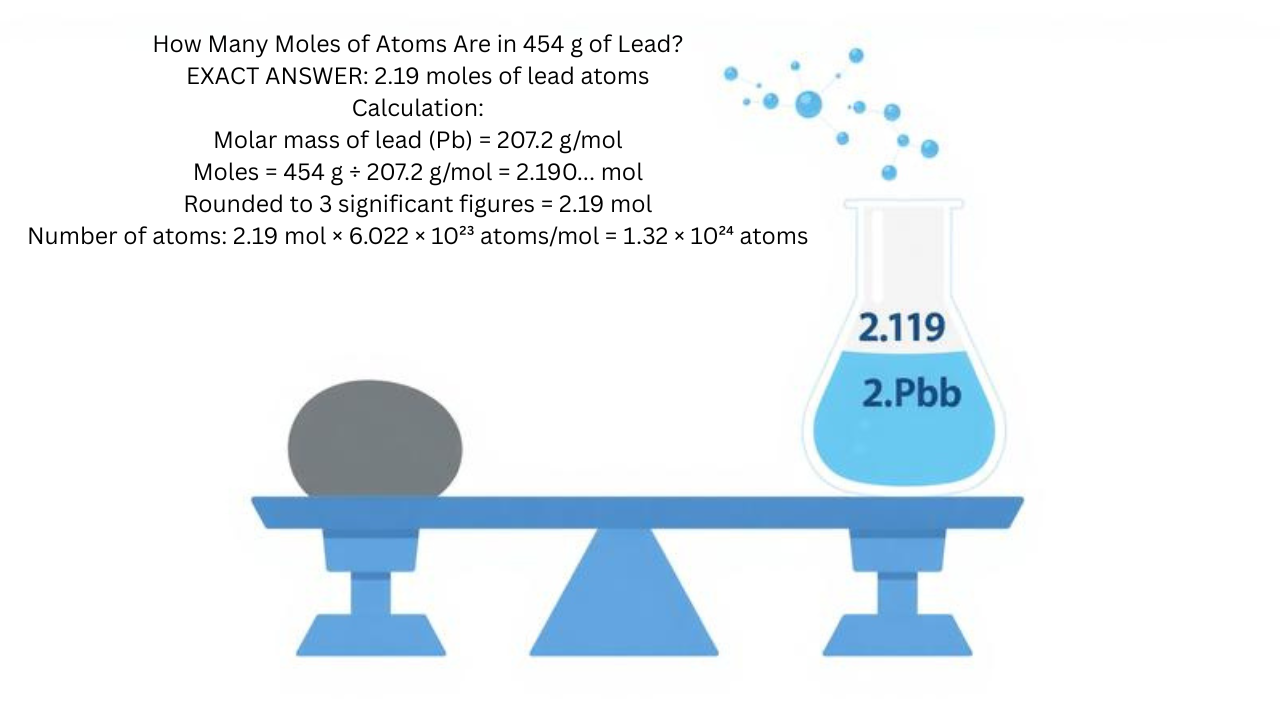
Introduction
Picture this: you’re holding a one-pound fishing sinker or a small wheel weight from your car. That chunk of dense, gray metal weighs exactly 454 grams. Now here’s a question that stumps many chemistry students: how many moles of atoms are in 454 g of lead? It’s not just a random textbook problem—it’s a gateway to understanding how chemists count particles that are too small to see.
In this guide, you’ll learn exactly how to convert grams of lead into moles using a simple formula. You’ll discover why the mole is chemistry’s version of a dozen, and you’ll walk away with step-by-step skills you can apply to any element or compound. By the end, you won’t just know the answer—you’ll understand the reasoning behind it. Let’s dive in.
Table of Contents
-
What Is a Mole? Understanding the Chemistry Counting Unit
-
Why the Mole Concept Matters in Chemistry
-
Mole Conversions — Key Facts and How They Work
-
How to Calculate Moles From Grams — Step-by-Step
-
Common Mistakes and Myths About Mole Conversions
-
Expert Tips for Mastering Mole Calculations
-
Frequently Asked Questions
What Is a Mole? Understanding the Chemistry Counting Unit
A mole (symbol: mol) is simply a counting unit—just like a dozen means 12, a mole means 6.022 × 10²³ of something. That gigantic number is called Avogadro’s number, named after the Italian scientist Amedeo Avogadro. Why so huge? Because atoms and molecules are unimaginably tiny, so you need a massive number of them to have a measurable amount in the lab.
Think of it this way: if you had a mole of donuts, you’d cover the entire Earth in a layer of donuts several kilometers thick. Fortunately, chemists use the mole for atoms, not donuts. The real beauty of the mole is that one mole of any element always contains the same number of atoms—Avogadro’s number—but each element has a different mass per mole.
That mass is called the molar mass, and it’s numerically equal to the element’s atomic weight on the periodic table, expressed in grams per mole (g/mol). For lead (Pb), the molar mass is 207.2 g/mol. That means one mole of lead atoms weighs 207.2 grams and contains 6.022 × 10²³ lead atoms. So when you ask how many moles of atoms are in 454 g of lead, you’re really asking: “How many sets of 207.2 grams fit into 454 grams?”
Why the Mole Concept Matters in Chemistry
You might wonder why you can’t just count atoms directly. The short answer: you’d be counting for longer than the universe has existed. The mole is chemistry’s bridge between the microscopic world of atoms and the macroscopic world of grams you can weigh on a scale.
Here’s why mastering this concept is non-negotiable for any student:
-
Stoichiometry: Every chemical reaction recipe (balanced equation) uses mole ratios. Without moles, you can’t predict how much product you’ll make.
-
Real-world applications: Pharmacists use moles to dose medications. Environmental scientists measure pollutants in moles. Materials engineers calculate alloy compositions using mole fractions.
-
Universal comparison: One mole of lead has the same number of atoms as one mole of hydrogen—even though lead is 207 times heavier. That’s a powerful insight.
-
Foundation for advanced topics: Everything from thermodynamics to quantum chemistry builds on the mole concept.
-
Problem-solving skill: Converting between grams, moles, and number of particles is a core skill tested on every major chemistry exam.
According to the National Institute of Standards and Technology (NIST), the Avogadro constant is one of the seven SI base units that underpin all modern measurement. In other words, without the mole, much of modern science would literally fall apart.
Mole Conversions — Key Facts and How They Work
To answer how many moles of atoms are in 454 g of lead, you need to understand the central relationship in mole chemistry. Here it is in plain English:
Moles = Mass (in grams) ÷ Molar Mass (in g/mol)
This is the golden rule of gram-to-mole conversions. Let’s break down the key facts you need to know.
The Molar Mass of Lead (Pb)
Lead’s atomic number is 82, and its standard atomic weight is 207.2 (with a small uncertainty of ±0.1). This number comes from the weighted average of all naturally occurring lead isotopes. For most calculations, 207.2 g/mol is precise enough.
The Conversion Formula
| What You Have | What You Do | What You Get |
|---|---|---|
| Grams of substance | Divide by molar mass (g/mol) | Moles |
| Moles of substance | Multiply by molar mass (g/mol) | Grams |
| Moles of substance | Multiply by Avogadro’s number (6.022 × 10²³) | Number of atoms/molecules |
Applying It to Lead
Mass of lead = 454 g
Molar mass of lead = 207.2 g/mol
Moles of lead = 454 g ÷ 207.2 g/mol = 2.19 mol
That’s it. 2.19 moles of atoms are in 454 g of lead. If you want the number of individual atoms, multiply 2.19 mol by Avogadro’s number:
2.19 mol × 6.022 × 10²³ atoms/mol ≈ 1.32 × 10²⁴ lead atoms
That’s over a septillion atoms—1.32 followed by 24 zeros. No wonder we use moles!
A Quick Comparison Table
| Substance | Molar Mass (g/mol) | Mass Given | Moles Calculated |
|---|---|---|---|
| Lead (Pb) | 207.2 | 454 g | 2.19 mol |
| Gold (Au) | 197.0 | 454 g | 2.30 mol |
| Iron (Fe) | 55.85 | 454 g | 8.13 mol |
| Carbon (C) | 12.01 | 454 g | 37.8 mol |
Notice how the same mass (454 g) gives very different mole counts depending on the element’s molar mass. Heavier atoms = fewer moles per gram. Lead is heavy, so 454 g gives only about 2.19 moles.
How to Calculate Moles From Grams — Step-by-Step
Now it’s your turn. Here’s a foolproof, 5-step method to calculate how many moles of atoms are in 454 g of lead—or any substance you’ll encounter in chemistry class.
Step 1: Identify the substance and find its molar mass.
Look at the chemical formula. For lead, it’s simply Pb. Grab a periodic table (or use a reliable online source) and find the atomic weight. For lead, that’s 207.2 g/mol. Write it down.
Step 2: Write down the given mass in grams.
Your problem gives you 454 g of lead. Always include the unit—it helps you catch mistakes later.
Step 3: Set up the conversion formula.
Use the golden rule: moles = mass ÷ molar mass. Write it as:
moles = 454 g ÷ 207.2 g/mol
Step 4: Perform the division.
Grab your calculator. 454 ÷ 207.2 = 2.190… Round to three significant figures (since 454 has three) → 2.19 mol.
Step 5: Double-check your answer with a sanity check.
Does 2.19 moles make sense? One mole of lead is 207.2 g, so 454 g is a bit more than two moles (2 × 207.2 = 414.4 g). Yes, 2.19 is slightly above 2—perfect. You’re done.
That same 5-step process works for any element or compound. Try it with 454 g of CO₂ next: molar mass of CO₂ = 44.01 g/mol, so 454 ÷ 44.01 = 10.3 mol. Different substance, same method.
Common Mistakes and Myths About Mole Conversions
Even smart students trip up on mole problems. Here are the most common traps—and how to avoid them.
-
Mistake: Confusing atomic mass with molar mass.
Atomic mass is in amu (atomic mass units) for a single atom. Molar mass is in g/mol for a mole of atoms. The numbers are the same, but the units are different. Always use g/mol for mole calculations. -
Mistake: Forgetting to convert units.
If your mass is in kilograms or milligrams, convert to grams first. 454 g is already in grams, so you’re safe here. But if someone gives you 0.454 kg, multiply by 1000 to get 454 g before dividing. -
Myth: “A mole of lead weighs the same as a mole of any other element.”
False. One mole always has the same number of particles (6.022 × 10²³), but the mass depends on the element. Lead is heavy, so a mole of lead weighs 207.2 g. A mole of hydrogen weighs only 1.008 g. -
Mistake: Rounding too early.
Don’t round intermediate values. Keep at least 4–5 decimal places during the calculation, then round your final answer to the correct significant figures. Premature rounding can throw off your result. -
Mistake: Using the wrong chemical formula.
Lead is Pb, not “LEAD” or “Pb₂”. For compounds like CO₂, remember to add the masses of all atoms in the formula. One carbon (12.01) + two oxygens (2 × 16.00) = 44.01 g/mol.
Expert Tips for Mastering Mole Calculations
Want to get faster and more accurate? Here are 5 pro tips straight from chemistry tutors.
-
Memorize the “mole triangle.” Draw a triangle with “mol” at the top, “mass” at the bottom left, and “molar mass” at the bottom right. Cover the value you need—the formula reveals itself instantly.
-
Always write units in your calculations. Treat units like numbers—they cancel and multiply. If your units don’t cancel to give “mol,” you’ve made a mistake.
-
Practice with everyday objects. How many moles of sugar are in a teaspoon? How many moles of water in a glass? These real-world estimates build intuition.
-
Use dimensional analysis (factor-label method). Write every conversion as a fraction. For example: 454 g × (1 mol / 207.2 g) = 2.19 mol. This almost eliminates errors.
-
Check your answer against a rough estimate. Before you calculate, guess: “Is it more or less than 1 mole?” For 454 g of lead, you know it’s more than 1 mole (since 454 > 207.2) but less than 3 moles (since 3 × 207.2 = 621.6). Your answer of 2.19 fits perfectly.
Frequently Asked Questions
How many moles are in a gram of lead?
One gram of lead contains 0.00483 moles. You get this by dividing 1 g by the molar mass (207.2 g/mol). That’s a tiny fraction of a mole—which makes sense because lead atoms are heavy.
How many moles are present in 454 g of CO₂?
10.3 moles of CO₂ molecules. The molar mass of CO₂ is 44.01 g/mol (12.01 for carbon + 2 × 16.00 for oxygen). So 454 g ÷ 44.01 g/mol = 10.3 mol. That’s nearly five times more moles than lead for the same mass, because CO₂ molecules are much lighter than lead atoms.
How much is 1 mole of lead?
One mole of lead weighs 207.2 grams and contains 6.022 × 10²³ lead atoms. In everyday terms, that’s about the mass of a small smartphone or a dense hockey puck. It occupies about 18.3 cm³ of volume—roughly the size of a golf ball.
Conclusion
You came here asking how many moles of atoms are in 454 g of lead, and now you have the complete answer: 2.19 moles. But more importantly, you now know how to get that answer—and how to apply the same method to any substance. The three key takeaways: (1) moles = mass ÷ molar mass; (2) lead’s molar mass is 207.2 g/mol; (3) always double-check your units and significant figures.
The mole is one of chemistry’s most powerful tools. Master it now, and you’ll breeze through stoichiometry, solution chemistry, and even thermodynamics later on. So grab a periodic table, pick a random element, and practice the conversion today. You’ve got this.
What’s the first substance you’ll try converting from grams to moles?