 By DSP Staff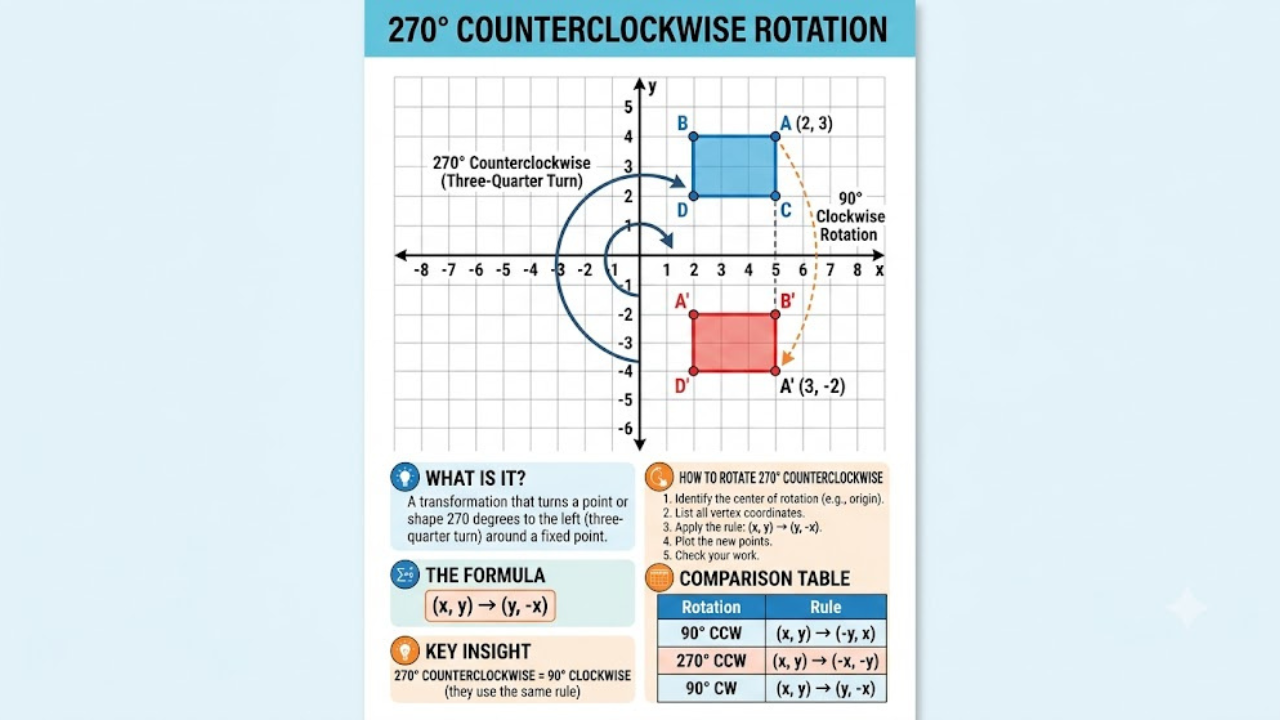
Introduction
What if you could turn any shape on a graph with a single, simple math rule? That’s exactly what 270 counterclockwise rotation lets you do. It’s one of the most powerful transformations in geometry, yet most students overcomplicate it.
Here’s the truth: a 270 counterclockwise rotation is just a three-quarter turn to the left. And the rule behind it? (x, y) → (y, -x). That’s it.
In this guide, you’ll learn exactly what 270 counterclockwise rotation means, why it matters, and—most importantly—how to apply it yourself. We’ll walk through the rule step by step, break down common mistakes, and give you expert tips to make rotating any shape feel effortless. By the time you finish, you’ll be able to handle any rotation problem with confidence. Let’s get started.
Table of Contents
-
What Is 270 Counterclockwise Rotation?
-
Why Does 270 Counterclockwise Rotation Matter?
-
270 Counterclockwise Rotation — Key Facts and How It Works
-
How To Rotate a Shape 270 Degrees Counterclockwise in 5 Steps
-
Common Mistakes and Myths to Avoid
-
Expert Tips for Best Results
-
Frequently Asked Questions
-
Conclusion
What Is 270 Counterclockwise Rotation?
A 270 counterclockwise rotation is a transformation that turns a point or shape 270 degrees in the counterclockwise direction around a fixed center, usually the origin (0,0). Think of it as making a three-quarter turn to the left—like rotating a steering wheel almost all the way around.
When you rotate a point 270 degrees counterclockwise about the origin, the new location follows a simple rule: swap the x and y coordinates, then change the sign of the new y. In math terms: (x, y) → (y, -x).
Here’s a real-world example. Picture the hour hand of a clock pointing at 12. If you rotate that hand 270° counterclockwise, it moves backward past 9, 6, and ends up pointing at 3. The hand itself doesn’t change size or shape—it just changes position. That’s exactly what happens when you rotate a geometric figure.
Whether you’re studying for a test, designing a game, or just curious about math, understanding 270 counterclockwise rotation is a fundamental skill that builds your spatial reasoning.
Why Does 270 Counterclockwise Rotation Matter?
You might be asking: Why should I care about rotating shapes 270 degrees? The answer is simple—rotations are everywhere, and this specific angle shows up more often than you think.
Here’s why mastering 270 counterclockwise rotation pays off:
-
Boosts test scores: Standardized exams frequently include rotation questions. Knowing the rule lets you solve them in seconds.
-
Essential for computer graphics: Video game engines and animation software rely on rotation matrices to move characters, cameras, and objects.
-
Builds spatial intelligence: Rotating shapes strengthens your ability to visualize objects in 3D space—a skill critical in engineering and design.
-
Saves time in advanced math: Once you master 270 counterclockwise, you can easily handle any rotation angle.
-
Practical in everyday tools: From rotating images in Photoshop to aligning parts in CAD software, this skill has real-world applications.
According to the National Council of Teachers of Mathematics, students who master geometric transformations early perform significantly better in higher-level math courses.
In short, this isn’t just a classroom exercise—it’s a skill that translates directly into problem-solving across disciplines.
270 Counterclockwise Rotation — Key Facts and How It Works
To truly master 270 counterclockwise rotation, you need to understand the rules, the math, and how it compares to other rotations.
The Rotation Rule (Origin)
When rotating about the origin (0,0), the rule is straightforward:
| Original Point | After 270° Counterclockwise |
|---|---|
| (x, y) | (y, -x) |
This works for any point on the coordinate plane.
270° Counterclockwise = 90° Clockwise
Here’s a key insight: a 270 counterclockwise rotation is exactly the same as a 90 clockwise rotation. Why? Because a full circle is 360°, and 360° – 270° = 90°. So if you ever get confused, just remember: 270° CCW = 90° CW.
Rotation Matrix Approach
For those who prefer algebra, the 270 counterclockwise rotation can be expressed using a rotation matrix:
[x']   [0   1] [x]
[y'] = [-1  0] [y]
Multiplying this matrix by your original coordinates gives you the rotated coordinates.
Comparison Table: All Rotation Rules
| Rotation | Rule | Equivalent |
|---|---|---|
| 90° CCW | (x, y) → (-y, x) | 270° CW |
| 180° | (x, y) → (-x, -y) | Either direction |
| 270° CCW | (x, y) → (y, -x) | 90° CW |
| 90° CW | (x, y) → (y, -x) | 270° CCW |
Notice that 270° CCW and 90° CW share the exact same rule.
How To Rotate a Shape 270 Degrees Counterclockwise in 5 Steps
Ready to rotate? Follow these 5 simple steps to apply a 270 counterclockwise rotation to any shape.
Step 1: Identify the Center of Rotation
First, determine the center of rotation. In most textbook problems, it’s the origin (0,0). If it’s a different point, you’ll need to translate the shape first, rotate, then translate back.
Step 2: List the Coordinates of Each Vertex
Write down the (x, y) coordinates of every vertex (corner) of your shape. For example, if you have a triangle with vertices A(2, 3), B(4, 5), and C(6, 1), list them clearly.
Step 3: Apply the Rotation Rule
For each point, swap the x and y values, then change the sign of the new y. That means (x, y) → (y, -x).
Using our example:
-
A(2, 3) → A'(3, -2)
-
B(4, 5) → B'(5, -4)
-
C(6, 1) → C'(1, -6)
Step 4: Plot the New Points
On a fresh coordinate grid, plot each new point. Connect them in the same order as the original shape. You’ll see the entire shape has turned 270 degrees counterclockwise.
Step 5: Double-Check Your Work
Verify that distances between vertices haven’t changed. Also, check that the shape’s orientation remains the same—rotations preserve orientation. If something looks off, revisit Step 3.
That’s it! Practice with a few different shapes, and the process will become automatic.
Common Mistakes and Myths to Avoid
Even experienced students make errors with 270 counterclockwise rotation. Here are the most common pitfalls—and how to steer clear of them.
-
Mistake: Confusing 270° CCW with 270° CW
Many people mix up (x, y) → (y, -x) with (x, y) → (-y, x). Remember: 270° counterclockwise = swap and negate the new y. 270° clockwise = swap and negate the new x. -
Mistake: Forgetting that 270° CCW = 90° CW
This equivalence is a huge time-saver. If you’re ever unsure about the rule, just remember: 270° counterclockwise is the same as 90° clockwise. -
Myth: Rotating changes the shape’s size
False. Rotation is an isometry—it preserves both distance and angle measures. Your shape stays exactly the same size. -
Mistake: Rotating only one point
To rotate an entire shape, you must rotate every vertex. Missing even one point will distort the shape. -
Myth: All rotations use the same rule
Not true. Each angle has its own rule. Memorize the table above to avoid confusion.
Expert Tips for Best Results
Take your 270 counterclockwise rotation skills to the next level with these pro tips.
-
Use graph paper for practice—it makes visualizing the rotation much easier.
-
Memorize the equivalence—270° CCW = 90° CW. This saves you from memorizing extra rules.
-
Check your work by rotating back—if you rotate the new points clockwise 270°, you should return to the original coordinates.
-
Leverage technology—tools like GeoGebra or Desmos let you experiment with rotations interactively.
-
Think in quadrants—a 270 counterclockwise turn moves a point through three quadrants on the coordinate plane.
Frequently Asked Questions
What is the formula for 270 counterclockwise rotation?
The formula for a 270 counterclockwise rotation about the origin is (x, y) → (y, -x). This means you swap the coordinates and change the sign of the new y (the second coordinate).
Is 270 counterclockwise the same as 90 clockwise?
Yes. A 270° counterclockwise rotation is exactly the same as a 90° clockwise rotation. This is because 360° – 270° = 90°. Both use the rule (x, y) → (y, -x).
How do you rotate a shape 270 degrees counterclockwise?
Swap the x and y coordinates of each vertex, then change the sign of the new y. Plot the new points and connect them in the same order. That’s all there is to it.
Conclusion
By now, you’ve learned that 270 counterclockwise rotation is a simple yet powerful transformation. Remember the three key takeaways:
-
The rule is (x, y) → (y, -x)—swap coordinates and negate the new y.
-
270° CCW = 90° CW—this equivalence makes the rule easy to remember.
-
Always rotate every vertex of a shape to preserve its form.
Start today by grabbing a piece of graph paper and rotating a few shapes on your own. You’ll be amazed at how quickly you master it.
270 Counterclockwise Rotation
What is 270 counterclockwise rotation?
A transformation that turns a point or shape 270 degrees to the left (three-quarter turn) around a fixed point.
What is the formula?
(x, y) → (y, -x)
What does it look like?
A point at (2, 3) moves to (3, -2).
Key insight:
270° counterclockwise = 90° clockwise (they use the same rule)
How to rotate 270° counterclockwise:
-
Identify the center of rotation
-
List all vertex coordinates
-
Apply the rule: (x, y) → (y, -x)
-
Plot the new points
-
Check your work
Comparison:
| Rotation | Rule |
|---|---|
| 90° CCW | (x, y) → (-y, x) |
| 180° | (x, y) → (-x, -y) |
| 270° CCW | (x, y) → (y, -x) |
| 90° CW | (x, y) → (y, -x) |
What’s the first shape you’re going to rotate 270 counterclockwise? Drop your answer in the comments—we’d love to hear from you!