 By DSP Staff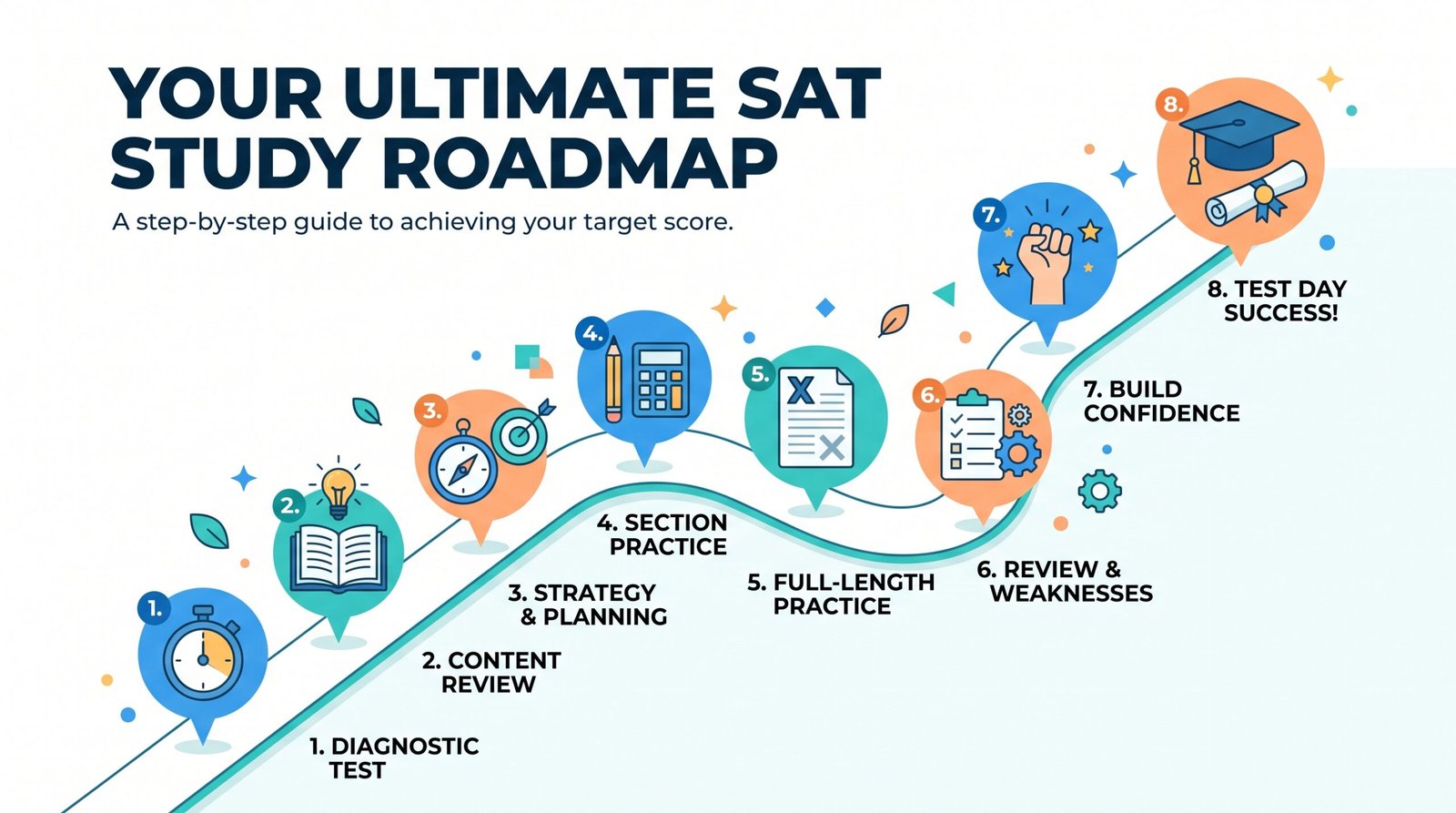
Learning how to study for the SAT is less about studying for as many hours as possible and more about using your time effectively.
The most useful SAT preparation starts with understanding the test, identifying your weakest skills, practicing with realistic questions, reviewing your mistakes, and repeating the process consistently.
The current SAT is digital and consists of two sections: Reading and Writing and Math. The test takes 2 hours and 14 minutes, excluding the 10-minute break, and each section is divided into two modules. The second module adjusts based on your performance in the first module.
That means your preparation should include both content practice and test-taking practice.
This guide shows you how to build an SAT study routine from the beginning, how to divide your time between Math and Reading and Writing, how to use official resources, and how to turn practice-test mistakes into measurable improvement.
How to Start Studying for the SAT
If you are starting SAT preparation for the first time, don’t immediately spend weeks doing random practice questions.
Start with a simple four-step process.
1. Learn how the SAT is structured
Before studying, understand what you will actually encounter on test day.
The SAT currently has:
- Reading and Writing: 54 questions, 64 minutes
- Math: 44 questions, 70 minutes
- Two modules in each section
- A 10-minute break between sections
- A total testing time of 2 hours and 14 minutes
The test uses multistage adaptive testing, meaning your performance in the first module affects the difficulty of the second module.
Understanding the structure helps you prepare for the actual experience instead of preparing for an outdated version of the SAT.
2. Take a diagnostic practice test
Your first practice test should be used as a diagnostic, not as a judgment of your ability.
The purpose is to discover where you currently stand.
After the test, ask:
- Which section was weaker?
- Which question types caused problems?
- Did I run out of time?
- Which mistakes were caused by missing knowledge?
- Which mistakes were caused by rushing?
- Which questions did I guess on?
- Which skills need the most attention?
College Board provides full-length digital SAT practice tests through Bluebook.
3. Set a realistic target score
Your target score should have a reason behind it.
Research the score ranges of colleges you’re interested in and consider how your SAT score fits into your overall application.
Then compare your target with your diagnostic score.
For example:
Diagnostic: 1120
Target: 1300
Gap: 180 points
A score gap gives you something concrete to work toward.
4. Identify your weakest skills
Don’t simply say:
“I’m bad at Math.”
Be more specific.
For example:
- Linear equations
- Quadratic equations
- Ratios and percentages
- Punctuation
- Transitions
- Inference questions
- Words in context
The more specific your diagnosis becomes, the easier it is to create an efficient study plan.
How Long Should You Study for the SAT?
There is no single number of weeks that works for every student.
Your ideal preparation period depends on:
- Current score
- Target score
- Available study time
- Academic background
- Weak areas
- Test date
- Previous SAT experience
A student with a strong foundation may need less preparation than someone who needs to rebuild several core skills.
4-week SAT study plan
A four-week plan works best when you already have a reasonable foundation.
Week 1: Diagnostic test and skill identification
Week 2: Focus on your weakest Math and Reading and Writing skills
Week 3: Timed practice and mixed question sets
Week 4: Full-length practice, review, and final adjustments
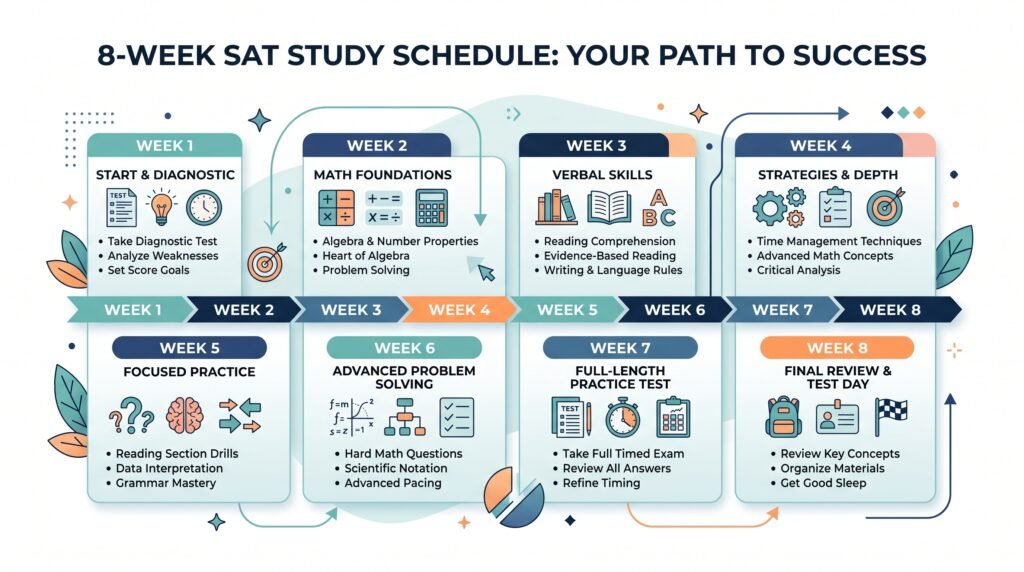
8-week SAT study plan
Eight weeks gives you more time to build skills.
Weeks 1–2: Diagnostic testing and fundamentals
Weeks 3–4: Targeted Math and Reading and Writing practice
Weeks 5–6: Mixed practice and timed modules
Week 7: Full-length practice tests and detailed review
Week 8: Weak-area review and test-day preparation
12-week SAT study plan
A 12-week plan gives you more room for gradual improvement.
You can divide it into three phases:
Weeks 1–4: Learn
Focus on concepts and foundational skills.
Weeks 5–8: Practice
Apply those concepts to SAT-style questions.
Weeks 9–12: Perform
Focus on timed modules, full-length tests, pacing, accuracy, and test-day strategy.
The important point is not simply the number of weeks.
Your study plan should become more targeted as you learn more about your weaknesses.
Build an SAT Study Schedule
A good SAT schedule should be realistic enough to follow consistently.
Don’t create a plan that requires four hours every weekday if you know you can only maintain one hour.
Consistency is more useful than an unrealistic schedule.
Decide how many hours you can study
Start with your existing commitments.
For example:
Monday: 60 minutes
Tuesday: 60 minutes
Wednesday: 45 minutes
Thursday: 60 minutes
Friday: Rest
Saturday: Full practice session
Sunday: Mistake review
Your schedule can be adjusted according to your test date and availability.
Divide time between Math and Reading and Writing
If one section is significantly weaker, give it more time.
For example, a student struggling with Math might use:
60% Math
40% Reading and Writing
Another student may need the opposite.
Your diagnostic test should determine the balance.
Schedule practice tests
Don’t take full-length practice tests every day.
Instead, use them at important points in your preparation.
A simple pattern is:
Diagnostic → targeted study → practice → full test → review → targeted study → full test
Review mistakes instead of only doing questions
This is one of the most important SAT study habits.
Getting a question wrong isn’t the end of the learning process.
Ask:
Why did I get it wrong?
Possible answers include:
- I didn’t know the concept.
- I misunderstood the question.
- I made a calculation error.
- I rushed.
- I chose an attractive wrong answer.
- I didn’t understand a word or phrase.
- I ran out of time.
The answer determines what you should do next.
How to Study for SAT Math
SAT Math preparation should combine concept learning, targeted practice, and timed problem solving.
Learn the concepts you miss
If you repeatedly miss questions involving a particular skill, don’t simply solve another ten questions.
Stop and learn the underlying concept.
For example, if you consistently struggle with quadratic equations, review:
- Factoring
- Roots
- Graphs
- Vertex form
- Relationships between equations and graphs
Then return to SAT-style questions.
Practice by skill
Random practice is useful later in your preparation.
Early on, skill-based practice can be more efficient.
For example:
Monday: Linear equations
Tuesday: Ratios and percentages
Wednesday: Quadratics
Thursday: Data analysis
Friday: Mixed review
This makes it easier to identify whether your accuracy improves.
Improve calculator and Desmos familiarity
Digital SAT preparation should include practice with the tools available in the testing environment.
Become comfortable using the calculator efficiently rather than experimenting with it for the first time during the actual test.
College Board’s current Bluebook materials also highlight improvements to calculator and reference-sheet functionality for the 2026–27 testing cycle.
Track recurring mistakes
Create a simple mistake log.
| Question Type | Mistake | Correct Approach |
|---|---|---|
| Algebra | Misread equation | Identify variables first |
| Percent | Used wrong base | Write the original amount |
| Geometry | Forgot formula | Review formula before practice |
| Data | Misread graph | Check labels and units |
After several practice sessions, patterns will start to appear.
How to Study for SAT Reading and Writing
The Reading and Writing section requires more than simply reading quickly.
You need to understand what each question is testing.
Practice grammar and Standard English conventions
Review areas such as:
- Sentence boundaries
- Punctuation
- Subject-verb agreement
- Verb forms
- Pronoun usage
- Modifiers
- Parallel structure
The goal isn’t to memorize hundreds of grammar rules.
It’s to recognize the rules that repeatedly appear in questions.
Learn how to analyze passages
Practice identifying:
- Main ideas
- Purpose
- Evidence
- Relationships between ideas
- Logical conclusions
- Meaning in context
Instead of reading every passage passively, read with a purpose.
Practice evidence-based questions
When answering a question, ask:
What evidence supports my answer?
Avoid choosing an answer simply because it sounds reasonable.
The correct answer needs to fit the information presented in the question and passage.
Improve pacing
Timed practice matters.
If you spend too much time on one difficult question, you may create unnecessary pressure later.
Use practice sessions to determine:
- How quickly you normally answer questions
- Which question types slow you down
- When you should move on
- How much time you need for review
College Board specifically recommends using practice tests to experiment with pacing and test-taking strategies before test day.
Use Official SAT Practice Resources
You don’t need to build your preparation around dozens of websites.
Start with high-quality official resources.
Bluebook practice tests
Bluebook provides full-length digital SAT practice tests designed to familiarize students with the digital testing environment.
These tests are especially valuable because they allow you to practice the experience of taking the digital SAT.
Official SAT Prep on Khan Academy
Khan Academy provides Official SAT Prep developed in partnership with College Board.
The course includes practice questions, lessons, videos, hints, and skill-based preparation.
Use it to strengthen specific skills rather than simply clicking through questions without reviewing your results.
Student Question Bank
College Board’s Student Question Bank contains thousands of official questions.
You can filter questions by:
- Test
- Section
- Domain
- Skill
- Difficulty
That makes it particularly useful after a diagnostic test because you can focus your practice on specific weaknesses.
How to Use SAT Practice Tests Effectively
Taking practice tests is important, but taking a test without reviewing it wastes much of its value.
Simulate real testing conditions
When possible, practice under conditions that resemble the actual test.
Use a quiet environment.
Follow the timing.
Avoid unnecessary distractions.
College Board recommends using realistic conditions when practicing so students become familiar with the testing experience.
Review every missed question
After a practice test, categorize your mistakes.
For example:
Knowledge mistake:
“I didn’t know how to solve this.”
Process mistake:
“I knew the concept but used the wrong method.”
Careless mistake:
“I understood the question but made an avoidable error.”
Timing mistake:
“I ran out of time.”
Each type requires a different solution.
Track your performance
Create a simple spreadsheet or notebook containing:
- Test date
- Total score
- Math score
- Reading and Writing score
- Questions missed
- Weak skills
- Main mistake patterns
This makes your improvement measurable.
Turn mistakes into a study plan
Suppose your practice test shows that you repeatedly miss questions involving transitions.
Your next study session shouldn’t be random.
Instead:
Identify the skill → Learn the rule → Practice the skill → Review mistakes → Retest
That’s a much stronger study loop.
Common SAT Study Mistakes to Avoid
Studying without taking a diagnostic test
You may spend hours studying skills you already understand while ignoring your actual weaknesses.
Doing questions without reviewing them
Practice is only valuable when you learn from the results.
Taking too many full-length tests
A practice test is a diagnostic tool.
If you don’t review it, taking another test immediately may not solve the underlying problem.
Using outdated SAT material
The current SAT is digital and adaptive.
Make sure your primary practice reflects the current test format.
Memorizing tricks instead of learning concepts
Strategies can help, but they shouldn’t replace understanding.
Ignoring time management
Knowing the material isn’t enough if you cannot apply it within the available time.
Creating an unrealistic study schedule
A plan that looks impressive but isn’t sustainable will quickly fall apart.
Build a schedule you can actually follow.
A Sample 8-Week SAT Study Plan
Here’s a practical example.
Week 1: Establish your baseline
- Take a full-length practice test
- Record your score
- Identify weak skills
- Set a target score
- Create your study schedule
Week 2: Build foundations
Focus on your weakest Math and Reading and Writing skills.
Review concepts before doing large amounts of practice.
Week 3: Target weak areas
Complete focused practice.
Track mistakes and identify recurring patterns.
Week 4: Mixed practice
Begin combining different question types.
Add timed practice sessions.
Week 5: Increase difficulty
Work on harder questions while maintaining accuracy on foundational skills.
Week 6: Practice pacing
Complete timed modules.
Experiment with different approaches to difficult questions.
Week 7: Full-length practice
Take another full-length practice test.
Compare the results with your diagnostic test.
Focus your final study sessions on the skills that still need work.
Week 8: Final preparation
Review your mistake log.
Complete targeted practice.
Take a final realistic practice test at an appropriate point before test day.
Avoid trying to learn everything at the last minute.
SAT Study Tips for the Week Before the Test
The final week should focus on preparation rather than panic.
Review your common mistakes
Look through your mistake log.
Focus on recurring errors.
Complete targeted practice
Practice your weakest remaining skills.
Avoid major changes
Don’t suddenly replace your entire study strategy a few days before the test.
Practice with the digital tools
Make sure you’re comfortable with the testing environment and available tools.
Protect your sleep
A rested student is better positioned to concentrate than someone who sacrifices sleep for last-minute studying.
Prepare for test day
Check the official College Board requirements and instructions before test day rather than relying on old advice from social media or outdated preparation websites.
Frequently Asked Questions
How should I start studying for the SAT?
Start by learning the current SAT structure, taking a full-length diagnostic practice test, identifying your weakest skills, setting a target score, and creating a realistic study schedule.
How long should I study for the SAT?
It depends on your starting score, target score, academic background, available time, and test date. Four, eight, or twelve weeks can all work when the study plan is targeted and consistent.
Is 3 months enough to study for the SAT?
Three months can provide enough time for a structured preparation plan, particularly if you study consistently and use practice-test results to identify and address weaknesses.
How many hours a day should I study for the SAT?
There is no universal number. A sustainable schedule that you consistently follow is generally more useful than an aggressive schedule that you abandon after a few days.
What is the best way to study for the SAT?
A strong approach is to combine a diagnostic test, targeted skill practice, official questions, timed practice, mistake review, and full-length practice tests.
How can I improve my SAT score?
Identify the skills responsible for your missed questions, learn those concepts, practice them with official questions, review your mistakes, and monitor your performance through practice tests.
Should I take a practice test before studying?
Yes. A diagnostic practice test can show you where you are starting and help you avoid wasting study time on areas you already understand.
How should I study for SAT Math?
Begin with your weakest Math skills, review the relevant concepts, practice targeted questions, track recurring mistakes, and gradually add mixed and timed practice.
How should I study for SAT Reading and Writing?
Study the specific skills tested, including grammar and Standard English conventions, comprehension, evidence, transitions, and rhetorical skills. Then practice with timed questions and review your mistakes.
What are the best free SAT study resources?
Start with official resources from College Board, including Bluebook practice tests, the Student Question Bank, and Official SAT Prep on Khan Academy. College Board lists these resources as part of its SAT preparation materials.
Is Khan Academy good for SAT preparation?
Khan Academy’s Official SAT Prep is an official preparation resource developed in partnership with College Board and provides skill-based practice, lessons, videos, hints, and questions.
How many SAT practice tests should I take?
Quality matters more than simply counting tests. Take enough full-length tests to become comfortable with the format and measure progress, but spend substantial time reviewing the mistakes from each test.
Conclusion
Learning how to study for the SAT doesn’t require endless hours of random practice.
The most effective approach is structured:
Diagnose → Identify weaknesses → Learn → Practice → Review mistakes → Retest → Adjust
Start with an official practice test to understand your current performance. Then create a realistic study schedule around your target score and available time.
Spend more time on the skills you actually need to improve. Use official resources such as Bluebook, the Student Question Bank, and Official SAT Prep on Khan Academy.
Most importantly, don’t measure your preparation only by how many questions you complete.
Measure it by what you learn from the questions you get wrong.
A good SAT study plan doesn’t simply give you more practice. It makes every practice session more useful.
Ready to start? Take an official diagnostic SAT practice test, record your score, identify your three weakest skills, and build your study schedule around them.