 By DSP Staff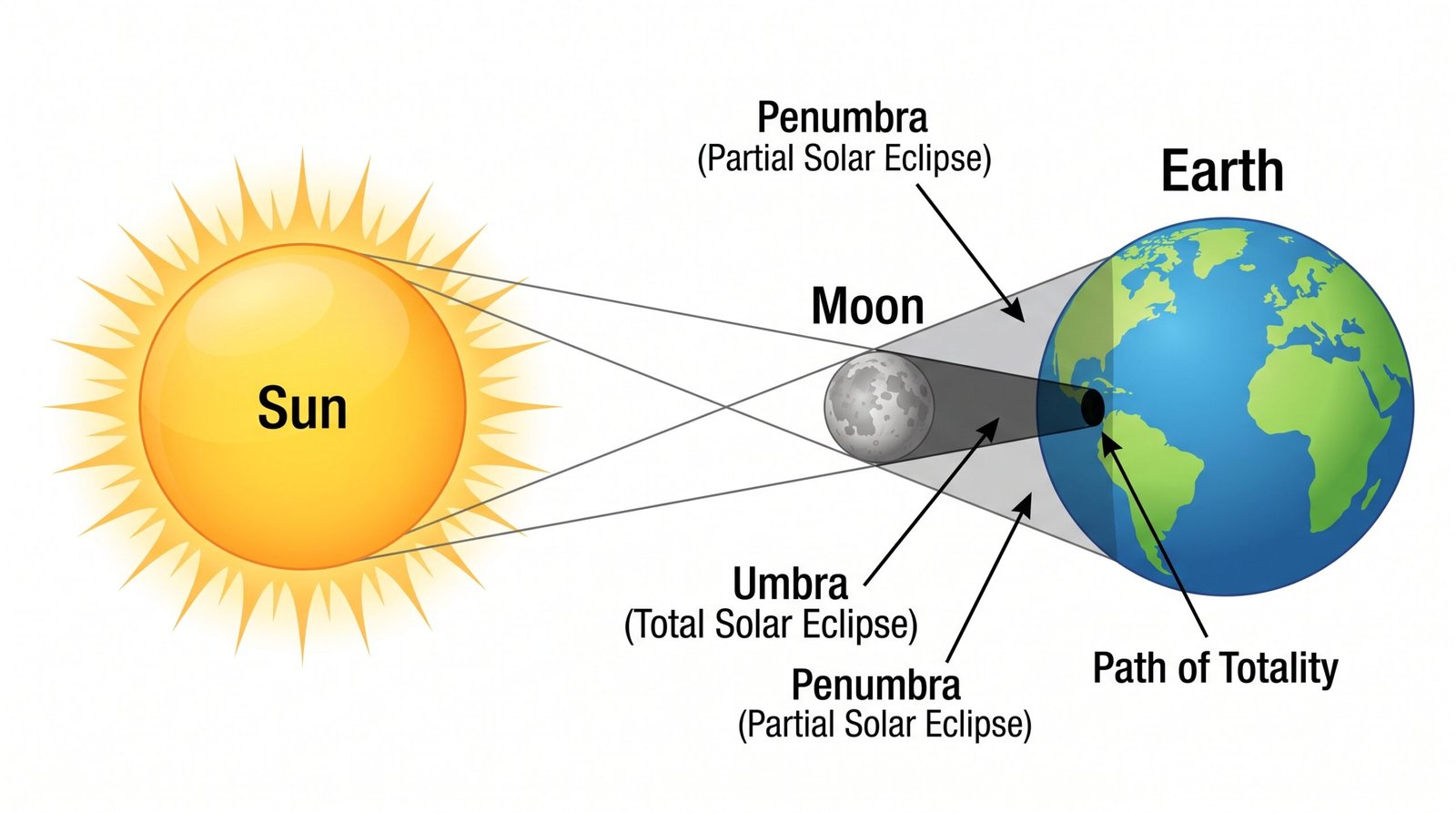
Every year, millions of people look up at the sky in awe — either watching the Sun mysteriously disappear in the middle of the day or witnessing the full Moon glow a deep, eerie red at night.
Both events are eclipses. But they work in completely opposite ways.
If you have ever wondered what actually separates a solar eclipse from a lunar eclipse — how each happens, how long it lasts, which one is safe to watch, and which one is truly rarer — you are in exactly the right place.
This guide breaks it all down in plain English with real science behind every answer. No complicated jargon. Just clear, honest explanations that make the night sky make sense.
Quick Answer: Solar Eclipse vs Lunar Eclipse at a Glance
Before we go deep, here is a side-by-side comparison for those who want the fast version:
| Feature | ☀️ Solar Eclipse | 🌕 Lunar Eclipse |
|---|---|---|
| What gets darkened | The Sun | The Moon |
| What causes it | Moon blocks Sun’s light | Earth blocks Sun’s light from reaching Moon |
| Position of Moon | Moon is between Sun and Earth | Earth is between Sun and Moon |
| Moon phase required | New Moon | Full Moon |
| How long it lasts | 2–7 minutes (totality) | Up to 2 hours (totality) |
| Where you can see it | Narrow path on Earth | Entire night side of Earth |
| Safe to watch? | ⚠️ Requires eclipse glasses | ✅ Completely safe, naked eye |
| Color you see | Black disc + white corona | Red/orange glow (blood moon) |
| How often it occurs | 2–5 times per year globally | 0–3 times per year |
| How rare it is for you | Very rare at your location | More accessible |
Now let us break each of these down so you truly understand what is happening up there.
What Is a Solar Eclipse?
A solar eclipse happens when the Moon moves directly between the Sun and Earth, blocking the Sun’s light and casting a shadow on parts of our planet.
The result from Earth’s surface is extraordinary — the sky goes dark in the middle of the day, temperatures drop suddenly, birds stop singing, and stars become briefly visible. At the peak of a total solar eclipse, the Sun’s outer atmosphere — called the corona — appears as a glowing white halo around a perfectly black disc.
How a Solar Eclipse Happens — Step by Step
The mechanics are simpler than you might think:
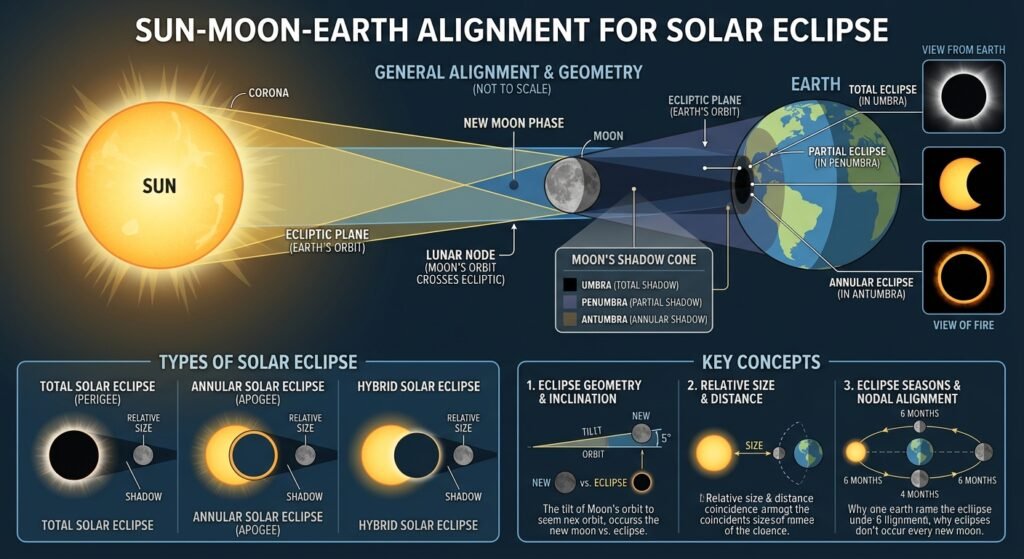
- The Moon orbits Earth in a slightly tilted path — about 5 degrees off from Earth’s path around the Sun
- Most months, the Moon misses — it passes either above or below the Sun from Earth’s perspective
- Occasionally, perfect alignment happens — the Moon’s orbital path crosses directly in front of the Sun
- The Moon’s shadow falls on Earth — creating a narrow path of darkness called the path of totality
- Anyone inside that path experiences the full solar eclipse; those nearby see a partial eclipse
The remarkable cosmic coincidence that makes this possible: the Sun is roughly 400 times larger than the Moon, but it is also roughly 400 times farther away. This means they appear almost exactly the same size in our sky — which is precisely why the Moon can block the Sun so perfectly during a total solar eclipse.
Types of Solar Eclipses
Not all solar eclipses are created equal. There are four distinct types:
Total Solar Eclipse The Moon completely covers the Sun. This is the most spectacular kind — the one that makes the sky go dark and reveals the solar corona. This is also the rarest type to witness from any single location on Earth.
Partial Solar Eclipse The Moon covers only part of the Sun. The result is that the Sun appears to have a bite taken out of it. This is the most commonly witnessed type of solar eclipse.
Annular Solar Eclipse This happens when the Moon is at its farthest point from Earth in its orbit and appears slightly smaller than the Sun. The Moon covers the center of the Sun but leaves a bright ring of sunlight visible around the edges — called the “ring of fire.”
Hybrid Solar Eclipse This is the rarest type of all. A hybrid eclipse shifts between total and annular as the Moon’s shadow moves across the curve of Earth’s surface.
When Can a Solar Eclipse Happen?
A solar eclipse can only occur during a new moon phase — when the Moon is positioned between Earth and the Sun and its dark side faces us. However, not every new moon produces an eclipse because the Moon’s orbit is tilted, so it usually passes above or below the Sun from our viewpoint.
What Is a Lunar Eclipse?
A lunar eclipse is the opposite scenario. Instead of the Moon blocking the Sun’s light, Earth gets in the way — and Earth’s shadow falls across the Moon.
During a total lunar eclipse, the Moon does not go completely dark. Instead, it turns a striking reddish-orange color, which is why total lunar eclipses are famously called “blood moons.” This red glow happens because some sunlight still reaches the Moon — it bends around the edges of Earth through our atmosphere, just like the red light of a sunrise or sunset.
How a Lunar Eclipse Happens — Step by Step
- The Sun, Earth, and Moon must align with Earth in the middle
- The Moon orbits into Earth’s shadow — the region behind Earth where direct sunlight cannot reach
- Earth’s shadow has two zones:
- The umbra — the darkest, central shadow (full lunar eclipses happen here)
- The penumbra — the outer, lighter shadow (penumbral eclipses are subtle and often barely noticeable)
- Sunlight bends through Earth’s atmosphere and paints the Moon red during totality
- The Moon passes through and exits the shadow — the entire event can take several hours from start to finish
Types of Lunar Eclipses
Total Lunar Eclipse (Blood Moon) The Moon moves completely into Earth’s umbra — the darkest part of the shadow. The Moon turns red, sometimes vivid scarlet, sometimes a deep brownish-red depending on atmospheric conditions on Earth at the time. Volcanic dust in Earth’s atmosphere tends to make blood moons darker and more intensely red.
Partial Lunar Eclipse Only part of the Moon enters Earth’s umbra. The result is that part of the Moon appears darkened while the rest stays normally lit. It is visually interesting but less dramatic than a total eclipse.
Penumbral Lunar Eclipse The Moon passes only through Earth’s outer shadow — the penumbra. The darkening is so subtle that many observers do not even notice it without specifically looking for it.
When Can a Lunar Eclipse Happen?
A lunar eclipse can only occur during a full moon phase — when Earth is positioned between the Sun and the Moon. Just as with solar eclipses, not every full moon triggers an eclipse because the Moon’s orbit is tilted and it usually passes above or below Earth’s shadow.
Solar Eclipse vs Lunar Eclipse: 8 Key Differences Explained
1. What Causes Each Eclipse
The fundamental cause is the direction of the shadow:
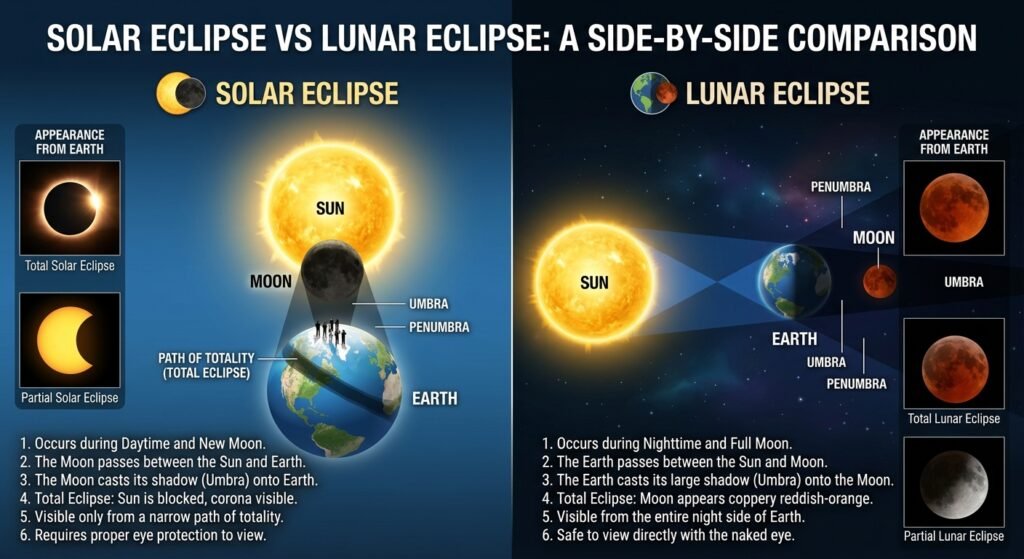
- Solar eclipse: The Moon’s shadow falls on Earth
- Lunar eclipse: Earth’s shadow falls on the Moon
Think of it this way: in a solar eclipse, you are standing in the Moon’s shadow. In a lunar eclipse, the Moon is standing in Earth’s shadow.
2. What Moon Phase Is Required
- Solar eclipse: Requires a new moon (Moon between Sun and Earth)
- Lunar eclipse: Requires a full moon (Earth between Sun and Moon)
This is why you can never have both types of eclipse on the same day. They require opposite positions of the Moon in its orbit.
3. How Long Each Eclipse Lasts
This is one of the most dramatic differences between the two:
- Solar eclipse totality: Only 2 to 7 minutes at maximum from any single location — because the Moon’s shadow is small and moves quickly
- Lunar eclipse totality: Up to 2 hours — because Earth’s shadow is much larger than the Moon, so the Moon stays inside it for a much longer time
If you include all phases — partial, total, and exit — a complete lunar eclipse event can span 3 to 6 hours.
4. Where on Earth You Can See Them
This is perhaps the most significant practical difference:
- Solar eclipse: Visible only from a narrow path on Earth — sometimes just a few hundred miles wide. If you are outside that path, you either see a partial eclipse or nothing at all.
- Lunar eclipse: Visible from everywhere on Earth’s night side — roughly half the planet can watch simultaneously.
This is why billions of people have seen a lunar eclipse but relatively few have experienced a total solar eclipse in person.
5. How Often Each Occurs
- Solar eclipses: 2 to 5 per year globally, but any specific location on Earth averages a total solar eclipse only once every 375 years
- Lunar eclipses: 0 to 3 umbral eclipses per year, visible from large portions of Earth each time
6. Is It Safe to Watch?
- Solar eclipse: ⚠️ Never look directly at the Sun during a solar eclipse without certified eclipse glasses (ISO 12312-2 compliant). The only safe time to look without glasses is during the brief totality of a total solar eclipse — and only while the Sun is completely blocked. Looking even a second too early or too late can cause permanent eye damage.
- Lunar eclipse: ✅ Completely safe to watch with the naked eye at all stages. You are looking at the Moon, not the Sun. No special equipment is needed, though binoculars or a telescope will make the experience richer.
7. What Colors and Visuals You Experience
- Solar eclipse: A black disc surrounded by the Sun’s white corona — a ghostly, otherworldly sight that no photograph fully captures
- Lunar eclipse: A red, orange, or brownish-red Moon — the exact shade depends on how much dust and cloud cover Earth’s atmosphere has at the time
8. Which Is More Rare?
Globally, solar and lunar eclipses happen with similar frequency. But from the perspective of any individual person standing in any given location:
- Solar eclipses feel extremely rare — because you are only in the path of totality once in a lifetime unless you actively travel to see them
- Lunar eclipses feel more common — because a much larger portion of Earth can see each one
Solar Eclipse vs Lunar Eclipse: Which Is More Spectacular?
Astronomers, photographers, and eclipse chasers almost universally agree: a total solar eclipse is the most spectacular natural event a human being can witness.
The combination of the sky going dark in daytime, the sudden temperature drop, the appearance of stars, the diamond ring effect, and the revealed solar corona creates an experience that many describe as genuinely life-changing. People travel to the far corners of the Earth — deserts, mountain ranges, remote islands — just to stand in the path of totality for two to seven minutes.
A total lunar eclipse, by contrast, is a beautiful, atmospheric event — slower, more meditative, and something you can watch from your own backyard with a cup of coffee and no special equipment. The blood moon’s deep red color is hauntingly beautiful, especially when photographed against a dark sky.
Both are worth watching. They are just very different experiences.
Upcoming Solar and Lunar Eclipses in 2026
August 2026 is an extraordinary month for skywatchers. Right now, two major eclipse events are either just occurring or just days away:
| Eclipse | Date | Type | Visible From |
|---|---|---|---|
| Total Solar Eclipse | August 12, 2026 | Total | Greenland, Iceland, Spain, parts of Europe |
| Partial Lunar Eclipse | August 27–28, 2026 | Partial | Europe, Asia, Australia, Americas |
If you missed the solar eclipse on August 12, mark your calendar for the August 27–28 partial lunar eclipse — it requires no special equipment and is visible across huge portions of Earth.
For the full list of upcoming eclipses worldwide, visit NASA’s Eclipse resource at eclipse.gsfc.nasa.gov or timeanddate.com/eclipse.
How to Remember the Difference Forever
The simplest memory trick — and it works every time:
The name tells you what gets dark.
- SOLAR eclipse → the SUN (sol = sun in Latin) gets blocked
- LUNAR eclipse → the MOON (luna = moon in Latin) gets darkened
Or think of it this way:
Solar = Sun disappears. Lunar = Moon changes color.
One more way to remember the positions:
S-M-E (Sun → Moon → Earth) = Solar eclipse S-E-M (Sun → Earth → Moon) = Lunar eclipse
Frequently Asked Questions
What is the main difference between a solar eclipse and a lunar eclipse?
In a solar eclipse, the Moon passes between the Sun and Earth, blocking sunlight and casting a shadow on our planet. In a lunar eclipse, Earth passes between the Sun and the Moon, casting Earth’s shadow onto the Moon’s surface. The key difference is which body is being darkened — the Sun in a solar eclipse, and the Moon in a lunar eclipse.
Which lasts longer — a solar eclipse or a lunar eclipse?
A lunar eclipse lasts significantly longer. Totality during a total lunar eclipse can last up to nearly two hours because Earth’s shadow is large enough to fully cover the Moon for an extended period. Totality during a total solar eclipse, by contrast, lasts only 2 to 7 minutes at any given location because the Moon’s shadow is much smaller.
Can you look at a lunar eclipse without eye protection?
Yes, a lunar eclipse is completely safe to watch with the naked eye at every stage because you are looking at the Moon — not the Sun. A solar eclipse, however, is dangerous to view without certified eclipse glasses (ISO 12312-2 rated) during all phases except the brief period of complete totality, when the Sun is fully blocked by the Moon.
Which is more rare — a solar eclipse or a lunar eclipse?
While both occur with roughly similar frequency globally, a total solar eclipse is far rarer from any given location on Earth. The path of totality for a solar eclipse is only a few hundred miles wide, meaning the average location on Earth experiences a total solar eclipse only once every 375 years. Lunar eclipses are visible from the entire night side of Earth, making them accessible to far more people.
What moon phase is required for each type of eclipse?
A solar eclipse can only happen during a new moon, when the Moon is positioned between Earth and the Sun. A lunar eclipse can only happen during a full moon, when Earth is positioned directly between the Sun and the Moon.
Why does the Moon turn red during a lunar eclipse?
During a total lunar eclipse, the Moon turns red because of a phenomenon very similar to what causes sunrises and sunsets to look red. Sunlight bending around Earth’s edges passes through our atmosphere, which filters out blue wavelengths and lets red and orange wavelengths through. This reddish-orange light falls on the Moon’s surface, giving it the iconic blood moon appearance.
How often do solar and lunar eclipses occur?
Globally, there are typically 4 to 7 eclipses per year — a combination of both types. Solar eclipses occur 2 to 5 times per year, while lunar eclipses visible from some part of Earth happen 0 to 3 times per year. However, a total solar eclipse visible from any specific location on Earth is only expected once every 375 years on average.
Conclusion
Solar eclipses and lunar eclipses are both products of the same cosmic geometry — the Sun, Earth, and Moon lining up in space. But they produce completely different experiences on the ground.
A solar eclipse is a fleeting, daytime event where the Moon briefly blocks our view of the Sun — visible only from a narrow path on Earth, lasting just minutes, and requiring proper eye protection.
A lunar eclipse is a longer, nighttime event where Earth’s shadow slowly darkens and reddens the full Moon — visible from half the planet simultaneously, lasting up to two hours, and completely safe to watch without any equipment.
Both are extraordinary. Both deserve a spot on your skywatching calendar.
The next time someone asks you the difference between a solar and lunar eclipse, you already know the answer — and now you know the science behind it too.
🌟 Ready to See the Next Eclipse?
The August 27–28, 2026 partial lunar eclipse is just days away. You do not need any special equipment — just step outside on a clear night, look up, and watch Earth’s shadow pass across the Moon in real time.
For full details on exactly when and where to watch, visit:
- NASA Eclipse Guide: eclipse.gsfc.nasa.gov
- TimeandDate Eclipse Finder: timeanddate.com/eclipse/2026
Bookmark this page and share it with anyone who wants to understand the night sky better. And if you are looking for your next eclipse viewing adventure, check out our guide to the best spots to watch upcoming celestial events.