 By DSP Staff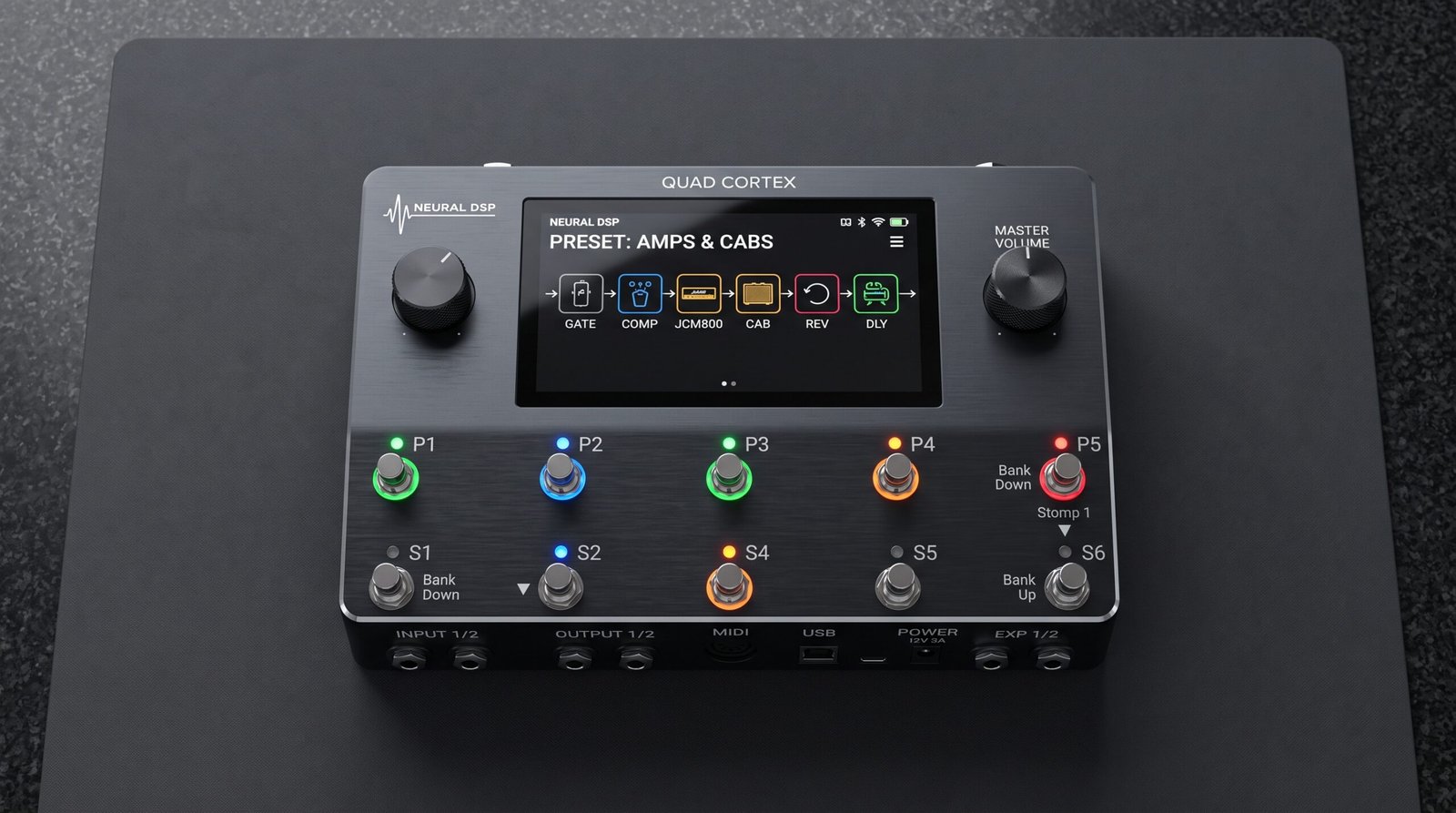
I’ll be honest with you: I was skeptical.
When Neural DSP — a software company known for killer amp simulation plugins — announced they were entering the hardware market, a lot of us wondered whether they could pull it off. Software to hardware is a big leap. The floor modeler market is already brutally competitive, with Line 6, Kemper, and Fractal all doing excellent work.
Then I plugged in the Quad Cortex and played it for three hours straight. I forgot to eat dinner.
This review is based on extended hands-on time with the Quad Cortex — both in live gigging situations and in the studio. I’m going to give you everything: what it does brilliantly, where it falls short, who it’s for, and whether you should spend your money on it. No fluff. No affiliate-driven bias. Just real-world experience.
Let’s get into it.
What Is the Neural DSP Quad Cortex?
A Brief History of Neural DSP
Neural DSP started as a plugin company based in Helsinki, Finland, building amp simulation software that quickly became the gold standard among home recording guitarists and professional producers alike. Their plugins — covering everything from Fortin Nameless to Parallax bass — are known for their hyper-realistic tone and low CPU overhead.
The Quad Cortex was their first major hardware product, and it arrived with enormous anticipation. The guitar community had been watching Neural DSP’s software quality for years, and many players wondered: what could they do if they built their own dedicated hardware?
The answer, as it turns out, is a lot.
What Makes the Quad Cortex Different?
Most floor modelers are constrained by their processing power. This means you hit a wall — you can only run so many effects simultaneously, and you constantly make compromises between tone quality and flexibility.
The processing power under the hood of the Quad Cortex is “way, way in excess of anything else out there short of a high-end studio computer.” With four of the most powerful processors available providing the juice, running out of DSP is virtually impossible.
Beyond raw power, the Quad Cortex introduced Neural Capture — an AI-powered technology that lets you clone your real physical amp and recreate it inside the unit with stunning accuracy. That alone separates it from the competition.
Quad Cortex Specs at a Glance
Key Technical Specifications
| Spec | Detail |
|---|---|
| DSP | 2GHz Quad-Core SHARC Processor |
| Display | 7″ Capacitive Multi-Touch Touchscreen |
| Amp Models | 50+ factory amp models |
| Effects | 70+ effects |
| Cabinet Simulations | 1,000+ IRs included |
| Inputs | Dual XLR + ¼” TS/TRS |
| Outputs | 4 outputs (2 XLR, 2 balanced ¼”) |
| FX Loops | 2 stereo FX loops |
| MIDI | MIDI In + Thru |
| USB | Full 8-in / 8-out USB audio interface |
| Connectivity | WiFi + USB-C |
| Neural Capture | Amp, cab, and pedal capturing |
| Expression Jacks | 2 expression pedal inputs |
| Price (USD) | ~$1,799 |
What’s in the Box?
- Neural DSP Quad Cortex unit
- Power supply
- Quick start guide
- USB cable
Note: No expression pedal or footswitch is included — budget accordingly if you need one.
Design & Build Quality
Hardware Design and Portability
The Quad Cortex is built like a tank. Its aluminum unibody chassis feels premium and road-ready. Compared to the plasticky feel of some competitors, the QC communicates “professional gear” from the moment you pick it up.
It’s not a lightweight unit — it’s designed for serious players — but it fits comfortably on a standard pedalboard and is easy to transport in a standard gear bag.
The footswitches use a dual-function rotary + stomp design. This takes a minute to understand but becomes second nature quickly. You press down to switch presets and rotate to adjust parameters in real time without ever needing to touch the screen.
Touchscreen Interface: Is It Intuitive?
From any angle, the Quad Cortex is a clever, feature-packed, well-built, and great-sounding unit. What’s more, it’s truly fun and inspiring to play and easy to use.
The 7″ touchscreen is the centrepiece of the experience. You can drag and drop effects in your signal chain, pinch-to-zoom into parameters, and navigate menus with natural finger gestures. It genuinely feels modern in a way that competitors’ displays don’t.
That said, if you’re coming from older gear, give yourself a week before judging it. The learning curve is real, but it’s not steep — it’s just different.
Sound Quality: How Does It Really Sound?
Let me cut to the chase: it sounds exceptional.
Amp Models and Tones
The guitar and bass amp emulations include “a wide variety of the most popular contestants — subtly renamed renditions of Marshalls, Dumbles, Friedmans, Mesas, Soldanos, Voxes, Fenders, Ampegs, and so on, plus a range of creative composites.”
The factory amp models are some of the most accurate I’ve heard in a floor processor. The feel — the pick response, the way the amp breathes when you dig in — is closer to a real amp than anything I’ve experienced at this price point.
For players who need versatility across genres — from pristine cleans to scorching high-gain — the Quad Cortex delivers without compromise.
Effects Quality
The Quad Cortex features 70+ effects built in, with reverbs, delays, modulation, drives, and more. The effects quality is studio-grade. The reverbs in particular are lush and three-dimensional. The delays are clear and musical. The new Spring Reverb Engine, available via Cortex Control, offers four different tank types with a lot of flexibility, and there are plenty of controls to tame it or let it run wild.
Cab Simulations and IRs
The factory IR library is massive and covers everything from vintage Celestion-loaded cabs to modern tight/aggressive metal cabs. You can also load third-party IRs from companies like Ownhammer, York Audio, and Choptones — and the QC handles them beautifully.
Third-party IRs can “quickly bulk up the already respectable cabinet selection.”
Neural Capture Explained
What Is Neural Capture?
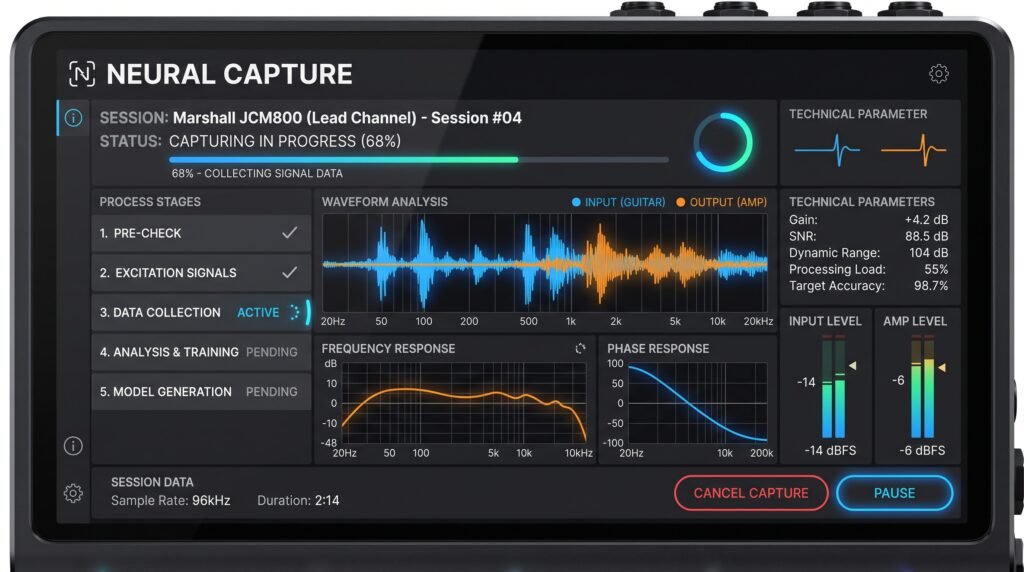
Neural Capture is Neural DSP’s proprietary AI-powered technology that creates a digital clone — called a “capture” — of your physical amplifier, cabinet, or pedal. Think of it as profiling, but built on machine learning rather than traditional impulse measurement.
The result is a capture that responds dynamically to your playing — cleaning up when you roll back your guitar’s volume, breaking up when you dig in — just like the real amp.
How to Use Neural Capture (Step-by-Step)
- Connect your amp to the Quad Cortex’s Neural Capture output jack.
- Navigate to Capture Mode via the touchscreen.
- Set your input gain so the signal is clean but strong.
- Press Capture — the device plays a series of test sweeps through your amp.
- Wait 2–5 minutes while the AI processes the signal.
- Name and save your capture — it’s now part of your preset library.
- (Optional) Upload to Cortex Cloud to share with the community or access on other devices.
Is Neural Capture Better Than Kemper Profiling?
This is the eternal debate. Here’s my honest take:
- Kemper Profiler has been refining its profiling algorithm for over a decade and the results are excellent.
- Neural Capture is newer but benefits from Neural DSP’s machine learning expertise. Captures tend to respond more dynamically to playing nuances.
- Winner for pure feel: Neural Capture, by a small but noticeable margin.
- Winner for workflow: Kemper, for now — the profiling ecosystem is more mature.
CorOS: The Software That Powers It All
CorOS Updates and What’s New in 2026
CorOS is the operating system that Neural DSP continuously updates for free. Since launch, they’ve added a built-in looper, new amp models, new effects, improved UI workflows, and expanded cloud features.
Neural has updated the firmware, included a looper, and added a ton of new sounds in the form of amps and effects.
The free update policy is a major differentiator. You’re not paying for features you should’ve had at launch — you’re getting a platform that genuinely improves over time.
Cortex Control App Review
Cortex Control is the desktop companion app (Mac/PC) that gives you deeper control over your presets, allows you to manage captures and IRs, and enables remote editing from your computer. It’s clean, fast, and reliable — exactly what you want from a professional tool.
Cloud Preset Library (Cortex Cloud)
Cortex Cloud is Neural DSP’s online community library where players upload and share their captures and presets. There are thousands of free presets available — including captures of famous artists’ rigs. It’s a massive value-add that makes the ecosystem incredibly rich.
Quad Cortex vs. The Competition
Quad Cortex vs. Line 6 Helix
| Feature | Quad Cortex | Line 6 Helix |
|---|---|---|
| DSP Power | ✅ Superior (2GHz Quad-Core) | Good (but less raw power) |
| Amp Capture | ✅ Neural Capture | ❌ No capture feature |
| Touchscreen | ✅ 7″ multi-touch | ❌ No touchscreen |
| Effects Quality | ✅ Excellent | ✅ Excellent |
| Price | ~$1,799 | ~$1,499 |
| Preset Ecosystem | Growing fast | ✅ Massive (decade+ of community) |
| Learning Curve | Moderate | Moderate |
Verdict: If you want amp capturing and future-proof DSP power, the Quad Cortex wins. If you want a lower price and a massive preset library right now, Helix is still excellent.
Quad Cortex vs. Kemper Profiler
| Feature | Quad Cortex | Kemper Profiler |
|---|---|---|
| Amp Capture | ✅ Neural Capture | ✅ Profiling (more mature) |
| Touchscreen | ✅ Yes | ❌ No (older UI) |
| Effects | ✅ More modern | Good but dated |
| Price | ~$1,799 | ~$1,799+ (with remote) |
| Form Factor | ✅ Sleek floor unit | Rack/head/stage format |
Verdict: For live use with a modern workflow, the Quad Cortex has the edge. For studio and capture workflow maturity, Kemper is still formidable.
Quad Cortex vs. Fractal FM9
| Feature | Quad Cortex | Fractal FM9 |
|---|---|---|
| DSP Power | ✅ Comparable | ✅ Excellent |
| Amp Capture | ✅ Neural Capture | ❌ No capture |
| Touchscreen | ✅ 7″ | Small display |
| Price | ~$1,799 | ~$2,099 |
| Tone Accuracy | ✅ Excellent | ✅ Legendary |
Verdict: Fractal loyalists will stay with Fractal. For everyone else, the Quad Cortex offers comparable tone at a lower price with better usability.
Quad Cortex vs. Quad Cortex Mini (2026)
The Quad Cortex Mini “takes the Quad Cortex platform, keeps the 7-inch touchscreen, keeps Neural Capture, keeps the core CorOS workflow, then shrinks the box to a smaller chassis with four rotary footswitches instead of the larger unit’s eleven.” Buy the Quad Cortex Mini if you want a compact flagship processor for studio or recording work. Buy the full Quad Cortex if live control with maximum footswitches matters more.
Who Is the Quad Cortex For?
Best for Live Gigging?
Yes — with confidence. The Quad Cortex’s 11 footswitches, robust signal routing, and pedalboard-friendly form factor make it one of the best live tools available. Your patches load instantly with zero gap between presets.
Best for Studio Recording?
Absolutely. The Quad Cortex functions as “a stand-alone Class 2.0 8 in/8 out low-latency USB audio interface” — meaning you can plug directly into your DAW with no additional hardware. The tone quality is professional recording-ready.
Best for Bedroom Players?
It’s excellent for bedroom use, but at ~$1,799, you may want to consider whether you’ll use its full feature set. If you’re gigging or recording seriously, every dollar is justified. If you’re purely at-home casual, the Quad Cortex Mini or a lower-cost option might suit you better.
Quad Cortex Pros and Cons
✅ Pros
- Unmatched DSP processing power
- Neural Capture is a genuine game-changer
- Beautiful, intuitive 7″ touchscreen
- Functions as a full 8-in/8-out USB audio interface
- Free CorOS firmware updates continuously add features
- Cortex Cloud gives access to thousands of free community presets
- Premium aluminum build quality
- Excellent sound quality across all amp types and genres
- Supports third-party IRs
❌ Cons
- Premium price (~$1,799) — not entry-level
- Learning curve for players coming from older gear
- Preset ecosystem is smaller than Line 6 Helix (though growing fast)
- No expression pedal included
- Some players find the footswitch layout takes getting used to
Where to Buy the Quad Cortex & Current Price
The Quad Cortex is available from the following authorized retailers:
- Sweetwater — neuraldsp.sweetwater.com (recommended for U.S. buyers — includes free 2-year warranty and excellent customer support)
- Guitar Center — in-store and online
- Neural DSP Official Site — neuraldsp.com (direct purchase with full warranty)
- Amazon — available but verify seller authenticity
The current U.S. price is approximately $1,399 for the Mini at Sweetwater, with Neural DSP listing the Mini at €1,299 and the full Quad Cortex at €1,749.
💡 Pro Tip: Buy from Sweetwater if you’re in the U.S. Their sales engineers can help you optimize your setup and their return policy is excellent.
Frequently Asked Questions
Q: What is the Neural DSP Quad Cortex?
The Neural DSP Quad Cortex is a professional floor amp modeler and multi-effects processor powered by a 2GHz Quad-Core SHARC processor. It features Neural Capture technology for cloning real amplifiers, 50+ amp models, 70+ effects, and a 7″ touchscreen interface.
Q: How much does the Quad Cortex cost?
The Quad Cortex retails for approximately $1,799 USD. The Quad Cortex Mini, a compact version with the same core platform, is available at around $1,399 USD.
Q: What is Neural Capture and how does it work?
Neural Capture is an AI-powered amp-cloning process. You connect your physical amp to the unit, the device plays test tones through it, and the machine learning algorithm creates a digital “capture” that mirrors your amp’s dynamic response — all in under 10 minutes.
Q: Can I use the Quad Cortex as a USB audio interface?
Yes. The Quad Cortex functions as a full 8-in/8-out, low-latency USB audio interface, making it an all-in-one recording solution without needing separate hardware.
Q: Is the Quad Cortex good for beginners?
The Quad Cortex is best suited for intermediate to advanced players. It has a learning curve, but the touchscreen and Cortex Cloud preset library make it more approachable than many professional processors. Beginners may find better value in a more affordable option.
Q: How does the Quad Cortex compare to Line 6 Helix?
The Quad Cortex has more raw DSP power, a touchscreen, and Neural Capture. The Helix has a larger community preset library and a lower price. For future-proof tone and amp capturing, most players prefer the Quad Cortex. For budget and community ecosystem, Helix is strong.
Q: What is CorOS?
CorOS is the Quad Cortex’s operating system, updated regularly and for free by Neural DSP. Each update adds new amp models, effects, features, and performance improvements — meaning your investment grows in value over time.
Q: Quad Cortex vs. Quad Cortex Mini — which should I buy?
Buy the full Quad Cortex for maximum live performance control with 11 footswitches. Buy the Quad Cortex Mini for the same processing power in a smaller, pedalboard-friendly chassis — ideal for studio work and compact touring rigs.
Final Verdict: Is the Quad Cortex Worth It?
The Quad Cortex is “an inspiring product that presents a future for amp modeling units that players of all styles will want to invest in.”
After extended time with this unit — at rehearsals, gigs, and in the studio — my verdict is this: if you’re a serious guitarist and you can budget for it, the Quad Cortex is one of the best investments you can make in your tone.
It’s not just a great floor modeler. It’s a platform. It gets better with every firmware update. Its Neural Capture ecosystem grows richer every day as more players upload their captures to Cortex Cloud. And its sound quality — especially the feel and dynamic response — is as close to a real amp as I’ve heard in a floor unit.
Is it perfect? No. The price is steep. The preset community hasn’t caught up to Helix’s decade-long head start. And if you’re a casual bedroom player, you may not need this much firepower.
But if you’re serious about your tone — and you want gear that will grow with you for years — the Quad Cortex earns every penny.
Rating: 4.8 / 5 ⭐⭐⭐⭐⭐