 By DSP Staff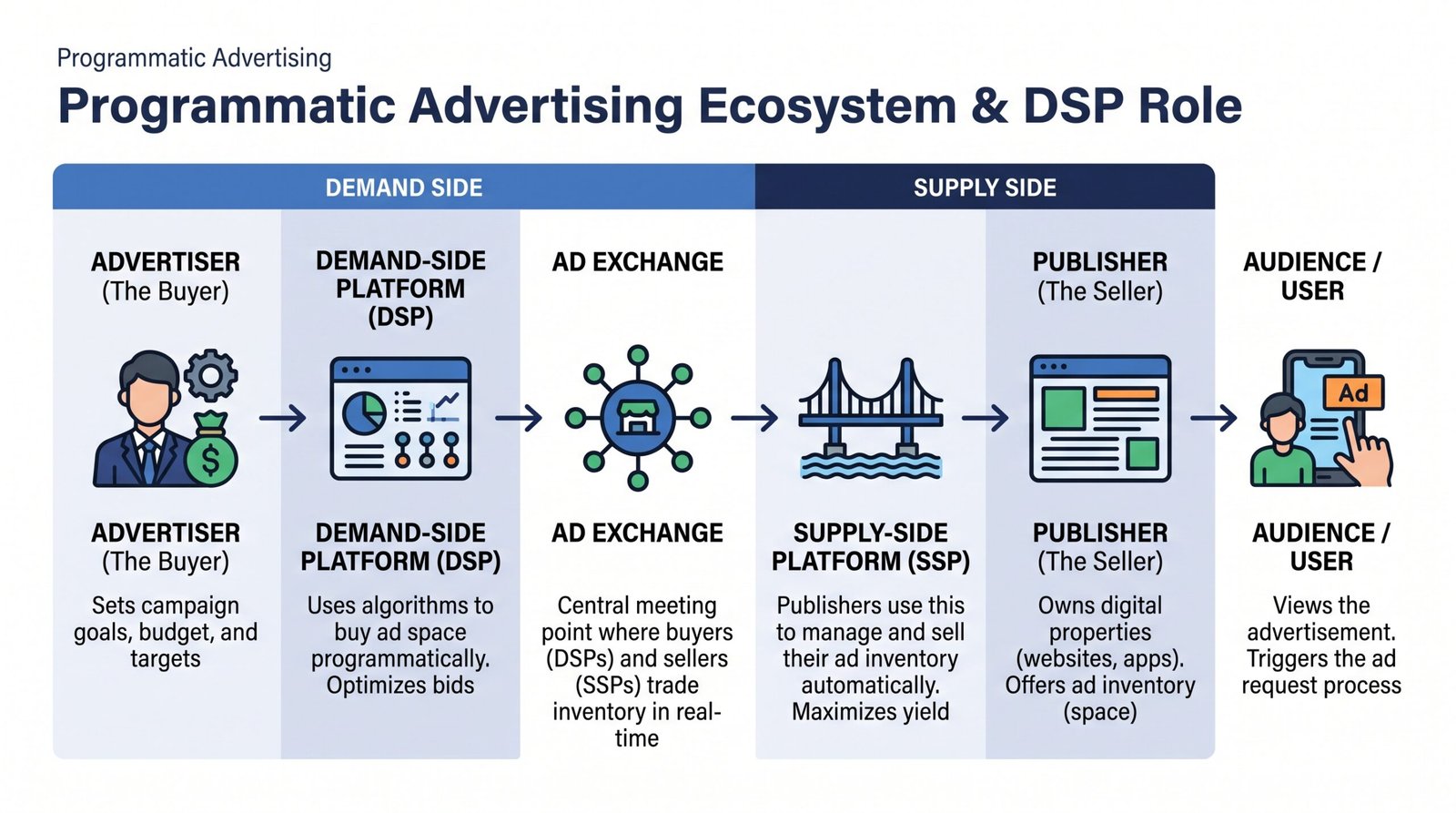
If you’ve ever wondered what is DSP in digital advertising, the simplest answer is this: a DSP, or demand-side platform, is technology that helps advertisers buy digital advertising inventory automatically across multiple websites, apps, publishers, exchanges, and channels.
Instead of manually negotiating and purchasing individual ad placements, advertisers can use a DSP to manage programmatic media buying, select audiences, set budgets, bid on available impressions, and measure campaign performance from one platform.
DSPs have become an important part of the modern programmatic advertising ecosystem. They can support campaigns across formats such as display, video, audio, and connected or streaming TV, depending on the platform and available inventory.
This guide explains DSPs from the ground up, including how they work, how they relate to programmatic advertising, the difference between a DSP and SSP, and how Amazon DSP fits into the ecosystem.
What Is DSP?
DSP stands for Demand-Side Platform.
A demand-side platform is an advertising technology platform that allows advertisers to purchase digital ad inventory from multiple sources through automated buying processes.
In simple terms, a DSP acts as a centralized buying system for digital advertising.
Instead of an advertiser visiting hundreds of websites and negotiating advertising space individually, the advertiser can use a DSP to:
- Define campaign objectives
- Select target audiences
- Set budgets
- Choose advertising formats
- Bid on available impressions
- Control campaign frequency
- Optimize performance
- Analyze results
Amazon Ads describes a DSP as technology that automates digital advertising purchases across publishers, supply-side platforms, and exchanges. Google similarly describes DSPs as technology that enables marketers to buy inventory across multiple platforms or exchanges.
The important idea is demand.
Advertisers create demand for advertising inventory because they want to reach potential customers. A DSP helps them find and purchase that inventory programmatically.
What Does DSP Stand For?
DSP stands for Demand-Side Platform.
The term comes from the two sides of the digital advertising marketplace:
Demand side: Advertisers looking to buy advertising inventory.
Supply side: Publishers looking to sell advertising inventory.
A DSP represents the advertiser’s side of the marketplace.
For example, imagine an online sports website has an advertising space available on one of its pages.
A publisher or supply-side platform can make that impression available to buyers. DSPs can evaluate the opportunity on behalf of advertisers and determine whether it fits their campaign targeting and bidding criteria.
This process can happen extremely quickly, often during the loading of a webpage or app.
How Does a DSP Work?
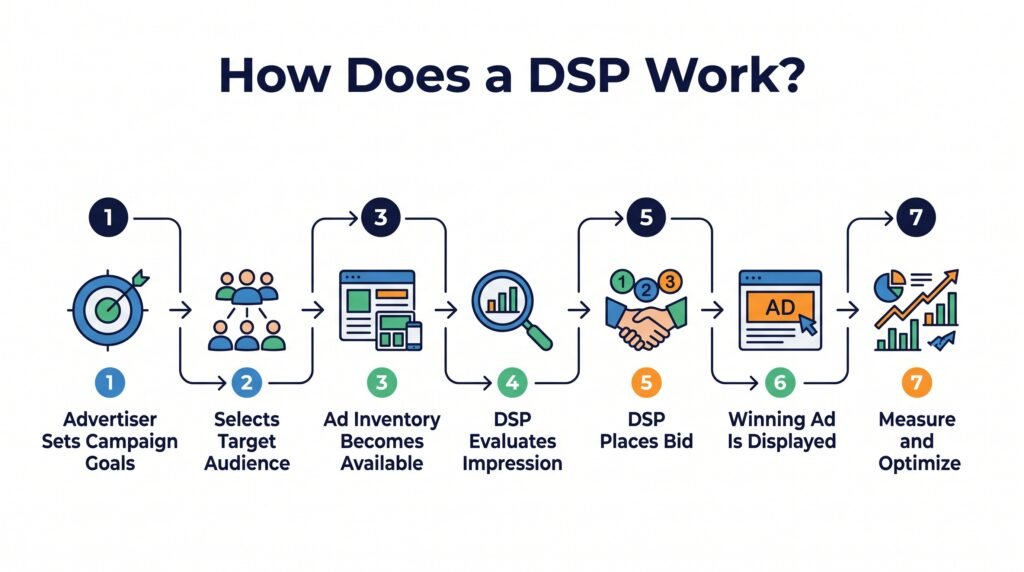
A DSP works by automating many parts of the digital media buying process.
Here’s a simplified version of the process.
1. An advertiser sets campaign goals
The advertiser first determines what the campaign needs to accomplish.
For example, the goal could be:
- Brand awareness
- Website traffic
- Product consideration
- Lead generation
- Sales
- Customer acquisition
- Retargeting
The campaign objective influences targeting, creative, bidding, and measurement decisions.
2. The advertiser selects an audience
The advertiser defines who they want to reach.
Depending on the DSP, targeting can involve factors such as:
- Demographics
- Interests
- Context
- Geographic location
- Device
- Previous interactions
- Shopping behavior
- First-party audience data
- Remarketing audiences
Modern DSPs can combine multiple signals to help advertisers find relevant audiences.
3. Ad inventory becomes available
When a user opens a website, app, video player, or another digital environment containing an available advertising placement, that impression can enter a programmatic marketplace.
The available inventory may be supplied through publishers, SSPs, ad exchanges, direct integrations, or other supply sources.
4. The DSP evaluates the impression
The DSP evaluates the available impression against the advertiser’s campaign requirements.
It can consider factors such as:
- Audience suitability
- Placement
- Context
- Device
- Location
- Bid strategy
- Budget
- Frequency
- Campaign objectives
If the impression doesn’t meet the campaign’s requirements, the DSP may decide not to bid.
5. The DSP places a bid
If the impression is valuable to the advertiser, the DSP can submit a bid through the applicable programmatic buying mechanism.
This is where real-time bidding (RTB) can become part of the process.
The objective isn’t simply to bid as much as possible. The platform needs to balance the value of the impression against the advertiser’s budget and campaign objectives.
6. The winning ad is displayed
If the advertiser’s bid wins the relevant auction, the campaign’s creative can be served to the user.
The process is designed to happen extremely quickly.
The user may simply see a normal display, video, audio, or other digital advertisement without realizing that an automated buying process occurred behind the scenes.
7. Campaign data is measured and optimized
After the ad is served, the advertiser can analyze performance.
Depending on the DSP and campaign setup, metrics can include:
- Impressions
- Clicks
- Click-through rate
- Conversions
- Cost per acquisition
- Viewability
- Video completion
- Reach
- Frequency
- Return on ad spend
Advertisers can then adjust budgets, audiences, bids, creatives, placements, or other campaign settings.
That creates a continuous cycle:
Target → Bid → Deliver → Measure → Optimize
What Is Programmatic Advertising?
Programmatic advertising is the automated buying and selling of digital advertising inventory using technology.
A DSP is one of the key technologies used by advertisers within this ecosystem.
Programmatic advertising can reduce the need for manual media buying by allowing software to evaluate advertising opportunities and make buying decisions based on predefined rules, audience signals, budgets, and bidding strategies.
A simplified programmatic ecosystem looks like this:
Advertiser → DSP → Ad Exchange/SSP → Publisher → Audience
The ecosystem can be more complicated in practice, but this model is useful for understanding the basic roles.
DSP and programmatic advertising are not exactly the same thing
This distinction is important.
A DSP is a technology platform.
Programmatic advertising is the broader automated advertising process and ecosystem.
In other words, DSPs are tools used to execute programmatic media buying.
What Does a DSP Do?
A DSP can perform several important functions for advertisers.
Automated media buying
Instead of manually purchasing individual placements, advertisers can use a DSP to access and manage inventory across multiple sources.
Audience targeting
DSPs can help advertisers identify and reach specific audience groups using available targeting signals and audience data.
Real-time bidding
Many programmatic campaigns use automated bidding to compete for individual advertising impressions.
Campaign optimization
DSPs can analyze campaign performance and help advertisers adjust bids, budgets, audiences, placements, or other settings.
Budget management
Advertisers can establish campaign budgets and spending controls to manage how much they are willing to spend.
Measurement and reporting
DSPs provide reporting tools that allow advertisers to evaluate campaign performance and make data-driven decisions.
DSP vs SSP: What Is the Difference?
The easiest way to remember the difference is:
DSP = helps advertisers buy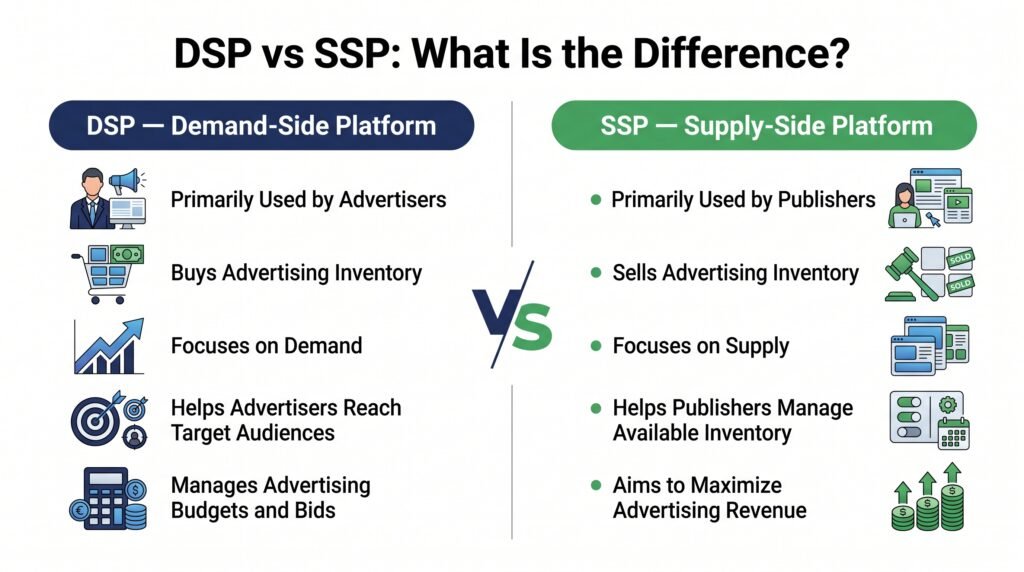
SSP = helps publishers sell
A Demand-Side Platform is designed primarily for advertisers.
A Supply-Side Platform is designed primarily for publishers.
For example, a brand may use a DSP to find and purchase advertising opportunities that match its target audience.
A publisher may use an SSP to make its advertising inventory available to multiple potential buyers and manage the selling process.
Both technologies can interact within the programmatic advertising ecosystem.
Simple DSP vs SSP example
Imagine a news website has one advertising impression available.
The publisher wants to sell that impression at a competitive price.
The SSP helps the publisher make the inventory available to potential buyers.
Multiple advertisers may have campaigns running through DSPs.
The DSPs evaluate the opportunity and determine whether to bid.
The resulting marketplace interaction helps connect advertising demand with advertising supply.
DSP vs Ad Network
DSPs and ad networks can look similar to beginners because both can help advertisers reach audiences across multiple websites.
However, they are not identical.
An ad network generally aggregates advertising inventory from publishers and sells access to advertisers as packaged inventory.
A DSP is an advertising technology platform that gives advertisers programmatic buying capabilities across multiple sources and marketplaces.
Modern advertising technology can be complex, and the exact capabilities vary by provider, so the distinction is not always perfectly clear-cut.
The easiest beginner-level distinction is:
Ad network: Aggregates and sells advertising inventory.
DSP: Provides technology for advertisers to programmatically purchase and manage advertising inventory.
What Types of Ads Can DSPs Buy?
DSP capabilities vary by platform, but modern DSPs can support multiple advertising formats.
Display advertising
Display ads appear across websites and apps in formats such as banners and other visual placements.
Video advertising
DSPs can support online video campaigns across websites, apps, and other digital environments.
Audio advertising
Programmatic audio can allow advertisers to reach listeners across supported digital audio inventory.
Connected TV and Streaming TV
Some DSPs support television-like inventory delivered through connected devices and streaming services.
Amazon DSP, for example, supports advertising formats including display, online video, audio, and Streaming TV.
The exact inventory available depends on the platform, market, publisher relationships, and campaign configuration.
What Can Advertisers Target With a DSP?
One of the major reasons advertisers use DSPs is the ability to define audiences and campaign conditions.
Targeting options can vary considerably between platforms.
Common targeting approaches include:
Demographic targeting
Advertisers may target audiences according to available demographic information.
Geographic targeting
Campaigns can be configured around geographic areas where the relevant targeting capability is available.
Contextual targeting
Contextual targeting focuses on the content or environment surrounding an advertisement.
For example, a sports equipment advertiser might want its ads to appear alongside relevant sports content.
Behavioral and interest-based targeting
Some platforms provide audience segments based on available behavioral or interest signals.
First-party audience targeting
Advertisers can sometimes use their own customer or website data to create audiences, subject to platform policies and applicable privacy requirements.
Remarketing
Remarketing allows advertisers to reconnect with people who have previously interacted with a brand, website, product, or other relevant touchpoint when supported by the platform.
What Are the Benefits of Using a DSP?
DSPs can provide several advantages to advertisers.
1. Centralized campaign management
Instead of managing every advertising opportunity separately, advertisers can manage many aspects of programmatic campaigns through one platform.
2. Automated buying
Automation can make it possible to evaluate and purchase large volumes of advertising opportunities efficiently.
3. Audience targeting
DSPs can help advertisers focus their budgets on audiences that align with their campaign objectives.
4. Cross-channel opportunities
Depending on the DSP, advertisers may be able to manage campaigns across display, video, audio, and streaming environments.
5. Data-driven optimization
Campaign performance data can be used to identify stronger audiences, placements, creatives, and strategies.
6. Scale
Programmatic buying can allow advertisers to access advertising inventory across a large number of publishers and environments.
What Is Amazon DSP?
Amazon DSP is Amazon’s demand-side platform for programmatic advertising.
It allows advertisers to programmatically buy advertising and reach audiences across Amazon-owned properties as well as eligible third-party destinations.
Amazon says advertisers can use Amazon DSP whether or not they sell products on Amazon. Its platform supports advertising across formats including display, video, audio, and Streaming TV.
Amazon DSP also uses Amazon’s audience signals and advertising technology to help advertisers reach relevant audiences.
How Is Amazon DSP Different?
One major differentiator is access to Amazon’s advertising ecosystem and audience signals.
Amazon describes its DSP as using signals from browsing, shopping, and streaming activity alongside other data and AI-powered capabilities to support audience targeting and campaign optimization.
Amazon DSP can also provide access to Amazon-owned properties and third-party inventory.
Examples of Amazon-owned environments can include:
- Amazon.com
- Prime Video
- Twitch
- Fire TV
- Kindle
- Alexa
Third-party inventory availability varies by market and supply relationship.
Who Can Use Amazon DSP?
Amazon states that Amazon DSP is available to brand advertisers, agencies, and tool providers, including advertisers that don’t sell products on Amazon.
This is an important distinction for beginners who assume Amazon DSP is exclusively for Amazon sellers.
DSP Example: How a Campaign Works
Imagine a sportswear brand wants to reach adults who are interested in running.
The brand could build a campaign around an audience and define:
- Campaign objective
- Geographic market
- Budget
- Ad format
- Target audience
- Bid strategy
- Frequency controls
- Measurement goals
The DSP then evaluates available advertising opportunities.
Suppose a relevant user visits a website with an available display impression.
The DSP can evaluate whether that impression fits the campaign.
If it does, the DSP may submit a bid.
If the bid wins, the advertisement can be displayed.
The brand then measures performance.
If certain audiences, placements, or creatives perform better, campaign strategy can be adjusted accordingly.
This is the core concept behind programmatic buying:
Use technology to evaluate many advertising opportunities and allocate budget toward opportunities that are more relevant to campaign goals.
Common DSP Terms Beginners Should Know
If you’re learning DSP advertising, these terms will appear frequently.
Ad Inventory
The advertising space or impressions available for purchase.
Ad Exchange
A technology marketplace that facilitates buying and selling of digital advertising inventory.
SSP
A supply-side platform used by publishers to help sell advertising inventory.
RTB
Real-time bidding is a programmatic buying process in which advertising impressions can be evaluated and auctioned in real time.
CPM
Cost per thousand impressions.
CPM is commonly used to describe the cost of purchasing one thousand ad impressions.
CTR
Click-through rate.
CTR measures the percentage of impressions that result in clicks.
Conversion
A desired action completed by a user, such as making a purchase or submitting a lead form.
Frequency
The number of times an audience member is exposed to an advertisement.
First-Party Data
Information collected directly by an organization from its own interactions with customers or users.
Programmatic Guaranteed
A programmatic buying arrangement where inventory is purchased according to an agreed deal rather than through a standard open auction.
Private Marketplace
A programmatic marketplace where selected buyers can access specific publisher inventory under defined conditions.
How to Choose a DSP
There isn’t one DSP that is automatically best for every advertiser.
When evaluating a DSP, consider:
1. Available inventory
Does the platform provide access to the channels and publishers your audience uses?
2. Audience capabilities
Does its targeting support your campaign requirements?
3. Measurement
Can you measure the outcomes that matter to your business?
4. Brand safety
Does the platform provide appropriate controls for managing where advertisements appear?
5. Optimization tools
Does the platform provide useful bidding, targeting, and optimization capabilities?
6. Transparency
Can you understand where your advertising budget is being spent and how campaigns are performing?
7. Cost and access
Understand platform fees, minimum budgets, managed-service requirements, and other commercial conditions before starting.
Frequently Asked Questions
What is DSP in digital marketing?
DSP stands for Demand-Side Platform. It is advertising technology that helps advertisers programmatically purchase digital advertising inventory across multiple sources.
What is a DSP used for?
A DSP is used for automated media buying, audience targeting, bidding, campaign management, optimization, and advertising measurement.
How does a DSP work?
A DSP evaluates available advertising impressions against an advertiser’s campaign requirements and can bid on relevant inventory. If the advertiser wins the applicable auction, the ad is delivered and performance can then be measured and optimized.
Is DSP the same as programmatic advertising?
No. A DSP is a technology platform used for programmatic media buying, while programmatic advertising refers more broadly to the automated buying and selling of digital advertising.
What is the difference between DSP and SSP?
A DSP primarily helps advertisers buy advertising inventory, while an SSP helps publishers sell their advertising inventory.
What is RTB in DSP?
RTB stands for real-time bidding. It is a programmatic buying process where advertising impressions can be evaluated and bid on in real time.
Is Amazon DSP a DSP?
Yes. Amazon DSP is Amazon’s demand-side platform. It enables advertisers to programmatically buy advertising across Amazon and eligible third-party inventory.
Can you use Amazon DSP without selling on Amazon?
Yes. Amazon states that Amazon DSP is available to advertisers even if they do not sell products on Amazon.
What types of advertising can DSPs support?
Depending on the platform, DSPs can support formats such as display, online video, audio, and Streaming TV.
Is a DSP only for large companies?
Not necessarily. DSP access models vary by provider. Some platforms offer self-service options, while others may have managed-service requirements or minimum spending levels.
Conclusion
So, what is DSP?
A DSP, or Demand-Side Platform, is advertising technology that helps advertisers buy digital advertising inventory programmatically across multiple sources.
Instead of manually purchasing individual ad placements, advertisers can use DSP technology to manage audiences, budgets, bids, inventory, campaigns, and performance measurement from a centralized platform.
The DSP is one of the most important components of the programmatic advertising ecosystem.
If you’re learning programmatic advertising, understanding DSPs gives you the foundation you need to understand more advanced concepts such as RTB, SSPs, ad exchanges, audience targeting, programmatic guaranteed, private marketplaces, Amazon DSP, campaign optimization, and attribution.
Amazon DSP takes this concept further by combining programmatic buying with Amazon’s advertising ecosystem, audience signals, and access to Amazon-owned and third-party inventory.
If you want to build real expertise in programmatic advertising, don’t stop at understanding the definition of a DSP. Learn how the entire ecosystem connects—from advertisers and DSPs to SSPs, exchanges, publishers, audiences, measurement, and optimization.
Ready to learn more? Explore the DSP Academy guides on programmatic advertising, Amazon DSP, RTB, targeting, campaign setup, and optimization.