 By DSP Staff
Ever wonder how your phone turns your voice into a text message, or how Spotify cleans up a scratchy old recording? The answer lives inside a single free book: The Scientist and Engineer’s Guide to Digital Signal Processing. Written by Steven W. Smith, this text has quietly trained thousands of students, hobbyists, and working engineers since the 1990s — and it’s still relevant in 2026.
In this article, you’ll learn what the book actually covers, why it matters even in the age of AI-powered tools, how its chapters are organized, and how to actually use it without getting overwhelmed. We’ll also compare it to other popular DSP resources like Oppenheim’s textbook, so you know which one fits your goals.
Let’s get into it.
Table of Contents
- What Is The Scientist and Engineer’s Guide to Digital Signal Processing?
- Why Does This DSP Guide Matter?
- Key Facts — Structure and Topics Covered
- How To Use The Scientist and Engineer’s Guide Effectively
- Common Mistakes to Avoid
- Expert Tips for Best Results
- Frequently Asked Questions
What Is The Scientist and Engineer’s Guide to Digital Signal Processing?
Think of digital signal processing (DSP) as the math and code behind anything that takes a real-world signal — sound, light, radio waves — and turns it into something a computer can clean up, analyze, or transform. The Scientist and Engineer’s Guide to Digital Signal Processing is a free textbook that teaches you exactly how that works, without requiring a PhD to follow along.
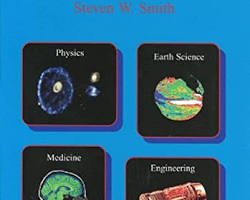
Here’s the analogy: imagine your favorite song as a squiggly line (a waveform). DSP is the toolbox that lets you stretch that line, remove noise from it, split it into frequencies, or compress it into an MP3. The book walks through each tool step-by-step, using plain English instead of dense academic jargon.
Unlike many university textbooks, this guide was written for engineers who need practical answers, not just theory. That’s why it’s remained a go-to reference for understanding digital signal processing for over two decades — and why students often read it alongside denser texts like digital signal processing Oppenheim for balance.
Why Does This DSP Guide Matter?
DSP isn’t a niche skill anymore — it’s baked into almost every device you own. Here’s why this particular guide has staying power:
- It’s free and legal. The full the scientist and engineer’s guide to digital signal processing pdf is available directly from the author’s site, no paywall required.
- It skips heavy proofs. You get practical explanations first, math second — ideal for beginners.
- It’s still cited constantly. Engineering forums, Reddit threads, and university course pages reference it as a top starting point even in 2026.
- It covers real applications. Audio, imaging, and communications examples make concepts stick.
- It complements formal courses. Many students use it alongside classroom texts like Oppenheim to fill in gaps.
According to , demand for DSP-related engineering roles has grown steadily as more devices rely on real-time signal analysis, from hearing aids to autonomous vehicles.
The Scientist and Engineer’s Guide — Key Facts and Structure
The book is organized into four main sections, moving from foundational math to advanced applications. Each chapter builds on the last, so you rarely feel lost.
Section 1: Fundamentals
Covers sampling, quantization, and basic statistics — the building blocks of any digital signal.
Section 2: Fourier Analysis
This is the heart of the book. It explains how any signal can be broken into simple sine waves, a concept central to nearly all of DSP.
Section 3: Filters
Covers digital filters, including FIR and IIR types, used to remove noise or isolate frequencies.
Section 4: Applications
Real-world use cases: audio processing, image processing, and neural network basics (added relevance in the AI era).
| Feature | Smith’s Guide | Oppenheim’s Textbook |
|---|---|---|
| Cost | Free (PDF) | Paid |
| Math depth | Light-to-moderate | Heavy, formal |
| Best for | Beginners, hobbyists | University courses, rigorous study |
| Writing style | Conversational | Academic |
| Real-world examples | Frequent | Occasional |
Both resources are valuable — many readers use Smith’s book to build intuition, then move to Oppenheim for deeper math.
How To Use The Scientist and Engineer’s Guide Effectively
- Download the free PDF first. Skip pirated copies — the official site offers the full text at no cost, so there’s no reason to look elsewhere.
- Start with Chapter 2, not Chapter 1. Many readers find the statistics chapter easier to digest after seeing a real signal example first.
- Read with a notebook nearby. DSP concepts like convolution and the Fourier transform click faster when you sketch them out by hand.
- Run the examples in Python. The book predates modern coding tools, so translating its examples into Python (using NumPy) reinforces the concepts.
- Pair it with video content. Search YouTube for visual walkthroughs of Fourier transforms to reinforce what you just read.
- Don’t skip the filter chapters. This is where most practical, job-relevant knowledge lives.
- Revisit chapters after projects. Concepts make more sense once you’ve tried to build something, like a simple audio equalizer.
Common Mistakes to Avoid
Mistake: Reading it front-to-back like a novel. The truth is this book is a reference, not a linear story — jump to what’s relevant to your project.
Mistake: Skipping the math because it’s “the easy book.” The truth is you still need basic algebra and trigonometry comfort to follow the Fourier chapters.
Mistake: Thinking it replaces a formal DSP course. The truth is it’s a supplement, especially for students also using Oppenheim’s material.
Mistake: Downloading random PDF copies from sketchy sites. The truth is the official version is free anyway, so there’s no reason to risk a virus-laden download.
Mistake: Ignoring the applications chapters. The truth is these sections show you why the math matters, which boosts retention.
Expert Tips for Best Results
- Bookmark the Fourier Transform chapter — you’ll return to it constantly as a reference.
- Code alongside the book using Python or MATLAB to see concepts in action.
- Join a DSP forum or subreddit to ask questions when a chapter confuses you.
- Watch playback speed videos on convolution if the text alone feels abstract.
- Apply concepts to a hobby project, like building a simple audio filter, to lock in what you learn.
Frequently Asked Questions
Is The Scientist and Engineer’s Guide to Digital Signal Processing still relevant in 2026?
Yes. While newer tools and AI-based signal methods have emerged, the core math — sampling, filtering, Fourier analysis — hasn’t changed. The book remains a solid foundation, especially for beginners who want plain-English explanations before tackling denser academic material.
Where can I get the PDF for free?
The author, Steven W. Smith, offers the complete the scientist and engineer’s guide to digital signal processing pdf free on his official website. Avoid third-party download sites, which often host outdated or altered versions.
Should I read this book or Oppenheim’s DSP textbook first?
If you’re a beginner, start with Smith’s guide for intuition, then move to Oppenheim for rigorous math. Students in formal engineering programs often read both side-by-side.
Conclusion
The Scientist and Engineer’s Guide to Digital Signal Processing remains one of the best free entry points into DSP, thanks to its plain-English style, real-world examples, and zero cost. Remember these three things: it’s a reference, not a novel; it pairs well with tools like Python and denser texts like Oppenheim’s; and the free PDF is only available legally on the author’s site.
Start today — download the guide, open Chapter 2, and try coding your first Fourier transform this weekend.
What part of DSP are you trying to learn right now? Drop it in the comments below.