 By DSP Staff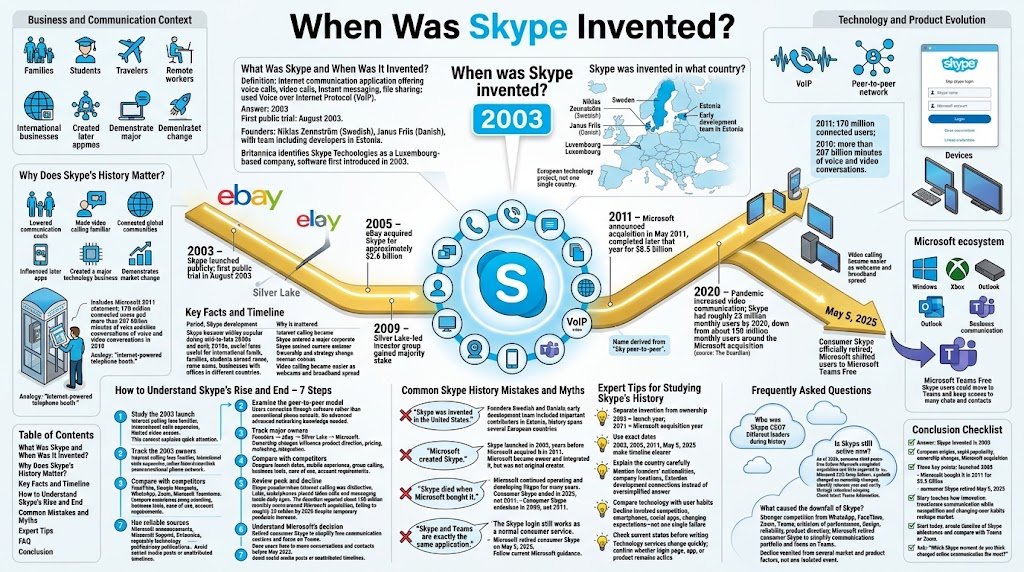
Introduction to When Was Skype Invented?
Before Zoom and smartphones, millions of people used Skype to call across borders for little or no cost. If you are asking when was Skype invented, the short answer is 2003.
Skype changed communication by allowing people to make voice calls, video calls, and instant messages through the internet. It helped families, students, travelers, and businesses communicate without depending only on expensive international phone services.
In this guide, you will learn what Skype was, where it was created, and Skype was invented in what country. You will also discover when Skype became popular, when Microsoft bought Skype, who its major owners were, and when Skype died as a consumer service.
You will also learn how the old Skype login worked, what happened to Skype users after its retirement, and why Microsoft moved users toward Teams. This history shows how quickly communication technology can rise, influence millions of users, and eventually disappear as new competitors take over.
Table of Contents
-
What Was Skype and When Was It Invented?
-
Why Does Skype’s History Matter?
-
When Was Skype Invented: Key Facts and Timeline
-
How to Understand Skype’s Rise and End
-
Common Skype History Mistakes and Myths
-
Expert Tips for Studying Skype’s History
-
Frequently Asked Questions
-
Conclusion
What Was Skype and When Was It Invented?
Skype was an internet communication application that offered voice calls, video calls, instant messaging, and file sharing. It used Voice over Internet Protocol, commonly called VoIP, to carry conversations through an internet connection instead of a traditional telephone network.
So, when was Skype invented? Skype was developed and introduced in 2003. Its first public trial took place in August 2003, and the service quickly attracted attention because users could make computer-to-computer calls at very low cost.
Skype was not invented by one person working alone. Swedish entrepreneur Niklas Zennström and Danish entrepreneur Janus Friis founded the company with a team that included developers in Estonia. Britannica identifies Skype Technologies as a Luxembourg-based company founded by Zennström and Friis, with the software first introduced in 2003.
If you ask Skype was invented in what country, the answer needs a little context. The founders came from Sweden and Denmark, the company had Luxembourg connections, and much of the early technical development happened in Estonia. That is why people often describe Skype as a European technology project rather than a product from one single country.
Think of Skype as an internet-powered telephone booth. Instead of paying a telephone company for every international minute, you opened the application, found a contact, and connected through the internet.
Why Does Skype’s History Matter?
Skype’s history matters because it shows how one software product changed expectations about communication.
-
It lowered communication costs: People could call other Skype users through the internet without paying traditional international calling rates.
-
It made video calling familiar: Skype helped ordinary users become comfortable with face-to-face online conversations.
-
It connected global communities: Families, students, remote workers, and companies used Skype across borders.
-
It influenced later applications: Many modern video and collaboration tools followed ideas that Skype made familiar.
-
It created a major technology business: Microsoft later purchased Skype for billions of dollars.
-
It demonstrates market change: A product can remain famous while new competitors and business priorities reduce its importance.
Microsoft stated in 2011 that Skype had 170 million connected users and more than 207 billion minutes of voice and video conversations in 2010. Those figures explain why Skype became an important part of internet history rather than just another messaging application.
When Was Skype Invented: Key Facts and Timeline
Skype 2003
The answer to when was Skype invented is 2003. The first public version appeared during a period when broadband internet was growing but video calling was still unfamiliar to many people.
The name “Skype” developed from the phrase “Sky peer-to-peer,” reflecting the software’s early peer-to-peer technology. The service allowed users to call one another through computers and later through phones, tablets, televisions, and other devices.
When Was Skype Popular?
Skype became widely popular during the mid-to-late 2000s and early 2010s. It became especially useful for international families, students studying abroad, remote teams, and businesses with offices in different countries.
Skype’s popularity increased because users could contact people by username rather than depending only on a telephone number. Video calling also became easier as webcams and broadband connections became more common.
Who Bought Skype?
eBay acquired Skype in 2005 for approximately $2.6 billion. eBay later sold its majority stake to an investor group led by Silver Lake in 2009.
Microsoft announced its agreement to acquire Skype in May 2011. Microsoft completed the acquisition later that year for $8.5 billion, making Skype part of Microsoft’s communication and software portfolio.
When Did Microsoft Buy Skype?
Microsoft bought Skype in 2011. The deal gave Microsoft access to a globally recognized communication service and millions of users. Microsoft connected Skype with products and platforms such as Windows, Xbox, Outlook, and business communication tools.
When Did Skype Die?
Consumer Skype officially retired on May 5, 2025. Microsoft announced that it was moving its focus toward Microsoft Teams Free, which offered many similar communication features.
Skype Login and User Accounts
The old Skype login allowed users to sign in with a Skype name, Microsoft account, or linked credentials, depending on the period and account setup.
After retirement, Microsoft directed users toward Teams Free. Microsoft explained that Skype users could move to Teams and keep access to many chats and contacts through the transition process.
How to Understand Skype’s Rise and End
1. Study the 2003 Launch
Begin with the technology available in 2003. Internet calling was less familiar, international phone calls were expensive, and many people had limited access to video communication.
This context explains why Skype attracted attention so quickly.
2. Examine the Peer-to-Peer Model
Skype originally used peer-to-peer technology to help connect users over the internet. Understanding this model helps you see how Skype differed from a traditional telephone exchange.
You do not need advanced networking knowledge to understand the basic idea: users connected through software rather than through a conventional phone network.
3. Track Its Major Owners
Create a timeline showing the founders, eBay, Silver Lake, and Microsoft. Ownership changes often influence product direction, pricing, marketing, and integration with other services.
This step also helps you answer questions such as who bought Skype and why the platform became connected to Microsoft products.
4. Compare Skype With Competitors
Compare Skype with FaceTime, Google Hangouts, WhatsApp, Zoom, and Microsoft Teams. Look at their launch dates, mobile experience, group calling, business tools, ease of use, and account requirements.
Skype did not disappear because communication stopped being useful. It faced stronger competition and changing user habits.
5. Review Its Peak and Decline
Skype became popular when internet calling was still distinctive. Later, smartphones placed video calls and messaging inside applications that users already opened every day.
The Guardian reported that Skype had about 150 million monthly users around the time Microsoft bought it, but the figure had fallen to roughly 23 million by 2020, despite a temporary pandemic increase.
6. Understand Microsoft’s Decision
Microsoft retired consumer Skype to simplify its free communication services and focus on Teams. The company gave users time to move their conversations and contacts before the May 2025 retirement date.
7. Use Reliable Sources
For a school assignment, use Microsoft announcements, Microsoft Support, Britannica, and reputable technology publications. Avoid relying only on social media posts or unattributed timelines.
Common Skype History Mistakes and Myths
-
“Skype was invented in the United States.” The founders were Swedish and Danish, and the early development team included important contributors in Estonia. Skype’s history spans several European countries.
-
“Microsoft created Skype.” Skype launched in 2003, years before Microsoft acquired it in 2011. Microsoft became an owner and integrated Skype into its ecosystem, but it was not the original creator.
-
“Skype died when Microsoft bought it.” Microsoft continued operating and developing Skype for many years. Consumer Skype ended in 2025, not in 2011.
-
“Skype and Teams are exactly the same application.” Teams Free replaced consumer Skype for many users, but the interfaces, features, account experience, and product direction are different.
-
“The Skype login still works as a normal consumer service.” Microsoft retired consumer Skype on May 5, 2025. Users should follow Microsoft’s current guidance rather than expect the old standalone service to operate.
Expert Tips for Studying Skype’s History
-
Separate invention from ownership. Record 2003 as the launch year and 2011 as the Microsoft acquisition year.
-
Use exact dates. Dates such as 2003, 2005, 2011, and May 5, 2025 make your timeline clearer and more reliable.
-
Explain the country carefully. Mention the founders’ nationalities, company locations, and Estonian development connections instead of giving an oversimplified answer.
-
Compare technology with user habits. Skype’s decline involved competition, smartphones, social apps, and changing expectations—not one single failure.
-
Check current status before writing. Technology services change quickly, so confirm whether a login page, app, or product remains active before publishing.
Frequently Asked Questions
Who was Skype CEO?
Skype had different leaders during its history. Tony Bates became chief executive before Microsoft completed its acquisition and later reported to Microsoft CEO Steve Ballmer. Leadership changed as ownership changed, so the answer depends on the period you are studying. For a school article, identify the relevant year and verify the executive through a reliable company announcement or historical source.
Is Skype still active now?
As of 2026, consumer Skype is no longer available as a standalone service. Microsoft retired it on May 5, 2025, and directed users toward Microsoft Teams Free. Skype for Business had a separate history and should not be confused with the consumer product. If you need Microsoft’s current communication service, check the latest Teams information rather than searching for the old Skype login.
What caused the downfall of Skype?
Skype faced stronger competition from mobile messaging and video platforms, including WhatsApp, FaceTime, Zoom, and Teams. Some users also criticized changes in performance, design, reliability, and product direction over time. Microsoft eventually retired consumer Skype to simplify its communications portfolio and focus on Teams. Its decline resulted from several market and product factors rather than one isolated event.
Conclusion
The answer to when was Skype invented is 2003, when the service introduced internet-based voice and video communication to a broad audience. Its European origins, rapid popularity, ownership changes, and Microsoft acquisition made it a major technology story.
The three key points are simple: Skype launched in 2003, Microsoft bought it in 2011 for $8.5 billion, and consumer Skype retired on May 5, 2025. Its story teaches you how innovation can transform communication while competition and changing user habits reshape the market.
Start today by creating a timeline of Skype’s major milestones and comparing it with Teams or Zoom. Which Skype moment do you think changed online communication the most?