 By DSP Staff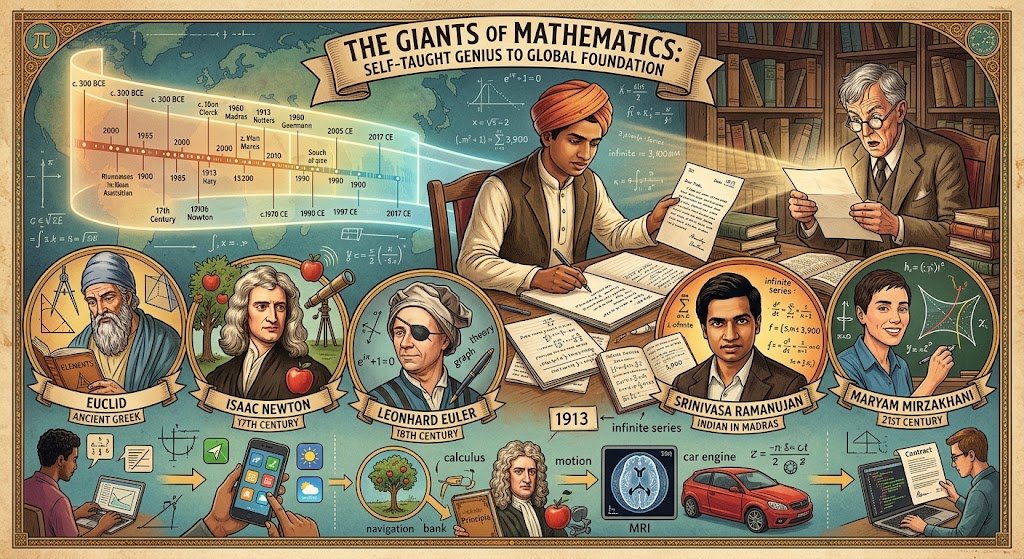
Some of the most famous math mathematicians in history learned almost everything on their own. Srinivasa Ramanujan, a clerk in Madras with no university training, wrote to English mathematician G.H. Hardy in 1913, and that letter changed both their lives. A century later, researchers still unpack the formulas he scribbled in his notebooks.
If you have ever wondered who these brilliant minds were, or why their names still fill classrooms, you are in the right place. Whether you are a student, a teacher, or someone who once hated algebra, these stories will change how you see numbers. Their ideas quietly power your phone, your bank, and the weather app you check each morning.
In this guide, you will learn what makes a mathematician famous, why their work still matters, and the key contributions of five legendary figures. You will also discover a practical method for studying their lives and uncover the myths that surround them.
Table of Contents
- What Is a Famous Mathematician?
- Why Famous Mathematicians Matter
- Famous Mathematicians and Their Contributions: Key Facts
- How To Study Famous Mathematicians and Their Work
- Common Myths About Famous Mathematicians
- Expert Tips for Learning About Famous Mathematicians
- Frequently Asked Questions About Famous Mathematicians
- Final Thoughts on Famous Mathematicians
What Is a Famous Mathematician?
A famous mathematician is a person whose ideas changed how humans count, measure, and predict the world. Historians usually recognize fame through three signs: a breakthrough theorem or method, a lasting influence on other fields, and recognition that survives for centuries. That’s why Euclid still appears in textbooks more than 2,300 years after he lived.
Think of mathematics as a giant cathedral. Most people walk through its rooms, but famous math mathematicians laid the foundations, invented the tools, or designed entire wings that others later decorated. Without them, the building would have no structure at all.
Take Euclid as your starting point. Around 300 BCE, he wrote Elements, which began with simple assumptions and proved everything step by step. Your high school geometry class still follows his method today.
Why Famous Mathematicians Matter
Understanding famous math mathematicians does more than fill trivia gaps. Here’s what their stories give you:
- They built the tools you use daily. Calculus, developed independently by Isaac Newton and Gottfried Leibniz, now powers everything from car engines to medical imaging.
- They teach you how to reason. Euclid’s proof-based thinking trains the same logic you use to read contracts, debug code, and win arguments.
- They open real career doors. The U.S. Bureau of Labor Statistics projects employment for mathematicians and statisticians to grow about 11% from 2023 to 2033, far faster than the average for all jobs.
- They prove persistence pays. Andrew Wiles spent roughly seven years working on Fermat’s Last Theorem, largely in secret, before his corrected proof appeared in 1995.
- They inspire new generations. Maryam Mirzakhani became the first woman to win the Fields Medal in 2014, showing that talent knows no gender or nationality.
- They reveal math as human history. Their rivalries, mentors, and mistakes remind you that even genius is messy and collaborative.
Famous Mathematicians and Their Contributions: Key Facts
Ranking the top 10 famous math mathematicians of all time is impossible, but five names consistently stand out. Here’s what each one contributed.
Euclid (Active Around 300 BCE)
Euclid organized geometry into 13 books of definitions, axioms, and proofs. His Elements remained a core textbook for roughly two thousand years, and its logical structure still shapes modern mathematics.
Isaac Newton (1643–1727)
Newton developed calculus to describe motion and change. He published his laws of motion and universal gravitation in Principia Mathematica (1687), uniting earthly and heavenly physics under one set of rules.
Leonhard Euler (1707–1783)
Swiss-born Euler was one of the most prolific mathematicians ever, producing more than 800 published works. He gave us Euler’s identity, e^(iπ) + 1 = 0, and he kept publishing even after losing his sight.
Srinivasa Ramanujan (1887–1920)
Largely self-taught, Ramanujan built his skills from a book of formulas and relentless experimentation. His notebooks contain about 3,900 results in infinite series and number theory, and researchers still study them today.
Maryam Mirzakhani (1977–2017)
Born in Iran, Mirzakhani studied hyperbolic geometry and the shapes of curved surfaces, ideas that connect to physics and dynamics. She won the Fields Medal in 2014, and her mathematical contributions continue to guide researchers worldwide.
| Mathematician | Era | Nationality | Key Contribution | Lasting Impact |
|---|---|---|---|---|
| Euclid | c. 300 BCE | Greek | Elements, axiomatic geometry | Foundation of logical proof |
| Isaac Newton | 1643–1727 | English | Calculus, laws of motion | Physics and engineering |
| Leonhard Euler | 1707–1783 | Swiss | Euler’s identity, graph theory | Modern analysis and networks |
| Srinivasa Ramanujan | 1887–1920 | Indian | Infinite series, partition theory | Number theory breakthroughs |
| Maryam Mirzakhani | 1977–2017 | Iranian | Hyperbolic geometry, Fields Medal | Geometry and dynamics research |
How To Study Famous Mathematicians and Their Work
Studying famous math mathematicians can sharpen your own thinking if you approach them strategically. Follow these seven steps.
- Pick one mathematician to start. Choose the figure whose story hooks you, such as Ramanujan’s self-taught journey. Commit to one biography before jumping to the next name.
- Read a short primary source. Look up a passage from Euclid’s Elements or Newton’s Principia in translation. Seeing the original reasoning reveals how their minds actually worked.
- Identify the problem they faced. Ask what question drove their work and which tools existed at the time. Summarize it in one sentence using your own words.
- Rebuild one proof by hand. Work through Euler’s identity or the Pythagorean theorem on paper. Solving it yourself builds understanding that memorization never will.
- Connect their ideas to modern life. Find one technology, such as GPS or online encryption, that depends on their work. Write a short paragraph explaining the link.
- Compare two mathematicians. Pick a pair, like Newton and Leibniz, and list their shared discoveries and disputes. Comparison sharpens your critical thinking.
- Build a timeline. Plot each mathematician on a visual timeline so you can see how ideas built on one another. Keep it nearby as your quick reference.
Common Myths About Famous Mathematicians
Several myths about famous math mathematicians keep circulating online, including the idea that some were bad at math. Here’s what’s actually true.
- Mistake: “Einstein failed math.” The truth: this myth came from a misread Swiss grading scale where 6 was the top mark. Einstein excelled at mathematics and had mastered calculus as a teenager.
- Mistake: “Famous mathematicians were born geniuses.” The truth: most combined natural curiosity with years of disciplined practice. Ramanujan filled his notebooks through daily experimentation, not effortless brilliance.
- Mistake: “Great mathematicians always had elite training.” The truth: Ramanujan worked as a clerk, and many pioneers learned through patrons, private study, or self-directed reading.
- Mistake: “Advanced math belongs only to experts.” The truth: proofs like Euclid’s remain readable for any curious student. Start with the ideas, not the symbols.
- Mistake: “Memorizing names is enough.” The truth: knowing that Mirzakhani studied curved surfaces teaches you far more than memorizing her birth year. Focus on contributions, not trivia.
Expert Tips for Learning About Famous Mathematicians
- Verify biographies with reliable archives. Check the MacTutor History of Mathematics archive at the University of St Andrews before sharing any story.
- Build context with a timeline. Pair your reading with our [ history of mathematics timeline] to see how ideas spread across centuries.
- Pair reading with video lectures. Watch short explanations of Euler’s identity to see the concept come alive visually.
- Keep a discovery notebook like Ramanujan. Write one formula or question each day, then revisit it weekly.
- Teach one story to someone else. Explaining Newton’s rivalry with Leibniz to a friend exposes gaps in your understanding fast.
Frequently Asked Questions About Famous Mathematicians
Q1: Who is the No. 1 mathematician in history?
There’s no official ranking, so the answer depends on what you value. Many historians name Carl Friedrich Gauss the “Prince of Mathematicians” for his deep work in number theory. He also shaped astronomy and statistics, and both fields still rely on his methods. Others choose Euler for sheer output or Newton for transforming physics, so pick the criterion that matters most to you.
Q2: What is called “I love you” in math?
There’s no official phrase, but the most popular answer is Euler’s identity, e^(iπ) + 1 = 0. Mathematicians often call it the most beautiful equation ever written because it links five fundamental constants in one short line. Some people also use the infinity symbol ∞ as a playful stand-in for “I love you forever.” Pick whichever feels right for your message.
Q3: Who is the guy with a 230 IQ?
The viral claim usually names Terence Tao, an Australian-American mathematician who won the Fields Medal in 2006. However, no verified test result supports a score of 230, and most IQ tests lose accuracy at such extremes. Tao’s reputation rests on his achievements instead, including major work in number theory, harmonic analysis, and combinatorics. Judge genius by documented contributions rather than viral numbers.
Final Thoughts on Famous Mathematicians
Three ideas matter most. First, famous math mathematicians like Euclid, Newton, Euler, Ramanujan, and Mirzakhani built the tools that still power your daily life. Second, their stories prove that persistence and curiosity often outweigh natural talent. Third, you can learn from them with a simple plan: pick one name, read a primary source, and rebuild one proof by hand.
Start today. Choose one mathematician from the table above, read one short biography, and write one sentence explaining why their work matters to you. Small daily steps turn a list of names into real understanding of the history of mathematics.
Which famous mathematician would you most like to meet, and why? Share your answer in the comments below.