 By DSP Staff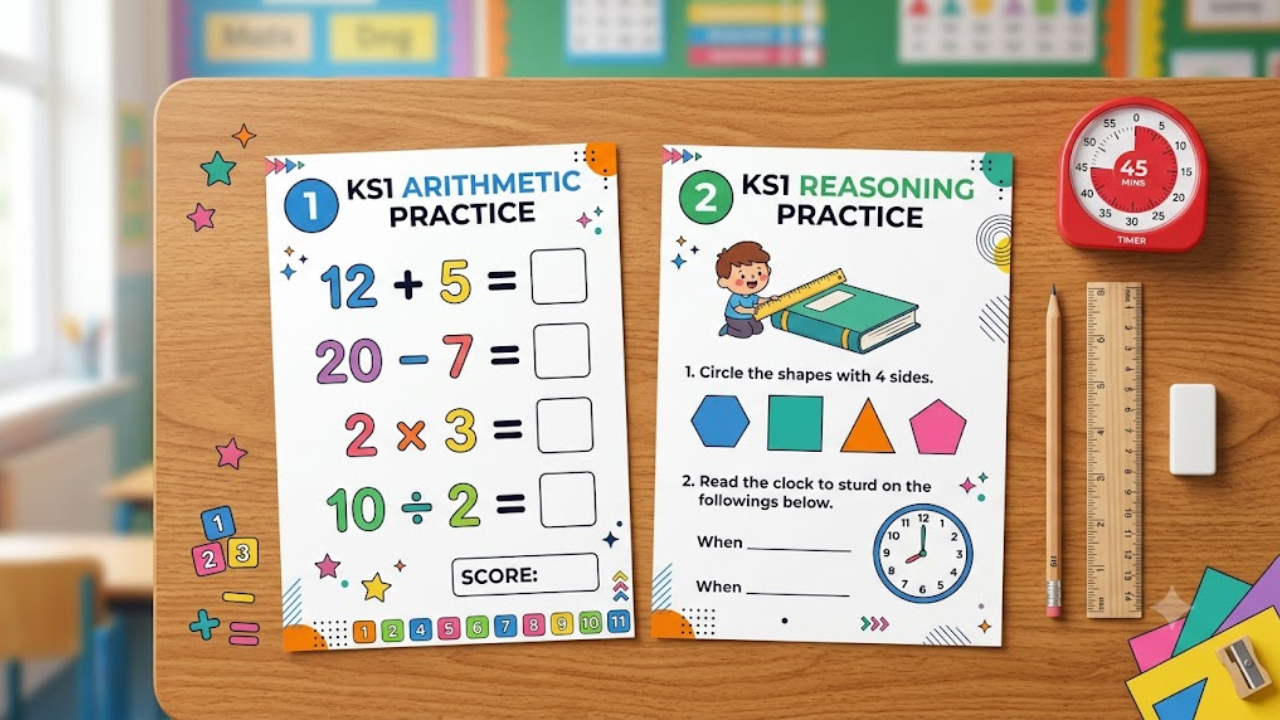
Introduction
Did you know that over 500,000 Year 2 students across England prepare for KS1 assessments each year? Whether your school calls them SATs, end-of-year tests, or just “the maths papers,” one thing’s certain—SATs papers maths KS1 can feel like a big deal. But here’s the truth: they’re simply a way to see how much you’ve learned.
In this guide, you’ll discover everything about SATs papers maths KS1—from what they are and why they matter, to where you can download free PDFs and how to use them effectively. Whether you’re a student, parent, or teacher, this article gives you the tools you need to approach these tests with confidence.
Table of Contents
-
What Are KS1 Maths SATs Papers? A Clear Introduction
-
Why Do KS1 Maths SATs Papers Matter? Key Benefits
-
KS1 Maths SATs Papers — Key Facts, Types, and How They Work
-
How To Download and Use KS1 Maths SATs Papers
-
Common Mistakes and Myths About KS1 Maths SATs
-
Expert Tips for Mastering KS1 Maths SATs Papers
-
Frequently Asked Questions
What Are KS1 Maths SATs Papers? A Clear Introduction
KS1 Maths SATs papers are official assessments taken by children in Year 2, typically around age 6–7, at the end of Key Stage 1. They measure each child’s progress in mathematics before they move on to Key Stage 2.
Think of them like a school photo for your learning. Just as a photo captures how you look at a certain age, SATs papers maths KS1 capture how well you’ve grasped key maths concepts by the end of Year 2. They’re not about passing or failing—they’re about understanding where you are and what you might need help with.
The maths test is made up of two papers: an Arithmetic Paper and a Reasoning Paper. The Arithmetic Paper checks your ability to do calculations quickly and accurately. The Reasoning Paper tests how well you can apply your maths knowledge to solve problems.
Here’s an analogy: imagine you’re learning to ride a bike. The Arithmetic Paper is like pedalling in a straight line—showing you can do the basics. The Reasoning Paper is like navigating a obstacle course—showing you can think on your feet and solve problems as they come.
Why Do KS1 Maths SATs Papers Matter? Key Benefits
Understanding SATs papers maths KS1 gives you several real advantages.
-
They show what you’ve learned. The papers cover everything you’ve studied in Year 1 and Year 2 maths—number, addition, subtraction, multiplication, division, measurement, geometry, and problem-solving. They give a clear picture of your strengths.
-
They identify areas to improve. Results help teachers spot where you might need extra support. This means you get help exactly where you need it most.
-
They build exam confidence. Practicing with past papers helps you get familiar with the format, question types, and timing. When the real test comes, you’ll know exactly what to expect.
-
They prepare you for KS2. The skills you develop while preparing for KS1 SATs—like reading questions carefully and managing your time—set you up for success in later years.
-
They’re optional but valuable. Since 2024, KS1 SATs have been non-statutory, meaning schools can choose to use them. Many still do because they provide useful information about student progress.
-
They’re free to access. Past SATs papers maths KS1 PDFs are available for free download from multiple official sources. This makes preparation accessible to everyone.
KS1 Maths SATs Papers — Key Facts, Types, and How They Work
The Two Papers Explained
Paper 1 — Arithmetic
The Arithmetic paper tests your basic calculation skills. It contains 25 questions covering addition, subtraction, multiplication, division, and fractions. Questions include single and double-digit calculations, missing number problems, and finding fractions of whole numbers—like one half of 14 or one quarter of 100.
Each question is worth 1 mark and requires you to perform calculations without context or word problems. The paper is expected to take approximately 20 minutes to complete.
Paper 2 — Reasoning
The Reasoning paper tests your ability to apply maths knowledge to solve problems. It contains around 32 questions covering number operations, place value, shape properties (like pentagons and triangular prisms), measurements (length, mass, time), money calculations, fractions, data interpretation (pictograms and block diagrams), arrays, and problem-solving.
This paper includes both aural and written questions. Some questions are read aloud to the whole class, while others require you to read and work out the answers yourself. The paper is expected to take approximately 35 minutes.
Key Facts at a Glance
| Feature | Paper 1 (Arithmetic) | Paper 2 (Reasoning) |
|---|---|---|
| Number of questions | 25 | 32 |
| Expected time | ~20 minutes | ~35 minutes |
| Question types | Pure calculations | Word problems, visual tasks |
| Topics covered | Addition, subtraction, multiplication, division, fractions | Number, shape, measurement, money, data, problem-solving |
| Marks per question | 1 mark each | Varies |
How the Tests Are Administered
Schools can administer the tests to the whole class, smaller groups, or individual pupils. The papers must be taken in order, but they don’t have to be taken on the same day.
During the Arithmetic Paper, questions can be read out loud to students who need it—but only the numbers, not the mathematical symbols. This ensures no one gets an unfair advantage. Calculators and number apparatus (like number lines or base ten materials) are not allowed. Students can use a ruler, pencil, and rubber.
How To Download and Use KS1 Maths SATs Papers
Follow these steps to get your hands on free SATs papers maths KS1 PDFs and start practicing effectively.
Step 1: Visit a trusted free download site. Head to sats-papers.co.uk, piacademy.co.uk, or satspapershub.co.uk. These sites offer official past papers from 1999 through 2026.
Step 2: Select the year you want. Choose from recent papers like 2022, 2023, 2024, 2025, or the latest 2026 papers. Each year’s pack includes the question paper, mark scheme, and administration guide.
Step 3: Download both papers. Make sure you get Paper 1 (Arithmetic) and Paper 2 (Reasoning). Some sites offer them as separate PDFs; others bundle them together.
Step 4: Print or view on screen. Print the papers for a more realistic test experience. If you’re practicing on a screen, use a separate piece of paper for your working out.
Step 5: Set a timer. Give yourself about 20 minutes for Paper 1 and 35 minutes for Paper 2. This helps you get used to working under time pressure.
Step 6: Mark your answers. Use the official mark scheme to check your work. Don’t just look at the right answer—understand why you got something wrong.
Step 7: Review and repeat. Identify the questions you found difficult. Practice those topics using other resources, then try another past paper. Regular practice builds confidence.
Common Mistakes and Myths About KS1 Maths SATs
Myth: KS1 SATs are compulsory and you can fail them.
Truth: Since 2024, KS1 SATs have been optional for schools. And there’s no pass or fail—results help teachers understand your strengths and areas for improvement. Your score is converted to a scaled score, with 100 representing the expected standard.
Mistake: Only practicing the arithmetic paper.
Truth: Both papers matter. The Reasoning paper tests different skills—problem-solving, reading comprehension, and applying maths to real situations. Neglecting it means missing half the test.
Myth: You need to buy expensive practice books.
Truth: Official SATs papers maths KS1 PDFs are available for free from multiple websites. You don’t need to spend money on practice materials.
Mistake: Rushing through questions.
Truth: Taking your time and checking your work usually leads to better results. The tests aren’t strictly timed, so you can work at your own pace.
Myth: The tests are the same every year.
Truth: While the format stays similar, the specific questions change each year. That’s why practicing with multiple years of past papers is more effective than just using one.
Expert Tips for Mastering KS1 Maths SATs Papers
Tip 1: Start early. Begin practicing 6–8 weeks before the tests. Short, regular sessions are more effective than last-minute cramming.
Tip 2: Mix paper types. Alternate between Arithmetic and Reasoning papers. This keeps your brain flexible and ensures you’re prepared for both.
Tip 3: Read questions twice. On the Reasoning paper, read each question carefully—twice if needed. Many mistakes happen because students misread what’s being asked.
Tip 4: Show your working. Even if you get the final answer wrong, showing your working can help you understand where you went wrong. It’s a learning tool, not just a test requirement.
Tip 5: Use the mark scheme. Don’t just check your score—study the mark scheme to understand what the examiners were looking for. This reveals patterns in how questions are marked.
Frequently Asked Questions
What are the SATs papers for KS1?
KS1 SATs papers are optional national assessments taken by Year 2 students (age 6–7) in England. The maths test has two papers: Arithmetic (25 questions on calculations) and Reasoning (around 32 questions on problem-solving). They measure progress before students move to Key Stage 2.
What is SATs maths paper 1?
SATs maths paper 1 is the Arithmetic paper. It contains 25 questions testing basic calculations—addition, subtraction, multiplication, division, and fractions. Each question is worth 1 mark, and the paper takes about 20 minutes to complete.
How many maths papers for SATs?
KS1 maths SATs have two papers: Paper 1 (Arithmetic) and Paper 2 (Reasoning). KS2 maths SATs have three papers: one Arithmetic paper and two Reasoning papers.
Conclusion
Let’s recap the three most important things you’ve learned about SATs papers maths KS1.
First, these tests are made up of two papers—Arithmetic and Reasoning. The Arithmetic paper checks your calculation skills, while the Reasoning paper tests your problem-solving ability.
Second, you can download free SATs papers maths KS1 PDFs from multiple websites, including past papers from 1999 through 2026. Practice with these to build confidence and familiarity.
Third, KS1 SATs are optional and there’s no pass or fail. They’re simply a tool to help teachers understand your progress and give you the support you need.
Start today. Download a free SATs papers maths KS1 PDF and try a few questions. The more you practice, the more confident you’ll feel.
Which part of the maths SATs do you find trickiest—the arithmetic calculations or the reasoning problems? Drop your answer in the comments below.