 By DSP Staff
Introduction
Picture this: You’re scrolling through social media when you stumble upon a seemingly simple math problem: 8 ÷ 2(2 + 2). The comments section is a war zone. Half the internet insists the answer is 16. The other half is equally certain it’s 1. Grown adults are arguing with strangers, mathematicians are weighing in, and somewhere, a calculator is quietly weeping.
This viral chaos isn’t just entertaining—it reveals something profound about how we learn mathematics. The culprit behind this digital firestorm? A tiny acronym that most of us learned in school and promptly forgot: BODMAS.
But here’s the uncomfortable truth: a 2024 study found that only 16% of adults fully understand the order of operations, and nearly 50% have specific misconceptions about the acronyms used to teach it. That means most of us are walking around mathematically illiterate when it comes to something as fundamental as solving basic expressions.
This article will demystify the BODMAS rule once and for all. You’ll learn exactly what it means, see it in action with real examples, understand why it matters, and—perhaps most importantly—discover why even this beloved mnemonic has its critics. By the end, you’ll never look at a mathematical expression the same way again.
Background: Where Did BODMAS Come From?
Before we dive into the nitty-gritty, let’s take a quick trip through history. The order of operations isn’t some ancient mathematical law handed down from the Greeks. It’s a convention—an agreement mathematicians made to ensure we all get the same answer when evaluating expressions.
The convention for prioritizing multiplication over addition has been around since the introduction of modern algebraic notation. But the need for a standardized order became pressing as mathematical notation grew more complex. The use of acronyms like BODMAS is believed to have started in the late 1700s to early 1800s, though the underlying conventions began emerging as early as the 1600s.
The mnemonic “My Dear Aunt Sally” (for MDAS—Multiplication, Division, Addition, Subtraction) appeared in print as early as 1935. The full PEMDAS version (“Please Excuse My Dear Aunt Sally”) gained traction in the 1980s. In the UK and Commonwealth countries, BODMAS became the standard.
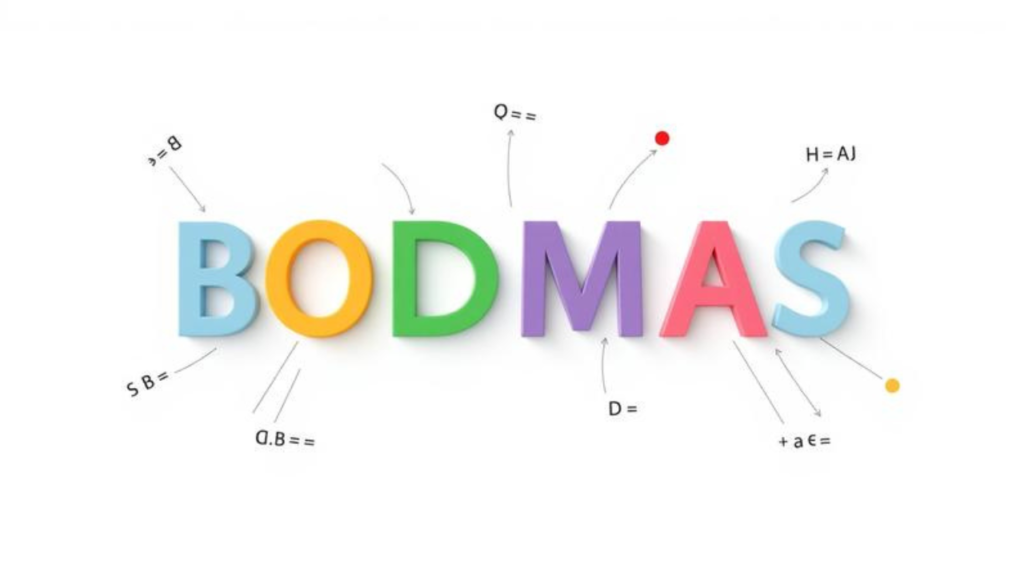
BODMAS stands for:
-
B – Brackets
-
O – Orders (powers, square roots, etc.)
-
D – Division
-
M – Multiplication
-
A – Addition
-
S – Subtraction
The “O” sometimes stands for “Of” (as in “powers of”), which explains why you might hear BODMAS pronounced as “Bod-mass” in classrooms.
What BODMAS Actually Means (And Why It Matters)
Here’s the core idea: when you have a mathematical expression with multiple operations, the order in which you perform them changes the answer.
Consider this: *2 + 3 × 4*
If you add first: (2 + 3) × 4 = 5 × 4 = 20
If you multiply first: 2 + (3 × 4) = 2 + 12 = 14
Two different answers. Which is correct? BODMAS says multiplication comes before addition, so the answer is 14.
The BODMAS Hierarchy:
-
Brackets first – Always solve what’s inside parentheses, brackets, or braces before anything else.
-
Orders next – Powers, square roots, and indices.
-
Division and Multiplication – These rank equally. Solve them from left to right as they appear.
-
Addition and Subtraction – These also rank equally. Solve them from left to right.
Let’s see this in action with a step-by-step example:
Example: 15 + (30 ÷ 2)
-
Step 1: Brackets first: 30 ÷ 2 = 15
-
Step 2: 15 + 15 = 30
xample: *3 + 6 × 2*
-
Multiplication before addition: 6 × 2 = 12, then 3 + 12 = 15
Example: (3 + 6) × 2
-
Brackets first: (3 + 6) = 9, then 9 × 2 = 18
Example: *12 ÷ 6 × 3 ÷ 2*
-
Division and multiplication rank equally, so go left to right:
-
12 ÷ 6 = 2, then 2 × 3 = 6, then 6 ÷ 2 = 3
The Trap: Where Most People Go Wrong
Despite its apparent simplicity, BODMAS trips people up constantly. Here’s why.
Misconception #1: “D comes before M, so I always divide first”
This is the most common mistake. Division and multiplication have equal priority. The acronym lists D before M, but that’s just alphabetical convenience. In reality, you perform whichever comes first when reading left to right.
Example: *30 ÷ 5 × 3*
-
Wrong (division always first): 30 ÷ 15 = 2
-
Right (left to right): 30 ÷ 5 = 6, then 6 × 3 = 18
Misconception #2: “A comes before S, so I always add first”
Same principle. Addition and subtraction have equal priority. You go left to right.
Example: *1 – 2 + 4*
-
Wrong (addition first): 1 – 6 = -5
-
Right (left to right): -1 + 4 = 3
Misconception #3: Forgetting brackets exist in different forms
Brackets aren’t just parentheses—they include square brackets [ ] and curly braces { } too. Solve from the innermost outward.
Example: [25 – 3(6 + 1)] ÷ 4 + 9
-
Innermost brackets: (6 + 1) = 7
-
Next: 3 × 7 = 21
-
Then: 25 – 21 = 4
-
Finally: 4 ÷ 4 + 9 = 1 + 9 = 10
A 2024 study found that nearly 50% of adults hold “literal” or “left-to-right” misconceptions about order of operations acronyms. You’re not alone if you’ve made these mistakes—but now you know better.
BODMAS vs PEMDAS: Same Rule, Different Name
If you’re American, you probably learned PEMDAS: Parentheses, Exponents, Multiplication, Division, Addition, Subtraction.
If you’re British, Indian, Australian, or from many other Commonwealth countries, you learned BODMAS.
Here’s the secret: they’re exactly the same.
The only difference is terminology:
-
Brackets = Parentheses
-
Orders = Exponents
In Canada, you might hear BEDMAS (Brackets, Exponents, Division, Multiplication, Addition, Subtraction). Some use BIDMAS, where “I” stands for Indices.
The order of operations is universal. The acronyms are just regional flavors.
The Critical Nuance: Whether you use PEMDAS or BODMAS, multiplication and division are always performed left to right at the same step. The same goes for addition and subtraction. The acronyms list them in a particular order, but that’s purely for memorization—not for execution.
Real-World Applications: Why This Actually Matters
You might be thinking, “When will I ever need this outside of a math class?” Fair question. Here’s the answer: constantly.
Personal Finance:
Calculating discounts, taxes, and interest rates all require order of operations. If you’re computing $100 + 10% tax × 3 items, getting the order wrong means paying the wrong amount.
Coding and Programming:
Every programming language uses order of operations. Write a formula incorrectly in Excel, SQL, or Python, and your results will be wrong.
Construction and Engineering:
Builders use formulas daily. A miscalculation in materials or measurements can be expensive—or dangerous.
Everyday Problem-Solving:
Think about splitting a restaurant bill with friends, calculating a tip, or figuring out how long a project will take. These all involve multiple operations.
One study even linked BODMAS understanding to success in competitive exams and job aptitude tests. It’s not just academic—it’s a practical life skill.
The Case Against BODMAS
Now for the plot twist. Some educators argue that BODMAS is fundamentally flawed.
The critique goes like this: BODMAS, as typically taught, implies a strict sequence—brackets first, then orders, then division, then multiplication, then addition, then subtraction. But as we’ve seen, this isn’t actually correct.
Example: *1 – 2 + 4*
A student following BODMAS literally might do addition first (because A comes before S), getting 1 – 6 = -5. The correct answer is 3.
One UK teacher describes having to “unteach” BODMAS because it creates more confusion than clarity. His department’s rule: “We never, ever use BODMAS”. They argue the acronym is misleading because it suggests a hierarchy that doesn’t exist between D/M and A/S.
The alternative? BOPS (Brackets, Orders, Products, Sums)—which more accurately reflects that multiplication/division are products done left to right, and addition/subtraction are sums done left to right.
The Nuance: The problem isn’t BODMAS itself—it’s how it’s taught. When teachers explain that D and M are equals (and A and S are equals), the rule works perfectly. The acronym isn’t wrong; it’s just incomplete without that crucial context.
Actionable Takeaways
-
Always solve brackets first. Innermost first, working outward.
-
Remember: D and M are equals. Don’t automatically divide before multiplying. Go left to right.
-
Remember: A and S are equals. Don’t automatically add before subtracting. Go left to right.
-
Write out each step. Rushing leads to mistakes. Break complex expressions into smaller pieces.
-
Use brackets for clarity. Even if they’re not strictly necessary, brackets make your intent clear and prevent ambiguity.
Frequently Asked Questions
Q1: What does BODMAS stand for?
BODMAS stands for Brackets, Orders, Division, Multiplication, Addition, and Subtraction. It’s the order in which you perform operations in a mathematical expression.
Q2: Is BODMAS the same as PEMDAS?
Yes. BODMAS is used in the UK, India, and Commonwealth countries; PEMDAS is used in the US. They represent the same order of operations.
Q3: Do I always divide before multiplying in BODMAS?
No. Division and multiplication have equal priority. You perform them from left to right as they appear in the expression.
Q4: Do I always add before subtracting in BODMAS?
No. Addition and subtraction have equal priority. You perform them from left to right as they appear.
Q5: What does the “O” in BODMAS stand for?
“O” stands for Orders—which means powers, square roots, and indices. Some teachers say it stands for “Of” (as in “powers of”).
Q6: Why do different calculators give different answers to the same problem?
Some calculators interpret expressions differently, especially with implied multiplication (like 2x vs. 2×x). Always use brackets to remove ambiguity.
Q7: Can I use BODMAS with negative numbers?
Yes. Just handle the negative sign carefully. Brackets around negative numbers help avoid confusion.
Conclusion
The BODMAS rule isn’t just a dusty mnemonic from your school days. It’s a global convention that ensures we all speak the same mathematical language. Without it, every expression would be open to interpretation—and we’d spend our days arguing about viral math problems instead of actually solving them.
But here’s the deeper lesson: BODMAS teaches us something beyond mathematics. It reminds us that order matters. In math, in life, in work—the sequence in which we do things affects the outcome. Jumping ahead, skipping steps, or misinterpreting instructions leads to different results than we intended.
The study that found only 16% of adults fully understand the order of operations isn’t a condemnation—it’s a call to action. Mathematics is a skill, not a genetic gift. With practice and the right understanding, anyone can master it.
So next time you see a multi-operation expression, take a breath. Remember your brackets. Remember that D and M are equals, A and S are equals. Work left to right. And smile—because you’re now part of the 16%.
The next time a viral math problem breaks the internet, you’ll not only know the answer—you’ll understand why everyone else is arguing. And that, dear reader, is a superpower worth having.