 By DSP Staff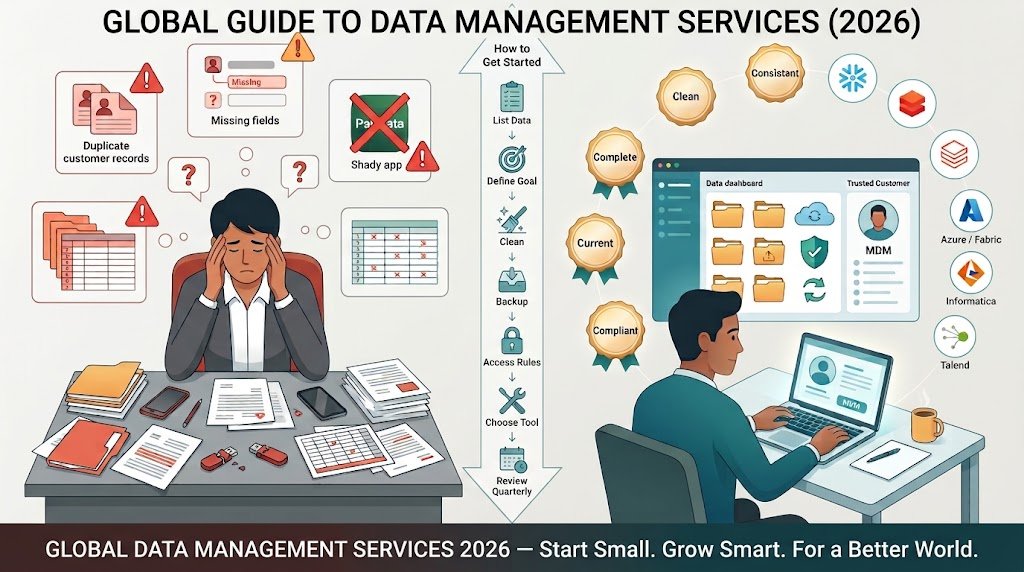
Imagine losing your phone and finding that every photo, contact, and file has vanished with no backup. Now picture a company losing its customer records the same way. That is why data management services exist, and why they matter to students, shop owners, freelancers, and large companies alike.
Data management services help you collect, store, clean, protect, and use information without chaos. In 2026, almost every job, business, and government office depends on them. Yet most people have never had a simple explanation.
In this guide, you will learn what these services are, why they matter, and which tools lead the market. You will also see how to get started step by step, whether you are in Pakistan or anywhere else. We also answer common questions, such as whether MDM is a good career and what the 5 C’s of data management are.
Table of Contents
- What Are Data Management Services?
- Why Do Data Management Services Matter?
- Data Management Services: Types, Tools, and the 5 C’s
- How to Get Started With Data Management in 2026
- Common Mistakes and Myths to Avoid
- Expert Tips for Best Results
- Frequently Asked Questions
- Final Thoughts
What Are Data Management Services?
Data management services are the tools, people, and processes that organize information so you can find it, trust it, and use it. They cover everything from saving files safely to cleaning messy spreadsheets and protecting private details.
Think of a big library. Books are your raw data. The librarian sorts them, labels them, repairs damaged ones, and keeps them safe. Data management services do the same job for digital information.
Without that librarian, you would have a pile of books on the floor. You might own great information, but you could never find the page you need.
These services usually include data storage, data integration, data quality checks, backup and recovery, security, and governance. Companies such as Microsoft, Oracle, and IBM sell them. Local firms in Pakistan also offer them, often with a focus on small and mid-sized businesses.
Why Do Data Management Services Matter?
Good data management saves money, time, and stress. Here are the main benefits you get:
- Better decisions: Clean, accurate data shows you what is really happening in your business.
- Lower costs: You stop paying for duplicate records, lost files, and repeated work.
- Stronger security: Proper controls keep sensitive information away from the wrong hands.
- Faster work: Your team finds what it needs in seconds instead of hours.
- Legal safety: Rules about personal data keep growing, and compliance protects you from fines.
- Smarter AI: AI tools only work well when you feed them high-quality data.
The numbers back this up. Gartner estimates that poor data quality costs organizations an average of $12.9 million per year. Even a small shop loses real money when customer lists are wrong or stock records do not match.
Data Management Services: Types, Tools, and the 5 C’s
The Main Types of Data Management
Every service falls into one of a few groups. Here is a quick summary table:
| Type | What It Does | Simple Example |
|---|---|---|
| Data Storage | Keeps data in databases or the cloud | Saving sales records online |
| Data Integration | Combines data from many sources | Merging website and shop sales |
| Data Quality | Fixes errors and duplicates | Removing repeated customer names |
| Master Data Management (MDM) | Creates one trusted record per person or product | One customer profile across all apps |
| Data Security | Protects data from theft or loss | Encryption and backups |
| Data Governance | Sets rules about who can use what | Access levels for staff |
What Is MDM, and Is It a Good Career?
Master Data Management (MDM) keeps your most important data, like customers, products, and suppliers, accurate and consistent everywhere. Yes, MDM is a good career. Banks, telecom companies, hospitals, and retailers all need people who can manage clean data, and these roles often pay well. You can start with SQL, Excel, and data modeling, then grow into specialist roles.
The Top 5 Data Management Tools
Here are five tools you will see most often in 2026:
- Snowflake: a cloud data platform that is easy to scale.
- Databricks: strong for big data and AI projects.
- Microsoft Azure Data Factory / Fabric: great if your team already uses Microsoft products.
- Informatica: a long-time leader in data quality and MDM.
- Talend (Qlik Talend): flexible data integration with open-source roots.
You do not need all five. Pick one that matches your budget, team size, and goals.
The 5 C’s of Data Management
Different experts list slightly different versions. A popular one is simple to remember:
- Clean: free of errors and duplicates.
- Consistent: the same facts appear the same way everywhere.
- Complete: no important fields are missing.
- Current: updated often enough to be useful.
- Compliant: it follows privacy laws and company rules.
Check your data against these five words, and you will spot most problems quickly.
Data Management Services in Pakistan
Searches like “data management services Pakistan” and “Pakistan data service” are growing fast. Local software houses, IT consultancies, and cloud partners now offer database setup, cloud migration, backup, and analytics for Pakistani businesses. When you compare providers, ask about security, support hours, and whether they follow data protection rules.
Be careful with names that look similar. Some people search for “Pak Data APK,” “PakData app download,” or “PakData CNIC” expecting a business tool. Many of these apps claim to show personal details tied to a CNIC or SIM. They are not professional data management services, and they raise serious privacy and legal concerns.
How to Get Started With Data Management in 2026
You do not need a huge budget. Follow these steps:
- List your data. Write down every place you keep information, such as spreadsheets, phones, apps, and paper files. You cannot manage what you cannot see.
- Define your goal. Do you want fewer errors, faster reports, better security, or all three? A clear goal keeps you from buying tools you will never use.
- Clean what you have. Remove duplicates, fix spelling, and fill missing fields. Even a free tool like Google Sheets or Excel can handle this for a small business.
- Choose a storage and backup plan. Move important files to a trusted cloud service and follow the 3-2-1 backup rule: three copies, two types of storage, one copy offsite. Test your restore process at least once.
- Set access rules. Decide who can view, edit, or delete each type of data. Give people only the access they need for their job.
- Pick a service or tool. Compare two or three providers by price, support, and ease of use. Ask for a free trial before you commit.
- Review every quarter. Check your data against the 5 C’s and update your rules. Good data management is a habit, not a one-time project.
Common Mistakes and Myths to Avoid
- Myth: “Data management is only for big companies.” Truth: a one-person online shop with messy customer lists has the same problems. Small teams often benefit the most.
- Mistake: Skipping backups. Hard drives fail and phones get stolen. One working backup can save your whole business.
- Mistake: Buying tools before fixing the process. An expensive platform will not fix bad habits. Clean your data and set rules first.
- Myth: “Cloud storage is automatically safe.” Truth: the cloud is only as safe as your passwords and access settings. Use strong passwords and two-factor login.
- Mistake: Using shady apps to look up personal data. Tools that promise CNIC or SIM details can expose you to malware, scams, and legal trouble. Real data management respects privacy.
Expert Tips for Best Results
- Name files and fields consistently. A simple naming rule saves hours of searching later.
- Automate repeat tasks. Scheduled backups and data cleaning scripts remove human error.
- Start small and grow. Fix one problem, like customer records, before you tackle everything.
- Train your team. The best system fails if people enter data carelessly.
- Document your rules. One shared page that explains who owns what data keeps everyone aligned.
Frequently Asked Questions
What are data management services?
Data management services are tools and support that help you store, organize, clean, secure, and use information. They include databases, backups, integration, quality checks, and governance. Businesses use them to make better decisions, avoid data loss, and follow privacy rules. You can buy them from a provider or build a simple version yourself using cloud tools and spreadsheets.
Is MDM a good career?
Yes, MDM is a good career in 2026. Master Data Management specialists help companies keep customer and product records accurate across systems. Demand is steady in banking, telecom, healthcare, and retail. You can begin with SQL, Excel, and data modeling, then add tools like Informatica or Talend. Many professionals later move into data governance or architecture roles.
Is the PakData app a safe data management tool?
No. Apps like “PakData” that promise CNIC or SIM details are not data management tools, and they carry privacy, legal, and malware risks. APK files from unknown websites are especially risky. If you need a real solution for your business, choose a reputable provider or a well-known cloud platform with clear security policies.
Final Thoughts
Data management services turn scattered information into something you can trust. Remember three things. First, clean, consistent, complete, current, and compliant data beats a big pile of messy data. Second, you can start small with a simple backup plan and a clean spreadsheet. Third, avoid shortcuts like unofficial apps, because real data management protects people’s privacy.
Start today: list where your data lives and fix one problem this week. Small steps add up fast.
Which data problem frustrates you most right now: messy records, lost files, or choosing the right tool? Tell us in the comments!