 By DSP Staff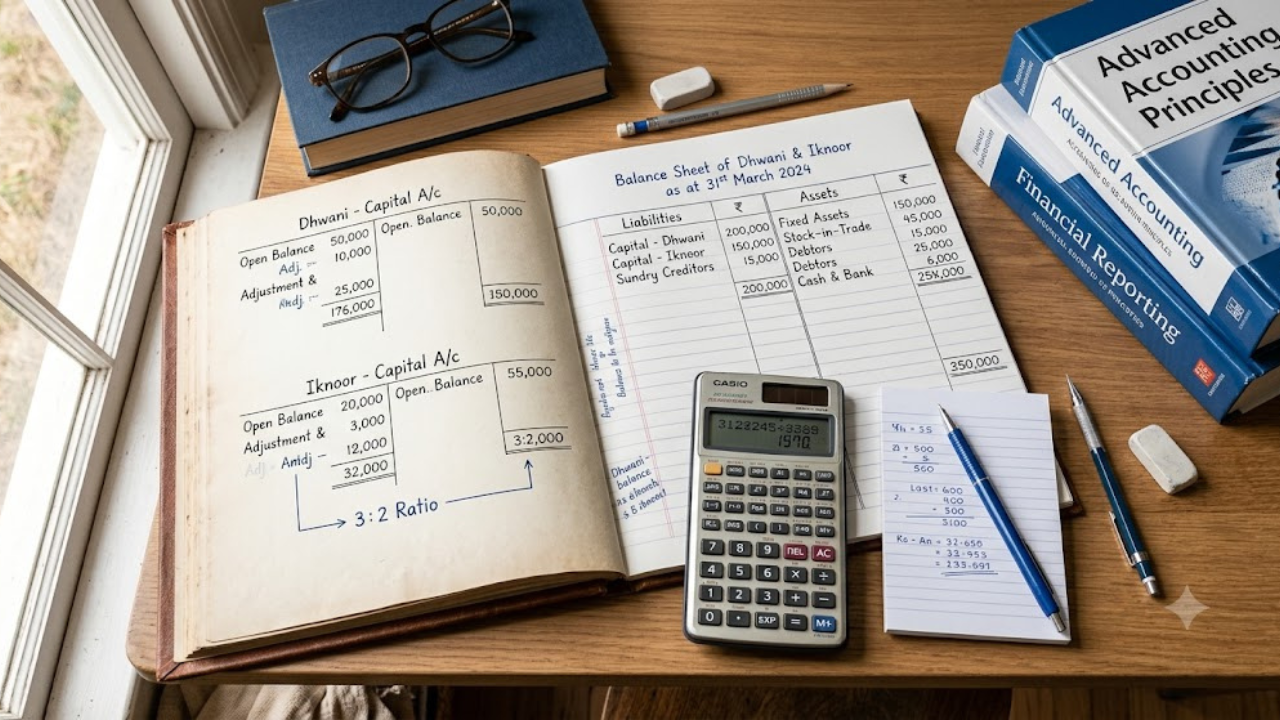
Introduction
Imagine you and a friend start a business together. You agree to split the profits in a specific ratio. Now, imagine bringing in a third person to expand the business. Suddenly, everything changes—assets need revaluing, goodwill must be calculated, and capital accounts get messy. This is exactly the scenario when Dhwani and Iknoor were partners sharing profits in the ratio 3:2 and decided to admit Ishaya into their firm.
This classic accounting problem appears in almost every Class 12 Accountancy exam. If you’re preparing for your boards or simply want to master partnership accounting, you’ve come to the right place. In this guide, you’ll learn the complete step‑by‑step solution to the Dhwani and Iknoor were partners sharing profits problem. You’ll understand revaluation accounts, goodwill treatment, partner capital adjustments, and how to handle provisions like doubtful debts. By the end, you’ll be able to solve similar problems with confidence.
Table of Contents
-
What Is the Dhwani and Iknoor Partnership Problem?
-
Why Does This Partnership Problem Matter for Students?
-
Partnership Accounting – Key Concepts and How They Apply
-
How to Solve the Dhwani and Iknoor Problem Step‑by‑Step
-
Common Mistakes and Myths to Avoid
-
Expert Tips for Acing Partnership Accounting
-
Frequently Asked Questions
-
Conclusion
What Is the Dhwani and Iknoor Partnership Problem?
Dhwani and Iknoor were partners sharing profits and losses in the ratio of 3:2 as of March 31, 2025. Their Balance Sheet showed Dhwani’s capital at ₹2,40,000 and Iknoor’s at ₹2,60,000, with total liabilities and assets of ₹7,50,000. On that date, they admitted Ishaya as a new partner for a 25% share in the firm. Ishaya brought ₹2,50,000 as capital and ₹40,000 for goodwill. The firm’s goodwill was valued at ₹2,00,000.
Think of it like this: Dhwani and Iknoor are running a bakery together. Dhwani owns 60% of the business, Iknoor owns 40%. They decide to bring in Ishaya, a master pastry chef, who will own 25% of the bakery. To make this fair, they need to revalue their ovens, ingredients, and other assets, adjust their capital accounts, and figure out how much Ishaya should pay for his share of the bakery’s reputation (goodwill). This problem tests your ability to handle all these accounting adjustments.
Why Does This Partnership Problem Matter for Students?
This problem isn’t just a random exam question—it’s a cornerstone of partnership accounting. Here’s why it’s essential for your studies:
-
Tests Multiple Concepts: It combines revaluation, goodwill, capital adjustment, and reserve distribution—all in one question.
-
Real‑World Application: Partnerships are common in small businesses, law firms, and medical practices. Understanding these adjustments prepares you for real accounting scenarios.
-
High Exam Weightage: Problems like this frequently appear in Class 12 board exams and competitive commerce tests. According to CBSE trends, partnership admission questions account for 15–20% of the total marks in the Accountancy paper.
-
Builds Logical Thinking: Solving this problem requires step‑by‑step reasoning, from calculating revaluation losses to adjusting partner capital accounts.
-
Foundation for Advanced Topics: Mastering this problem prepares you for retirement, death, and dissolution of partnership firms—all of which build on the same principles.
Partnership Accounting – Key Concepts and How They Apply
Understanding the Dhwani and Iknoor were partners sharing profits problem requires mastering a few key accounting concepts. Let’s break them down.
Revaluation Account
When a new partner joins, the firm revalues all assets and liabilities to reflect their true worth. Any gain or loss goes to the Revaluation Account. In this problem, the firm faced a net loss of ₹90,000. This loss is shared by Dhwani and Iknoor in their old ratio of 3:2.
Goodwill Treatment
Goodwill is the premium a new partner pays for the firm’s reputation. Ishaya brought ₹40,000 for goodwill. This amount is credited to the old partners in their sacrificing ratio—the ratio in which they give up their share of profits.
Reserves and Accumulated Profits
Reserves like Investment Fluctuation Reserve (₹50,000), General Reserve (₹60,000), and Profit & Loss A/c (₹1,00,000) are distributed to old partners before admission. These are shared in the old profit‑sharing ratio.
Capital Adjustment
The new partner’s capital contribution determines the new capital structure. Ishaya brought ₹2,50,000 for a 25% share, meaning the total capital of the new firm should be ₹10,00,000. Dhwani’s and Iknoor’s capitals are adjusted accordingly, with differences transferred to their Current Accounts.
Summary Table: Key Adjustments
| Adjustment | Amount (₹) | Sharing Ratio | Affected Partners |
|---|---|---|---|
| Revaluation Loss | 90,000 | 3:2 | Dhwani, Iknoor |
| Goodwill brought in | 40,000 | 3:2 (sacrificing) | Dhwani, Iknoor |
| Investment Fluctuation Reserve | 50,000 | 3:2 | Dhwani, Iknoor |
| General Reserve | 60,000 | 3:2 | Dhwani, Iknoor |
| Profit & Loss A/c | 1,00,000 | 3:2 | Dhwani, Iknoor |
How to Solve the Dhwani and Iknoor Problem Step‑by‑Step
Follow these six steps to solve the Dhwani and Iknoor were partners sharing profits problem accurately.
-
Prepare the Revaluation Account: Start by identifying all changes in asset and liability values. Write off bad debts of ₹5,000. Decrease provision for doubtful debts from ₹8,000 to ₹7,500 (a gain of ₹500). Reduce investments from ₹1,20,000 to ₹1,00,000 (a loss of ₹20,000). Write off accrued income not recovered (₹5,500 loss). Reduce building by 20% (₹60,000 loss). The net loss is ₹90,000, shared by Dhwani (₹36,000) and Iknoor (₹24,000).
-
Distribute Reserves and Accumulated Profits: Transfer the Investment Fluctuation Reserve (₹50,000), General Reserve (₹60,000), and Profit & Loss A/c (₹1,00,000) to the old partners in their old ratio of 3:2. Dhwani gets ₹1,26,000 and Iknoor gets ₹84,000.
-
Record Goodwill: Ishaya brings ₹40,000 for goodwill. Calculate the sacrificing ratio: Dhwani sacrifices 15% (0.15) and Iknoor sacrifices 10% (0.10), giving a ratio of 3:2. Credit Dhwani with ₹24,000 and Iknoor with ₹16,000.
-
Open Partners’ Capital Accounts: Start with the opening capitals—Dhwani ₹2,40,000 and Iknoor ₹2,60,000. Debit each partner’s share of revaluation loss. Credit each partner’s share of reserves and goodwill.
-
Adjust Capitals Based on Ishaya’s Contribution: Ishaya brings ₹2,50,000 for a 25% share. Total capital of the new firm should be ₹10,00,000. Dhwani’s new capital should be ₹4,50,000 (45% of ₹10,00,000) and Iknoor’s should be ₹3,00,000 (30% of ₹10,00,000). Compare these with their adjusted capitals and transfer the difference to their Current Accounts.
-
Prepare the Final Balance Sheet: After all adjustments, prepare the new Balance Sheet with the updated capital balances and asset values. This confirms that all debits equal credits.
Common Mistakes and Myths to Avoid
Even bright students make errors in this problem. Here are the most common ones—and how to avoid them.
-
Mistake: Using the new ratio for revaluation losses.
Truth: Revaluation losses and profits are always shared in the old ratio (3:2), not the new ratio. The new ratio only applies after admission. -
Mistake: Forgetting to adjust reserves and accumulated profits.
Truth: All reserves and the Profit & Loss A/c balance must be distributed to old partners before admission. Ignoring this step will give you wrong capital figures. -
Mistake: Confusing sacrificing ratio with old ratio for goodwill.
Truth: Goodwill brought in by the new partner is credited to old partners in their sacrificing ratio, not their old profit‑sharing ratio. Calculate sacrifice as old share minus new share. -
Mistake: Incorrectly calculating provision for doubtful debts.
Truth: Always calculate the new provision based on the revised debtors after writing off bad debts. In this problem, debtors reduce from ₹80,000 to ₹75,000, and the provision drops from ₹8,000 to ₹7,500. -
Mistake: Overlooking the Current Account adjustment.
Truth: When capitals are adjusted based on the new partner’s contribution, any surplus or deficit goes to the partners’ Current Accounts, not to cash or bank.
Expert Tips for Acing Partnership Accounting
Mastering problems like Dhwani and Iknoor were partners sharing profits takes practice. Here are five tips to help you excel:
-
Always start with the Revaluation Account: It sets the foundation for all subsequent adjustments. Get this right, and the rest follows.
-
Memorize the order of adjustments: Revaluation → Reserves → Goodwill → Capital Adjustment. Following this sequence prevents confusion.
-
Use T‑accounts for clarity: Drawing ledger accounts for each partner helps you visualize debits and credits, reducing errors.
-
Double‑check your ratios: Whether it’s old, new, or sacrificing ratio—one wrong ratio ruins the entire solution.
-
Practice with variations: Try similar problems like Raju, Rinku and Munni were partners sharing profits in the ratio 3:1:1. The more variations you solve, the better you’ll understand the core concepts.
Frequently Asked Questions
What is the profit‑sharing ratio of Dhwani and Iknoor?
Dhwani and Iknoor were partners sharing profits and losses in the ratio of 3:2. This means Dhwani receives 60% of the profits or losses, and Iknoor receives 40%.
Why is a Revaluation Account prepared when a new partner is admitted?
A Revaluation Account is prepared to record changes in the value of assets and liabilities at the time of admission. It ensures that old partners are not unfairly burdened with losses or gains that occurred before the new partner joined.
How is goodwill treated when a new partner brings cash for it?
When a new partner brings cash for goodwill, the amount is credited to the old partners’ Capital Accounts in their sacrificing ratio. In this problem, Ishaya’s ₹40,000 goodwill was shared by Dhwani (₹24,000) and Iknoor (₹16,000).
Conclusion
The Dhwani and Iknoor were partners sharing profits problem is a classic example of partnership admission accounting. You’ve learned the three most important takeaways: revaluation adjustments must be made in the old ratio, reserves and goodwill are distributed before admission, and capital accounts are adjusted based on the new partner’s contribution. Mastering this problem gives you a strong foundation for tackling more complex partnership scenarios.
Start practicing this problem today—draw the Revaluation Account, prepare the Capital Accounts, and verify your balances. The more you practice, the more confident you’ll become. And remember, every accounting master started exactly where you are now.
What’s the one concept in this problem that still feels tricky to you? Drop your question in the comments below!