 By DSP Staff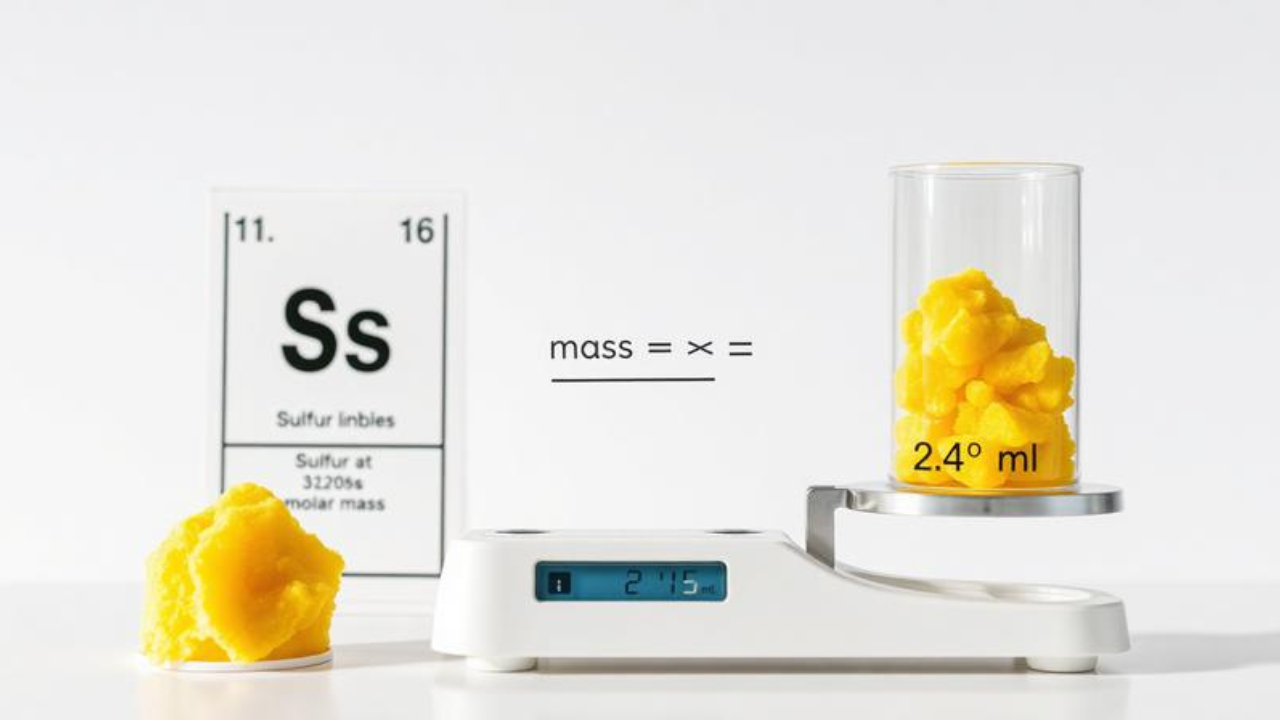
Introduction
You’re staring at a chemistry problem, and it’s asking: “How many grams are in 2.4 moles of sulfur?” It seems simple enough, but if you’re not sure how to connect the dots between moles and grams, even a straightforward question can feel overwhelming.
Here’s the problem many students and professionals face: chemistry problems often assume you already know how to use molar mass as a conversion tool. But if you’re new to stoichiometry or just need a refresher, you might find yourself stuck—unsure where to find the right number or how to do the multiplication correctly.
This article delivers exactly what you need: a clear, step-by-step answer to how many grams are in 2.4 moles of sulfur, plus a complete explanation of the concept behind the calculation. You’ll learn what a mole is, why molar mass matters, how to find it on the periodic table, and how to avoid the most common mistakes. By the end, you won’t just have the answer—you’ll understand the chemistry behind it.
What Is a Mole and Why Does It Matter?
Before we can answer how many grams are in 2.4 moles of sulfur, we need to understand what a “mole” actually is.
The Mole: Chemistry’s Counting Unit
In everyday life, we use counting units like “dozen” (12 items) or “gross” (144 items). In chemistry, the mole is the standard counting unit for atoms, molecules, and other particles. One mole is defined as exactly 6.022 × 10²³ particles—a number known as Avogadro’s number.
Why such a strange number? Because 6.022 × 10²³ atoms of carbon-12 weigh exactly 12 grams. This connection between number of particles and mass in grams is what makes the mole so useful in chemistry.
Molar Mass: The Bridge Between Moles and Grams
The molar mass of a substance is the mass of one mole of that substance, expressed in grams per mole (g/mol). For elements, the molar mass is numerically equal to the atomic mass you see on the periodic table.
For sulfur (chemical symbol S), the atomic number is 16, and its standard atomic weight is approximately 32.065 g/mol. This means:
One mole of sulfur atoms has a mass of 32.065 grams.
Different sources may list sulfur’s molar mass slightly differently—32.06 g/mol, 32.065 g/mol, or 32.07 g/mol—depending on the level of precision. For most calculations, 32.07 g/mol is perfectly acceptable.
The Elemental Form of Sulfur
It’s worth noting that sulfur naturally exists as S₈ molecules (eight sulfur atoms bonded together), not as individual S atoms. However, when chemists talk about “moles of sulfur” in stoichiometry problems, they typically mean moles of sulfur atoms (S) unless otherwise specified. The molar mass of atomic sulfur is 32.065 g/mol, while the molar mass of S₈ would be 8 × 32.065 = 256.52 g/mol. For the problem at hand—”2.4 moles of sulfur”—we’re working with atomic sulfur.
Why Knowing This Conversion Matters
Understanding how to convert moles to grams isn’t just about passing a test. It’s a fundamental skill that applies to real-world chemistry in countless ways.
1. Laboratory Work and Experiments
When you’re in a chemistry lab, you can’t count out individual atoms or molecules. Instead, you weigh substances on a balance. But chemical reactions happen on a molecular scale—they depend on the number of molecules, not their weight. The mole-to-gram conversion lets you weigh out the exact number of molecules you need for a reaction.
If a reaction calls for 2.4 moles of sulfur, you need to know that’s 76.97 grams so you can weigh it out correctly.
2. Stoichiometry and Reaction Yields
In chemical equations, coefficients represent moles. For example, the reaction S + O₂ → SO₂ tells us that 1 mole of sulfur reacts with 1 mole of oxygen to produce 1 mole of sulfur dioxide. If you have 2.4 moles of sulfur, you know exactly how much product you can make—and how much of each reactant you need.
3. Pharmaceutical and Industrial Applications
From fertilizer production to pharmaceutical manufacturing, chemists routinely convert between moles and grams. Sulfur is used in the production of sulfuric acid (the most widely produced industrial chemical), rubber vulcanization, and agricultural fungicides. Getting the conversion wrong can mean wasted materials, failed reactions, or even safety hazards.
4. Building Chemistry Intuition
Learning to convert moles to grams builds your understanding of the scale of atoms. A mole of sulfur weighs about 32 grams—about the weight of a AA battery. But that same mole contains 602 sextillion atoms. This perspective helps you appreciate just how tiny atoms really are.
Step-by-Step: How to Calculate Grams in 2.4 Moles of Sulfur
Now let’s get to the heart of the matter. Here’s how to calculate the answer, step by step.
Step 1: Identify What You’re Given
You have 2.4 moles of sulfur (S).
Step 2: Find the Molar Mass of Sulfur
Look at the periodic table. Sulfur (S) has an atomic mass of approximately 32.065 g/mol. For this calculation, we’ll use 32.07 g/mol for simplicity.
Step 3: Apply the Conversion Formula
The formula to convert moles to grams is:
Mass (grams) = Moles × Molar Mass (g/mol)
Plug in your values:
Mass = 2.4 mol × 32.07 g/mol
Step 4: Multiply
Mass = 2.4 × 32.07 = 76.968 grams
Step 5: Round to Appropriate Significant Figures
The given value (2.4 moles) has two significant figures. Therefore, the answer should be rounded to two significant figures:
76.97 g (or 77 g if rounded to two sig figs)
The Short Answer
There are approximately 76.97 grams of sulfur in 2.4 moles of sulfur.
Different sources may give slightly different results depending on the molar mass used:
| Molar Mass Used | Calculation | Result |
|---|---|---|
| 32.00 g/mol | 2.4 × 32.00 | 76.80 g |
| 32.065 g/mol | 2.4 × 32.065 | 76.956 g |
| 32.066 g/mol | 2.4 × 32.066 | 76.958 g |
| 32.07 g/mol | 2.4 × 32.07 | 76.968 g |
All are correct within rounding. For most purposes, 77 grams is the right answer.
Common Mistakes to Avoid
Converting moles to grams seems simple, but there are several pitfalls that can trip you up. Here are the most common mistakes—and how to avoid them.
Mistake 1: Using the Wrong Molar Mass
The Problem: You might accidentally use the molar mass of a compound instead of the element. For example, sulfur dioxide (SO₂) has a molar mass of about 64.06 g/mol—nearly double that of sulfur alone.
The Fix: Always check what substance you’re working with. If the problem says “sulfur (S),” use the atomic mass of sulfur. If it says “sulfur dioxide (SO₂)” or “sulfur hexafluoride (SF₆),” use the molar mass of that compound.
Mistake 2: Confusing Atomic Sulfur with S₈
The Problem: Sulfur naturally exists as S₈ molecules. Some students mistakenly use the molar mass of S₈ (256.52 g/mol) when the problem asks for moles of sulfur atoms.
The Fix: Read the problem carefully. “Moles of sulfur” almost always means moles of sulfur atoms (S) unless the problem explicitly says “moles of S₈ molecules.”
Mistake 3: Forgetting to Multiply
The Problem: Some students divide instead of multiply, or they forget to include the molar mass entirely.
The Fix: Remember the formula: Mass = Moles × Molar Mass. If you’re going from moles to grams, you multiply. If you’re going from grams to moles, you divide.
Mistake 4: Ignoring Significant Figures
The Problem: Your given value has two significant figures (2.4), but you report an answer with five decimal places (76.96800 g).
The Fix: Your answer should have the same number of significant figures as the least precise measurement in your calculation. Since 2.4 has two significant figures, round your answer to two significant figures: 77 g.
Mistake 5: Using an Outdated or Inaccurate Periodic Table
The Problem: Different periodic tables may list slightly different atomic masses. Using 32.00 instead of 32.07 changes your answer by about 0.2%.
The Fix: Use a reliable source. The standard atomic weight of sulfur is 32.065, with a range of [32.059, 32.076] depending on isotopic composition. For most classroom calculations, 32.07 g/mol is perfectly acceptable.
Mistake 6: Misplacing the Units
The Problem: You forget to include units in your calculation, leading to confusion about whether your answer is in grams, kilograms, or something else.
The Fix: Always write out your units. The calculation should look like this:
2.4 mol × 32.07 g/mol = 76.97 g
The “mol” units cancel out, leaving you with grams. This is called dimensional analysis, and it’s one of the most powerful tools in chemistry.
FAQs About Moles and Grams of Sulfur
1. How many grams are in 2.4 moles of sulfur?
Answer: Approximately 76.97 grams (or 77 grams when rounded to two significant figures). This is calculated by multiplying 2.4 moles by the molar mass of sulfur, which is 32.07 g/mol.
2. What is the molar mass of sulfur?
Answer: The molar mass of sulfur (S) is approximately 32.065 g/mol. For most calculations, 32.06 g/mol or 32.07 g/mol is used. The standard atomic weight of sulfur is [32.059, 32.076].
3. Why do different sources give slightly different answers?
Answer: The atomic mass of sulfur varies slightly depending on the isotopic composition of the sample. Sulfur has several stable isotopes, and the “standard” atomic weight is an average. Additionally, some sources round to different numbers of decimal places (32.06 vs. 32.07 vs. 32.065). All these variations are within acceptable tolerance for most calculations.
4. Is the molar mass of sulfur the same as the molar mass of sulfur dioxide?
Answer: No. Sulfur (S) has a molar mass of about 32.07 g/mol. Sulfur dioxide (SO₂) has a molar mass of about 64.06 g/mol because it includes one sulfur atom and two oxygen atoms. Always make sure you’re using the molar mass of the correct substance.
5. How do I convert grams to moles?
Answer: To convert grams to moles, use the formula: Moles = Mass (grams) ÷ Molar Mass (g/mol). For example, if you have 76.97 grams of sulfur, you would divide by 32.07 g/mol to get 2.4 moles.
6. What is Avogadro’s number, and why is it important?
Answer: Avogadro’s number is 6.022 × 10²³, the number of particles (atoms, molecules, ions, etc.) in one mole of a substance. It’s important because it connects the microscopic world of atoms to the macroscopic world of grams that we can measure in a lab.
7. How many atoms are in 2.4 moles of sulfur?
Answer: To find the number of atoms, multiply the number of moles by Avogadro’s number:
2.4 mol × 6.022 × 10²³ atoms/mol = 1.445 × 10²⁴ atoms of sulfur.
Conclusion
So, how many grams are in 2.4 moles of sulfur? The answer is approximately 76.97 grams—or about 77 grams when rounded to two significant figures.
But more importantly, you now understand why that’s the answer. You know that the mole is chemistry’s counting unit, that molar mass is the bridge between moles and grams, and that the periodic table is your go-to source for atomic masses. You’ve learned the step-by-step calculation, seen the common mistakes to avoid, and explored why this conversion matters in real-world chemistry.
Whether you’re a student preparing for an exam, a professional working in a lab, or just someone curious about how chemistry works, mastering the mole-to-gram conversion is an essential skill. It’s the foundation of stoichiometry, the language of chemical reactions, and the key to understanding how matter behaves at the molecular level.
The next time you’re faced with a moles-to-grams problem, you’ll know exactly what to do: find the molar mass, multiply, and round with confidence.
If you found this guide helpful, you might also enjoy our articles on [how to convert grams to moles] or [understanding stoichiometry step by step]. Subscribe to our newsletter for more chemistry guides, problem-solving tips, and exam preparation resources delivered straight to your inbox.