 By DSP Staff
INTRODUCTION
Thomas Edison was labeled “addled” by his teacher. Albert Einstein was deemed “slow” in childhood. And Chen Zhangxing, a renowned physicist, scored just 10 out of 100 on his English exam for China’s college entrance test. If today’s standards had been applied, these names might never have made it past high school.
Here’s the uncomfortable truth that nobody tells you: learning speed has no correlation with ultimate success.
In any classroom, some students grasp concepts instantly while others need to chew on them for a while. Educational researchers use a simple metaphor: if knowledge is water, fast learners are buckets, while slower learners are narrow-mouthed bottles—same capacity, different flow rate.
A 2022 study published in Nature found that individuals with lower general cognitive ability actually showed larger improvements from structured learning interventions than those with higher ability. In other words: slower learners often gain more from good study strategies.
But here’s the challenge: most study advice is written for fast learners. It assumes you can skim a chapter once and absorb it. It assumes you can sit for hours without needing a break. t assumes “slower” means “less capable”—which is a lie.
This article is different. It’s written for the student who takes longer to process, needs more repetition, or simply learns differently. By the time you finish reading, you’ll understand that being a slow learner isn’t a weakness—it’s just a different rhythm. And with the right strategies, that rhythm can take you further than you ever imagined.
The Slow Learner Myth
Let’s start by busting a dangerous myth: slow learning is NOT the same as low intelligence.
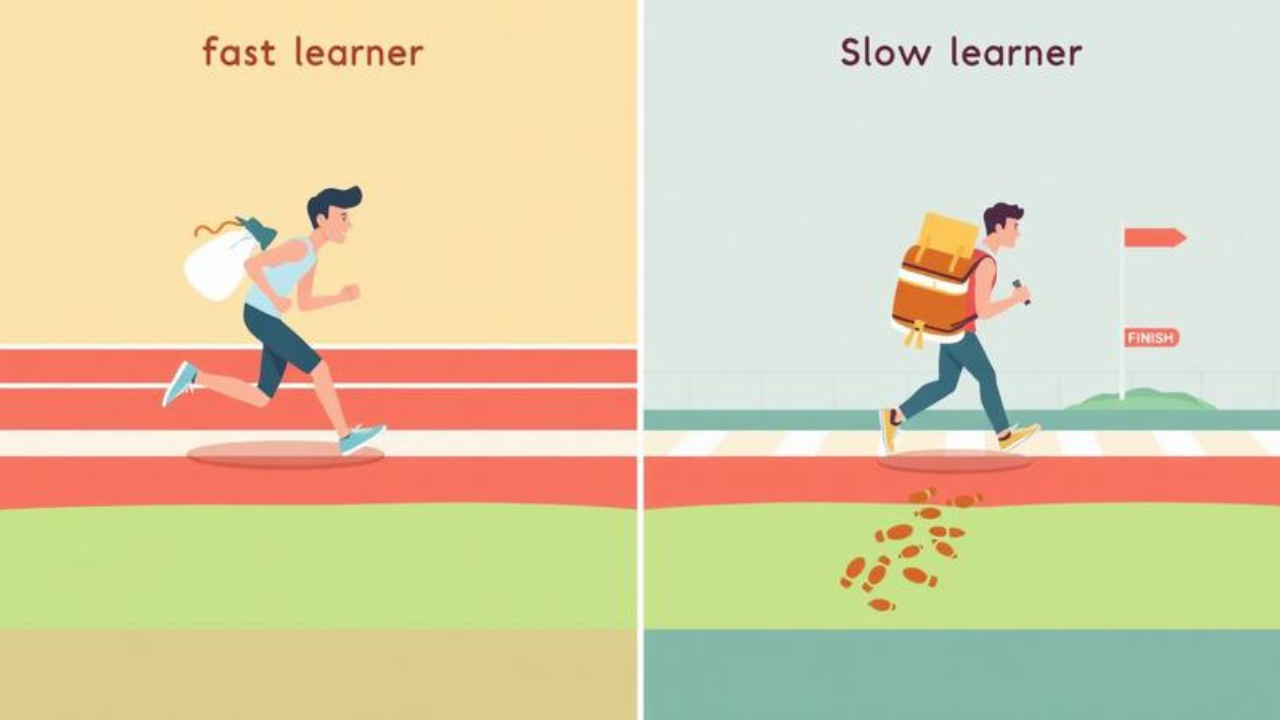
According to Verywell Mind, slow processing speed is a neurological difference, not a deficit. It affects how quickly your brain takes in, understands, and responds to information. Some people’s brains process information like a race car on a track. Others process like a train—slower to start, but powerful, steady, and capable of carrying immense weight.
The key insight from educational psychology is that processing speed and learning capacity are entirely separate things. You can have a brilliant mind that simply takes more time to digest information.
Dr. Ellen Braaten, a psychologist at Harvard Medical School, explains that slow processing speed often gets mistaken for laziness or lack of intelligence—especially in school settings. But the reality is that many children with slow processing speed “know more than they can show in a given time.”
Why This Matters Now
We live in an age of speed. Everything is measured in speed. Reading speed. Problem-solving speed. How fast you can finish a test. This cultural obsession with speed has created a crisis for slow learners.
A study by the University of Glasgow found that children who were labeled as “slow” by teachers were significantly less likely to pursue higher education, regardless of their actual abilities. The label became a self-fulfilling prophecy.
But here’s the counter-trend: educators are finally waking up. A 2023 review in Educational Psychology Review found that differentiated instruction—teaching that adapts to individual learning speeds—significantly improves outcomes for slower learners. The “one-size-fits-all” model is crumbling.
And research from Cognition and Instruction confirms that metacognitive strategies (thinking about how you learn) are particularly effective for students who learn more slowly. When slow learners are taught how to learn, the gap between them and fast learners shrinks dramatically.
The implication is clear: the problem isn’t the learner—it’s the method.
The Science of Slow Learning—Why It’s Not a Handicap
Your Brain Works Differently, Not Worse
Neuroscience reveals something fascinating about slow learners: your brain actually forms more robust neural connections when you learn slowly. Think of it like building a road. Fast learning is like laying down a dirt path—quick, but easily washed away. Slow learning is like paving a highway—takes longer, but the connection is permanent.
A 2023 study in NeuroImage found that individuals who learned a new skill slowly showed stronger neural connectivity after the learning period than those who learned quickly. The slow learners had to build more circuits, but those circuits were more durable.
The Testing Effect: Slow Learners’ Secret Weapon
Here’s a powerful insight from cognitive science: the act of retrieving information from memory is one of the most effective learning techniques—and slow learners benefit from it even more than fast learners.
Researcher Xinyi Li and colleagues conducted a study comparing fast and slow learners. They asked participants to learn a list of paired associates through either testing or studying. The result? Testing significantly improved learning—but the difference between test-based and study-based learning was larger for slow learners.
What does this mean in practice? Don’t just read—test yourself. Turn the page and try to remember what you just read. Cover the answers and try to solve the problem without help. This is especially powerful for slow learners because it forces your brain to build those neural highways.
Spaced Repetition: Your Best Friend
A 2018 study involving Japanese learners found that spaced repetition (reviewing material at gradually increasing intervals) is highly effective for language learning—and researchers specifically noted that it “works best for learners who require more repetition to achieve high scores.”
The science is simple: your brain needs time to consolidate information. Slow learners need more consolidation time. By spacing out your study sessions, you give your brain exactly what it needs.
Study Strategies Designed for Slow Learners
Strategy 1: Break Everything Down
The biggest mistake slow learners make is trying to learn like fast learners—in big chunks. The solution: micro-learning.
Instead of studying an entire chapter, break it into small, manageable sections:
-
1-2 paragraphs at a time
-
One concept at a time
-
Three vocabulary words at a time
Set a timer for 15-minute micro-sessions rather than hour-long marathons. In a 15-minute session, you can:
-
Learn 3 new vocabulary words
-
Master one problem type
-
Understand one sub-topic
-
Memorize one key concept
Strategy 2: Write It Out—Don’t Just Read It
This is non-negotiable. Reading doesn’t stick for slow learners. Writing does.
Cognitive science researcher Ilana Bennett confirms that note-taking creates “spatial and tactile memory” that deepens understanding. When you write something down, you’re forcing your brain to process it in a different way.
Try this technique:
-
Read one paragraph
-
Close the book
-
Write down what you remember in your own words
-
Check if you got it right
-
If not, repeat
This is called the Feynman Technique—and it’s particularly powerful for slow learners because it forces you to move information from your short-term memory to your long-term memory.
Strategy 3: Say It Out Loud
When you speak information aloud, you’re engaging multiple senses—visual (reading), motor (speaking), and auditory (hearing yourself). This multi-sensory approach creates multiple memory pathways.
Try this: when you’re stuck on a concept, teach it to an imaginary student—or to a real one. One mentor advises: “If you want to understand a concept, explain it to a child. If you can make it simple enough for a child to understand, you’ve truly mastered it.”
Strategy 4: Use Visual Aids
For slow learners, visual learning is often more effective than text-based learning. Mind maps, diagrams, flow charts, and color-coded notes help create visual connections that your brain can access more easily.
Draw the concept. Make it visual. Find a YouTube video that explains the topic. Turn abstract ideas into concrete images.
Strategy 5: Pre-Learn Before the Class
If you’re a slow learner, the worst thing you can do is walk into a classroom cold. Pre-reading the material before class can level the playing field.
When you pre-learn, you’re doing the “heavy lifting” of basic comprehension at your own pace. When the teacher covers the same material in class, you’re already familiar with it—so you can focus on deepening your understanding rather than struggling to understand the basics.
The Mindset Shift—From Frustration to Growth
Stop Comparing Yourself to Fast Learners
This is the hardest lesson. When you see classmates blazing through material, it’s natural to feel inadequate. But remember: the race isn’t over at the finish line of the test. It’s over at the finish line of life.
Chen Zhangxing, a theoretical physicist and professor, failed his English exam with a score of 10 out of 100. Years later, he published over 70 papers in top international journals—in English. His secret? He didn’t try to learn English fast. He learned it slowly. e returned to his dormitory after every session to review his notes, constantly reviewing and reinforcing.
Another physics prodigy admitted to practicing every calculus problem three to four times after each lecture. He wasn’t naturally talented at mathematics—he just understood that for him, mastery required repetition.
Embrace the “Growth Mindset”
Psychologist Carol Dweck’s research on mindset shows that students who believe intelligence can be developed (growth mindset) outperform those who believe it’s fixed (fixed mindset). This is especially true for slow learners.
When you fail, say: “I’m not good at this yet.” When you struggle, say: “This is challenging, which means my brain is growing.” This isn’t feel-good nonsense—it’s neuroscience. Your brain physically rewires itself when you learn, and the process of struggle is what drives that rewiring.
Celebrate Small Wins
Slow learning is a marathon, not a sprint. If you’re always measuring yourself against fast learners, you’ll always feel behind. Instead, measure yourself against yourself.
Last week, you understood nothing about this topic. Today, you understand this one concept. That’s progress. That’s success.
Section 4: What Top Slower Learners Do Differently
Consistency Over Intensity
When researchers studied students who scored in the top 10% despite describing themselves as “slow learners,” they found one consistent pattern: these students studied every day.
Not for 8 hours straight. Not in last-minute cram sessions. But 30-60 minutes every single day. No gaps. No excuses.
They Use Active Learning
Slow learners who succeed don’t just read—they:
-
Draw diagrams
-
Teach concepts to others
-
Write summaries in their own words
-
Test themselves constantly
-
Make flashcards and review them
They Optimize Their Study Environment
Slow learners are more sensitive to distractions because it takes them longer to get back into focus. Top performers know this and create study environments that minimize interruptions:
-
Phone in another room
-
Quiet space
-
Consistent routine
They Build Habits, Not Hopes
“Slow learners” who achieve top results don’t rely on motivation. Motivation fades. They rely on habits. Study time isn’t something they decide to do—it’s something that happens automatically, like brushing their teeth.
COUNTERARGUMENT / NUANCE
“But Some People Are Just Smarter”
Let’s address the elephant in the room. Yes, some people have faster processing speeds. Yes, some people can grasp concepts with minimal effort. And yes, that gives them advantages in academic settings.
But here’s what the research also shows:
-
Fast learning ≠ deep learning. Students who grasp concepts quickly often don’t retain them as long. A study in Psychological Science found that fast learners actually forgot material faster than slow learners in some contexts.
-
The real world rewards depth, not speed. In the workplace, consistency, reliability, and deep understanding matter more than how quickly you learned something in college.
-
Learning speed is highly context-dependent. Someone who learns science slowly might pick up languages rapidly. Someone who struggles with math might excel at music. The label “slow learner” is almost always too broad.
The Medical School Example
One medical student shared this perspective: “I’m a slow learner, but not in the way others think. It takes me more time to understand complex concepts, but once I get it, I don’t forget it. I’ve seen fast learners cram, memorize, ace the test, and then not remember anything three weeks later. Who’s really learning slower?”
ACTIONABLE TAKEAWAYS
-
Break everything down. Don’t study chapters—study paragraphs. Slow Learner Study Tips Don’t learn 20 words—learn 3 at a time. Micro-learning is your superpower.
-
Write everything. Reading alone won’t stick. Write notes, summaries, flashcards. The physical act of writing reinforces memory.
-
Test yourself constantly. Self-quizzing improves retention more than re-reading. Slow learners benefit from testing even more than fast learners.
-
Space your study sessions. Cramming is useless for slow learners. Study 30-60 minutes daily instead of 4 hours once a week.
-
Pre-learn before class. Preview material at your own pace so you’re already familiar when the teacher presents it.
-
Stop comparing. Your journey is yours alone. Measure progress against yourself, not against others.
-
Teach to learn. Explain concepts out loud to an imaginary student. If you can teach it, you truly understand it.
FREQUENTLY ASKED QUESTIONS
1. What is a slow learner? Is it the same as having a learning disability?
No. A slow learner is someone who takes longer to process and understand new information compared to their peers. This doesn’t mean they have a learning disability or lower intelligence. Slow learning is a neurological difference, not a deficit.
2. Can slow learners become high achievers?
Absolutely. Many successful people—from Einstein to Chen Zhangxing—were slow learners. High achievers don’t necessarily learn quickly. They learn deeply, persistently, and with the right strategies. Consistency and effective study methods matter far more than speed.
3. What are the best study methods for slow learners?
The most effective methods are active recall (testing yourself), spaced repetition (reviewing at increasing intervals), micro-learning (short sessions), and multi-sensory learning (combining reading, writing, speaking, and visualizing). Writing things down and explaining concepts out loud are especially powerful.
4. How long should a slow learner study each day?
About 30-60 minutes of focused study per day is more effective than 4-6 hours of cramming. Consistency is more important than quantity. Use the Pomodoro Technique: 25 minutes of focus, then a 5-minute break.
5. How can I stop feeling discouraged when others learn faster?
Remember that fast and deep learning are different. Fast learners often forget faster. Also, everyone has different strengths—you may be a slower learner in one subject but excel in others. Celebrate small wins and measure your progress against yourself, not others.
6. Should slow learners take more breaks during study sessions?
Yes. Slow learners often need more breaks because their brains are working harder to process information. Try the Pomodoro Technique (25-30 minutes of work, 5 minutes of break) and see if you need shorter or longer work periods.
7. Can a slow learner ever “catch up” to fast learners?
Research shows that slow learners can absolutely close the gap with fast learners—especially when they use effective study strategies. A study from 2022 found that individuals with lower cognitive ability showed larger improvements from structured learning interventions. The key is consistency and using the right techniques.
CONCLUSION
Here’s what nobody tells you about being a slow learner: it’s not a limitation. It’s a different path.
The world celebrates speed—fast readers, quick thinkers, instant answers. But speed and depth are not the same thing. The student who needs more time to understand a concept often understands it better. The student who reviews material multiple times often remembers it longer. he student who struggles, persists, and eventually masters a subject often values that knowledge more.
Thomas Edison was told he was too slow to learn. Einstein was labeled a slow learner. Chen Zhangxing failed an English exam. These weren’t stories of overcoming limitations—they were stories of different rhythms producing extraordinary outcomes.
If you’re a slow learner, stop apologizing for your pace. Stop comparing yourself to the student who seems to absorb everything effortlessly. That student’s path is not your path—and your path is just as valid.
The research is clear: slow learners who use active recall, spaced repetition, and consistent study habits don’t just keep up—they often surpass faster learners in retention and deep understanding.
Your speed is not your ceiling. Your persistence is.
So take your time. Break things down. Write everything. Test yourself. Keep showing up, day after day. And trust that the same brain that takes longer to learn is also the brain that learns deeper.
Slow doesn’t mean less. It just means different. And different, as history shows, can be extraordinary.