 By DSP Staff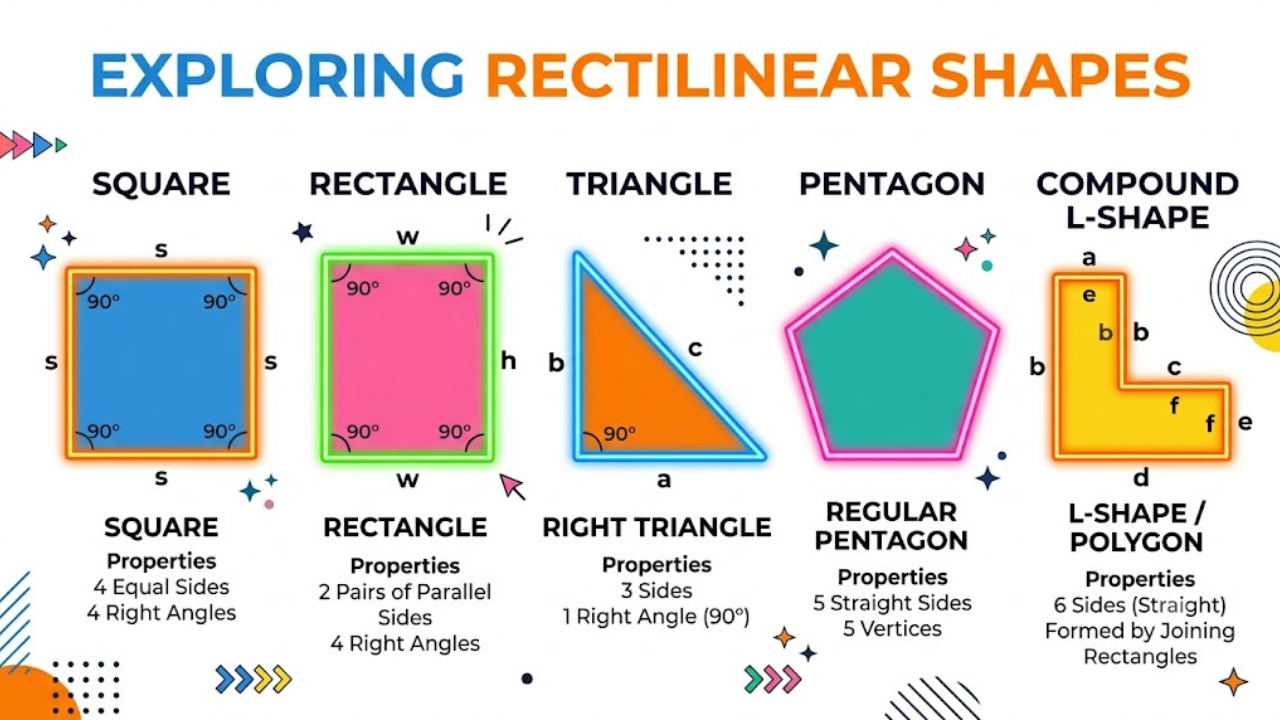
Introduction
Look around your room right now. How many straight-edged objects can you count? Your phone, your notebook, your desk, the screen you’re reading this on—they all share one thing in common. They’re built from rectilinear forms. These shapes made entirely of straight lines surround you every single day, yet most people never stop to think about what they are or why they matter.
So what exactly are rectilinear forms? In simple terms, a rectilinear form is any shape or figure composed entirely of straight line segments. No curves. no circles. No wavy edges—just clean, straight lines meeting at corners. Think of a square, a rectangle, or even a triangle. Those are all rectilinear forms.
In this guide, you’ll learn everything you need to know about rectilinear forms—from the basic definition and types to how they appear in architecture, art, and everyday life. Whether you’re a Year 4 student learning about shapes for the first time or a design student exploring geometric principles, this article has you covered.
Table of Contents
-
What Are Rectilinear Forms? A Clear Introduction
-
Why Do Rectilinear Forms Matter? Key Benefits
-
Rectilinear Forms — Key Facts, Types, and How They Work
-
How To Identify and Work With Rectilinear Forms
-
Common Mistakes and Myths About Rectilinear Forms
-
Expert Tips for Mastering Rectilinear Forms
-
Frequently Asked Questions
What Are Rectilinear Forms? A Clear Introduction
Rectilinear forms are geometric shapes made entirely from straight line segments. The word “rectilinear” comes from Latin—rectus means “straight,” and linea means “line”. Put them together, and you get “straight line.”
Think of it this way. If you draw a shape using only a ruler and never pick up a curved stencil, you’re creating rectilinear forms. Every edge is a straight line. Every corner is where two straight lines meet. That’s it. No curves allowed.
Here’s a simple example to lock it in. A rectangle is a rectilinear form. Its four sides are all straight. They meet at four corners. There are no rounded edges, no arches, no circular parts. A circle is NOT a rectilinear form because it has curved edges.
In geometry, a rectilinear figure is a 2D shape that can be drawn using only straight line segments. These shapes can be open or closed, simple or complex. When a rectilinear form is closed and simple—meaning it has no self-intersecting lines—it’s called a polygon.
Here’s the key takeaway: Every polygon is a rectilinear form, but not every rectilinear form is a polygon. Why? Because a rectilinear form can be open (like the letter “L” drawn with two lines) while a polygon must be closed.
For Year 4 students learning about shapes, a rectilinear shape is typically defined as a 2D shape with straight sides where all sides meet at right angles. This means squares, rectangles, and even compound shapes like “L” shapes and “T” shapes all count as rectilinear.
Why Do Rectilinear Forms Matter? Key Benefits
You might wonder why rectilinear forms deserve your attention. Here’s why they matter—and why understanding them gives you an edge.
-
They’re everywhere. From the building you live in to the phone in your hand, rectilinear forms dominate the human-made world. Understanding them helps you see your environment more clearly.
-
They’re easier to measure. Straight lines and right angles make calculations simple. Finding the area, perimeter, or volume of a rectilinear shape is straightforward compared to curved forms.
-
They’re structurally efficient. In architecture, rectilinear forms provide stability and maximize usable space. Buildings with straight walls are easier to construct, furnish, and maintain than curved ones.
-
They train your brain. Working with rectilinear forms develops spatial reasoning and problem-solving skills. These abilities transfer to fields like engineering, design, and computer science.
-
They’re visually clear. The human eye processes straight lines and right angles more easily than complex curves. This makes rectilinear forms ideal for communication, from signage to user interfaces.
-
They’re the foundation of geometry. Before you can understand curved shapes, you need to master straight ones. Rectilinear forms are the building blocks of mathematical thinking.
According to educational research, students who develop strong spatial reasoning skills in primary school perform better in STEM subjects later on. Mastering rectilinear forms is your first step toward that advantage.
Rectilinear Forms — Key Facts, Types, and How They Work
Types of Rectilinear Forms
Rectilinear forms come in many varieties. Here are the main types you’ll encounter.
H3: Simple Rectilinear Forms (Basic Polygons)
These are the building blocks. Triangles have three straight sides. Quadrilaterals have four straight sides, including squares, rectangles, and rhombuses. Pentagons have five sides, and hexagons have six. All of these are rectilinear forms because every side is a straight line.
H3: Compound Rectilinear Forms
These shapes combine multiple rectangles or simple polygons. Think of an “L” shape made from two rectangles joined together. Or a “T” shape. Or any irregular polygon where all sides are straight. These are also rectilinear forms.
H3: Rectilinear Polygons (Axis-Aligned)
In advanced geometry, a rectilinear polygon is a special case where all edges are horizontal or vertical, meeting at right angles. The interior angles are always 90° or 270°. This type appears frequently in computer graphics, urban planning, and digital design.
H3: Open Rectilinear Forms
Not all rectilinear forms are closed shapes. An open form might be a simple angle made of two straight lines, or a zigzag line with multiple segments. These are still rectilinear because they consist entirely of straight lines.
Comparison Table: Rectilinear vs. Curvilinear Forms
| Feature | Rectilinear Forms | Curvilinear Forms |
|---|---|---|
| Edges | Straight lines only | Contains curves |
| Examples | Squares, triangles, rectangles | Circles, ovals, arches |
| Measurement | Simple (length, width, height) | Complex (radius, circumference) |
| Common in | Architecture, technology, design | Nature, art, organic design |
| Human perception | Perceived as stable, orderly | Perceived as natural, flowing |
How Rectilinear Forms Work in Different Fields
In mathematics, rectilinear forms are the foundation of geometry. Every polygon is a rectilinear figure. Students learn to calculate perimeter, area, and angles using these shapes.
In architecture, rectilinear forms dominate building design. Skyscrapers, houses, and office buildings typically use straight walls and right angles for structural efficiency and maximized interior space.
In art, rectilinear forms appear in movements like De Stijl and Minimalism. Artists use straight lines and geometric shapes to create order, rhythm, and visual tension.
In everyday life, your phone, laptop, book, and even your bedroom are filled with rectilinear forms. Once you start looking, you’ll see them everywhere.
How To Identify and Work With Rectilinear Forms
Follow these steps to master rectilinear forms in your studies and daily life.
Step 1: Look for straight edges. Examine any shape or object. Does it have any curved edges? If yes, it’s not a rectilinear form. If every edge is straight, you’re looking at one.
Step 2: Check the corners. In a rectilinear form, corners are where straight lines meet. Count the number of sides. That’s also the number of corners (vertices) the shape has.
Step 3: Identify the type. Is the shape closed or open? If closed, is it a triangle, quadrilateral, pentagon, or something else? Name it based on the number of sides.
Step 4: Measure the sides. Use a ruler to measure each straight edge. For rectilinear forms in math problems, you’ll often need to find missing side lengths by adding or subtracting known measurements.
Step 5: Calculate perimeter and area. For perimeter, add all side lengths together. For area, break compound shapes into simple rectangles, calculate each area, then add them together.
Step 6: Look for right angles. Many rectilinear forms in primary math have right angles (90°) at every corner. Check if your shape meets this criterion.
Step 7: Practice with real objects. Find objects around you—books, screens, windows, tables—and identify their rectilinear forms. The more you practice, the faster you’ll recognize them.
Common Mistakes and Myths About Rectilinear Forms
Myth: All rectilinear forms have right angles.
Truth: Not true. A rectilinear form simply means all sides are straight. Triangles can have acute or obtuse angles. A pentagon can have various angles. Right angles are common but not required.
Mistake: Confusing “rectilinear” with “rectangle.”
Truth: A rectangle IS a rectilinear form, but not all rectilinear forms are rectangles. Triangles, pentagons, hexagons, and many other straight-sided shapes are also rectilinear.
Myth: Rectilinear forms are boring.
Truth: Rectilinear forms can create stunning visual complexity. Think of skyscrapers, geometric art, or intricate tile patterns. Straight lines can produce rhythm, balance, and dynamic compositions.
Mistake: Thinking circles are rectilinear.
Truth: Circles have curved edges. They are NOT rectilinear forms. A shape must have ALL straight sides to qualify.
Myth: Rectilinear forms only exist in math class.
Truth: Rectilinear forms are everywhere—in architecture, art, design, technology, and nature (think crystals and honeycombs). You encounter them daily without even realizing it.
Expert Tips for Mastering Rectilinear Forms
Tip 1: Sketch every day. Draw different rectilinear forms—triangles, quadrilaterals, pentagons, compound shapes. The more you draw, the more intuitive they become.
Tip 2: Use grid paper. Grid paper makes it easy to draw rectilinear forms with precise straight lines and right angles. Practice creating shapes with specific areas or perimeters.
Tip 3: Play with composite shapes. Combine multiple rectangles to create “L” shapes, “T” shapes, and other compound rectilinear forms. This builds spatial reasoning.
Tip 4: Connect to real life. Next time you’re outside, count how many rectilinear forms you can spot in buildings, signs, and windows. Turn it into a game.
Tip 5: Teach someone else. Explaining rectilinear forms to a friend or family member reinforces your own understanding. If you can teach it, you know it.
Frequently Asked Questions
What is a rectilinear shape in Year 4 maths?
A rectilinear shape in Year 4 is a 2D shape with straight sides where all sides meet at right angles (90°). These shapes can be simple like squares and rectangles, or compound like “L” shapes and “T” shapes. You learn to find missing side lengths and calculate perimeter.
What are examples of rectilinear shapes?
Common examples include squares, rectangles, triangles, pentagons, and hexagons. Compound shapes like “L” shapes and “T” shapes also qualify. In everyday life, think of books, screens, windows, tables, and buildings—all made from rectilinear forms.
What is a rectilinear triangle?
A rectilinear triangle is simply a triangle—a closed shape with three straight sides. The term “rectilinear” emphasizes that all sides are straight line segments. Any triangle you draw with a ruler is a rectilinear triangle.
Conclusion
Let’s recap the three most important things you’ve learned about rectilinear forms.
First, a rectilinear form is any shape made entirely of straight lines—no curves allowed. Squares, triangles, rectangles, and polygons of all kinds are rectilinear forms.
Second, these shapes matter because they’re everywhere—in architecture, art, technology, and everyday objects. Understanding them builds spatial reasoning skills that help you in math, design, and problem-solving.
Third, you can identify and work with rectilinear forms by looking for straight edges, counting sides, measuring lengths, and practicing with real-world objects.
Start today. Look around your room right now and count every rectilinear form you can find. The more you practice, the sharper your skills will become.
What’s the most surprising place you’ve spotted rectilinear forms today? Drop your answer in the comments below.