 By DSP Staff
What is the BODMAS Rule in Maths?
The BODMAS rule is a fundamental order of operations used in mathematics. It’s a set of rules that tells you the correct sequence in which to solve different parts of a mathematical expression to get the right answer. When an expression has multiple operations (like addition, subtraction, multiplication, division, and brackets), performing them in the wrong order can lead to a completely different result.
BODMAS Full Form
The full form of BODMAS is an acronym that stands for:
-
B – Brackets (or Parentheses)
-
O – Orders (or Of/Indices), which means powers, square roots, etc.
-
D – Division
-
M – Multiplication
-
A – Addition
-
S – Subtraction
This is the order in which you should solve a mathematical problem.
BODMAS Chart (Detailed)
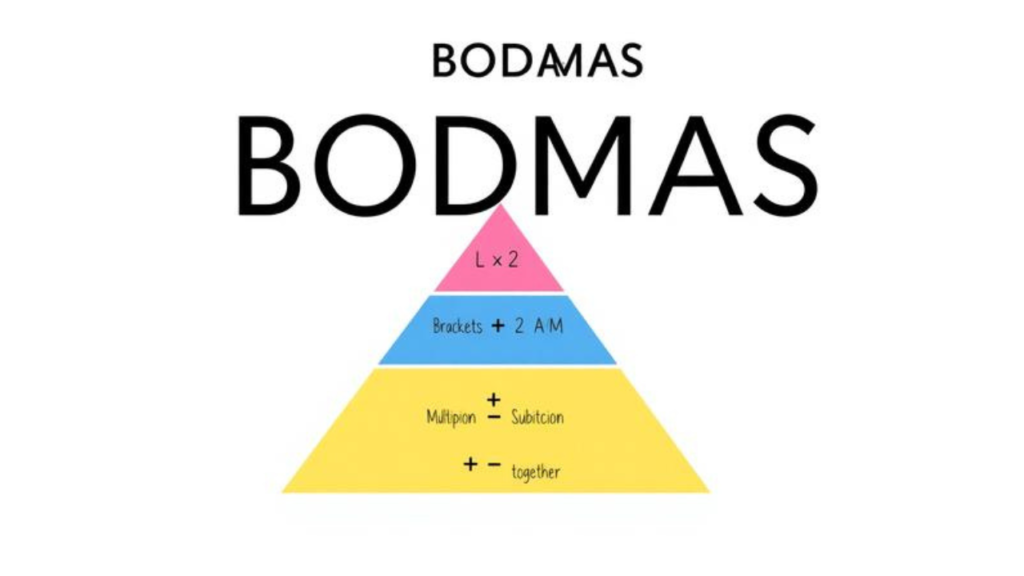
Here is a visual guide to the BODMAS hierarchy, showing the priority of operations from highest to lowest:
| Priority Level | Operation | Description |
|---|---|---|
| 1 (Highest) | Brackets ( ) | Solve everything inside brackets first. Start with the innermost bracket if there are multiple sets. |
| 2 | Orders (O) | Calculate any powers (exponents) or square roots. |
| 3 | Division (÷) & Multiplication (×) | These have equal priority. Perform them from left to right as they appear in the expression. |
| 4 (Lowest) | Addition (+) & Subtraction (-) | These also have equal priority. Perform them from left to right as they appear in the expression. |
How to Explain BODMAS to a Child
The best way to explain BODMAS to a child is to use a fun analogy and simple steps.
-
Introduce the “Rules of the Road”: Tell them that BODMAS is like the “rules of the road” for math. It tells everyone the order to follow so that we all get the same answer.
-
Use the Acronym: The word BODMAS itself is a memory trick. Explain each letter simply:
-
B stands for Brackets. These are like “VIP” areas in a math problem and must be solved first.
-
O stands for Orders, which are the “superpower” numbers, like small numbers written above others (e.g., 3²).
-
D and M stand for Division and Multiplication. They are like twins who are equally important. We deal with them as we see them, from left to right.
-
A and S stand for Addition and Subtraction. They are also twins. Once you’ve done everything else, you do these from left to right.
-
-
Show, Don’t Just Tell: Work through a simple example step-by-step (like the ones below), explaining why each step is taken.
BODMAS Rule Questions and Answers – dsp-academy
BODMAS Rule with Examples and Answers (Class 7 Level)
Let’s look at some examples to solidify the concept.
Example 1: Basic
-
Question:
16 + 8 ÷ 4 – 2 × 3 -
Solution:
-
Step 1 (Division & Multiplication – Left to Right):
8 ÷ 4 = 2and2 × 3 = 6.
The expression becomes:16 + 2 – 6. -
Step 2 (Addition & Subtraction – Left to Right):
16 + 2 = 18, then18 – 6 = 12.
-
-
Answer:
12
Example 2: With Brackets
-
Question:
10 + (5 × 3 + 2) -
Solution:
-
Step 1 (Brackets First): Inside the bracket, we have multiplication and addition. According to BODMAS, we do multiplication first:
5 × 3 = 15.
The bracket becomes:(15 + 2) = 17. -
Step 2 (Addition):
10 + 17 = 27.
-
-
Answer:
27
3: With Multiple Brackets
-
Question:
[{(45 + 90 ÷ 3 × 6) × 2} ÷ ½] × 56 -
Solution:
-
Step 1 (Innermost Brackets):
(45 + 90 ÷ 3 × 6). Inside, do division/multiplication left to right:90 ÷ 3 = 30, then30 × 6 = 180. Then add:45 + 180 = 225. -
Step 2 (Curly Brackets):
{225 × 2} = 450. -
Step 3 (Square Brackets):
[450 ÷ ½] = 450 × 2 = 900. -
Step 4 (Final Multiplication):
900 × 56 = 50400.
-
-
Answer:
50400
BODMAS Questions for Practice
Test your understanding with these practice questions:
-
8 ÷ 4 × (6 + 2 of 4) + 32 – 2 -
2 + 4 ÷ (22 + 6) × 2 -
5 × (2 × 34) ÷ 6 + 7 – 8 -
[25 – 3(6 + 1)] ÷ 4 + 9
(Answers can be found at the end of this document)
What is the BODMAS Rule for 39 - 2 * 6 + 11?
Let’s solve this step-by-step:
-
Expression:
39 - 2 * 6 + 11 -
Step 1 (Multiplication First):
2 * 6 = 12.
The expression becomes:39 - 12 + 11. -
Step 2 (Addition & Subtraction – Left to Right):
39 - 12 = 27, then27 + 11 = 38. -
Answer:
38
What is PEMDAS, BODMAS, and BIDMAS?
They are all the same rule—just different names used in different countries.
-
PEMDAS (Parentheses, Exponents, Multiplication, Division, Addition, Subtraction) is commonly used in the United States.
-
BODMAS (Brackets, Orders, Division, Multiplication, Addition, Subtraction) is used in the UK, India, and many Commonwealth countries.
-
BIDMAS is another variation where “I” stands for Indices, which is another word for powers or roots.
The key difference is just the terminology (Parentheses vs. Brackets, Exponents vs. Orders/Indices). The underlying rule of operation priority is identical.
What is the BODMAS Rule Used For?
The BODMAS rule is used for one primary purpose: to ensure there is only one correct answer when solving a mathematical expression with multiple operations.
Without a standard order of operations, math would be chaotic and subjective, with different people getting different results for the same problem.
When is the BODMAS Rule Not Applicable?
While BODMAS is a standard convention, there are specific scenarios where it doesn’t apply:
-
When All Operations are the Same: If an expression only contains addition, only subtraction, only multiplication, or only division, the rule is redundant. You just solve from left to right.
-
Example:
10 - 3 - 2. You just do it left to right:7 - 2 = 5.
-
-
In “Operator Replacement” Puzzles: Some brain teasers or puzzle questions change the meaning of operators (e.g., ‘+’ means ‘–’ and ‘×’ means ‘÷’). In these cases, the problem will often state that the BODMAS rule does not apply, and you must evaluate the expression strictly from left to right or according to the new rules.
-
In Some Computer Programming Languages: While most programming languages follow an order of operations, a few older or simpler ones (and some calculators) might evaluate expressions purely from left to right. It’s always important to use brackets to avoid ambiguity.
Answers to Practice Questions
-
Answer:
58-
8 ÷ 4 × (6 + 2 of 4) + 32 – 2 -
= 8 ÷ 4 × (6 + 8) + 9 – 2(Brackets: 2 of 4 = 2×4=8, then 6+8=14) -
= 8 ÷ 4 × 14 + 9 – 2 -
= 2 × 14 + 9 – 2(Division left to right) -
= 28 + 9 – 2(Multiplication) -
= 37 – 2(Addition left to right) -
= 35
-
-
Answer:
2 2/7-
2 + 4 ÷ (22 + 6) × 2 -
= 2 + 4 ÷ 28 × 2 -
= 2 + (1/7) × 2(Division: 4/28 = 1/7) -
= 2 + 2/7(Multiplication: 1/7 × 2 = 2/7) -
= 2 2/7
-
-
Answer:
134-
5 × (2 × 34) ÷ 6 + 7 – 8 -
= 5 × (2 × 81) ÷ 6 + 7 – 8 -
= 5 × 162 ÷ 6 + 7 – 8 -
= 810 ÷ 6 + 7 – 8(Multiplication) -
= 135 + 7 – 8(Division) -
= 142 – 8(Addition) -
= 134
-
-
Answer:
10-
[25 – 3(6 + 1)] ÷ 4 + 9 -
= [25 – 3(7)] ÷ 4 + 9(Innermost Brackets: 6+1=7) -
= [25 – 21] ÷ 4 + 9(Multiplication: 3×7=21) -
= [4] ÷ 4 + 9(Brackets: 25-21=4) -
= 1 + 9(Division: 4÷4=1) -
= 10
-