 By DSP Staff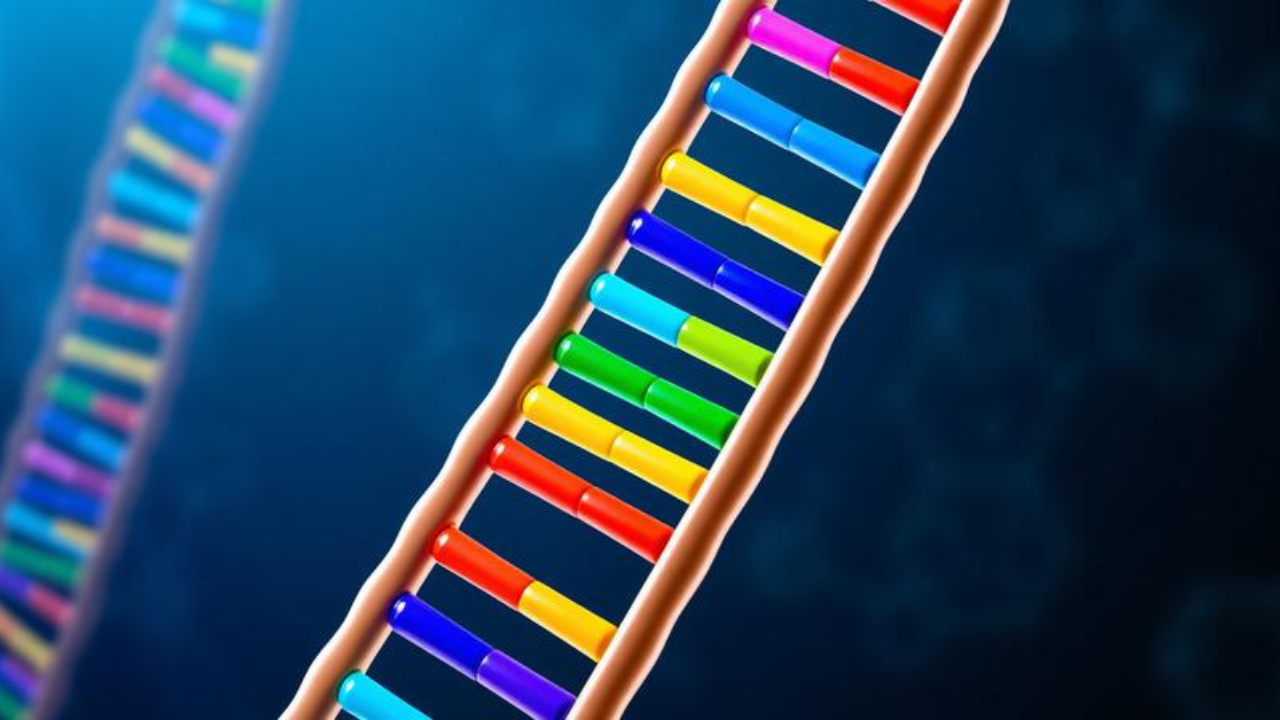
Introduction
Have you ever looked at a diagram of DNA and wondered what are the rungs of the DNA ladder made of? The short answer is nitrogenous bases—specifically four chemical compounds that pair up in a precise, predictable way. These base pairs are the foundation of your entire genetic code.
You’re about to learn exactly what are the rungs of the DNA ladder made of, how they pair together, and why this structure is so important. We’ll cover the four bases (adenine, thymine, cytosine, and guanine), the sugar found in DNA, where DNA is located, and why DNA is called the blueprint of life. By the end, you’ll have a clear understanding of how this microscopic ladder holds the instructions for every living thing on Earth.
Table of Contents
-
What Are the Rungs of the DNA Ladder Made Of?
-
Why Does the DNA Ladder Structure Matter?
-
DNA Ladder Rungs — Key Facts & How It Works
-
How To Understand DNA Base Pairing
-
Common Mistakes & Myths About DNA
-
Expert Tips for Mastering DNA Basics
-
Frequently Asked Questions
What Are The Rungs Of The DNA Ladder Made Of
What Are the Rungs of the DNA Ladder Made Of?
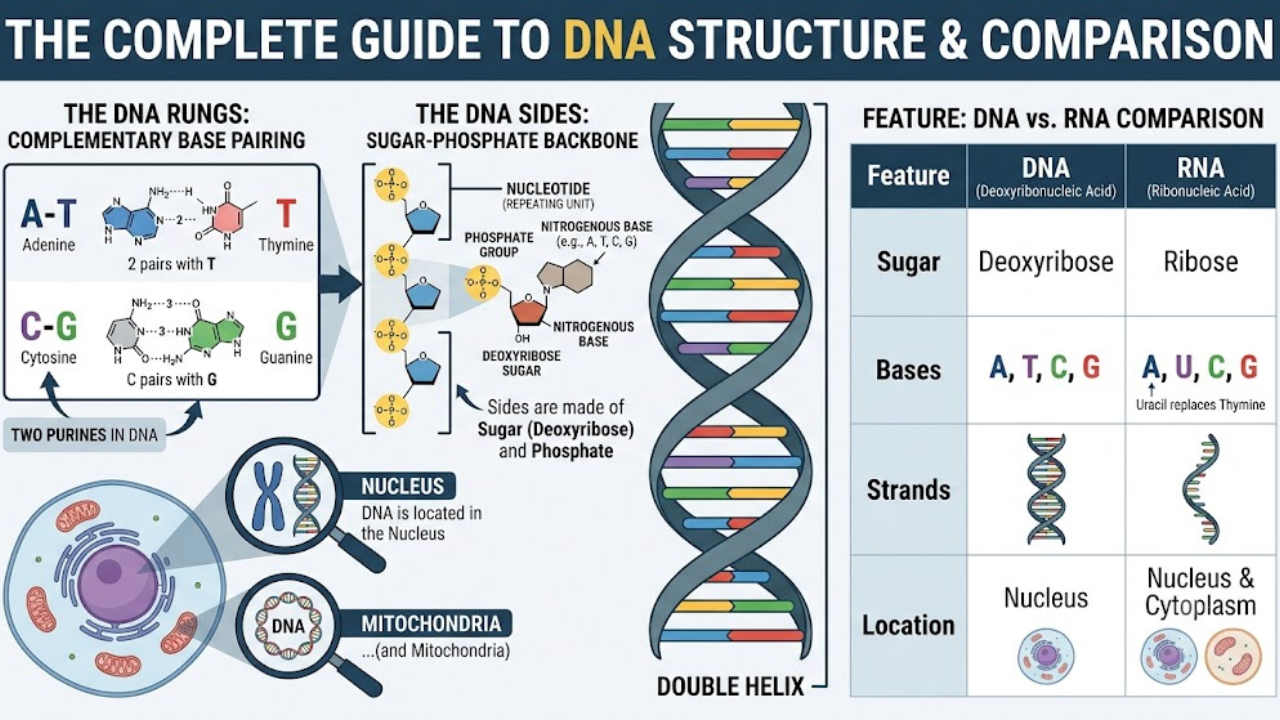
The rungs of the DNA ladder are made of nitrogenous bases. Think of DNA as a twisted ladder. The sides of the ladder are made of sugar (specifically deoxyribose) and phosphate molecules. The rungs—the steps you’d grab onto—are made of pairs of nitrogen-containing bases.
There are four types of nitrogenous bases in DNA:
-
Adenine (A)
-
Thymine (T)
-
Cytosine (C)
-
Guanine (G)
These bases pair up in a very specific way. Adenine always pairs with thymine, and cytosine always pairs with guanine. This is called complementary base pairing.
Here’s an analogy to make it stick: Imagine a ladder where each rung is made of two puzzle pieces that only fit together one way. A only fits with T, and C only fits with G. There are no other combinations. This strict pairing rule ensures that the genetic code is copied accurately when cells divide.
So when someone asks, “What are the rungs of the DNA ladder made of?” — the answer is pairs of nitrogenous bases (A-T and C-G) held together by hydrogen bonds.
Why Does the DNA Ladder Structure Matter?
The structure of the DNA ladder isn’t just a cool biology fact—it’s essential for life. Here’s why it matters:
-
Stores genetic information — The sequence of bases along the DNA ladder spells out the instructions for building and maintaining your body. DNA is called the blueprint of life because it contains all the information needed to create proteins, which do most of the work in your cells.
-
Enables accurate replication — When a cell divides, the DNA ladder “unzips” down the middle. Each strand then serves as a template to build a new complementary strand. This ensures each new cell gets an exact copy of the DNA.
-
Allows for protein synthesis — The order of bases determines which proteins are made. This process—from DNA to RNA to protein—is the central dogma of molecular biology.
-
Provides stability — The double helix shape, with its sugar-phosphate backbone on the outside and base pairs on the inside, protects the genetic code from damage.
-
Makes evolution possible — Changes (mutations) in the base sequence can create new traits. Over time, this drives evolution and adaptation.
According to the National Human Genome Research Institute, the human genome contains about 3 billion base pairs of DNA. If you stretched out all the DNA in a single human cell, it would be about 2 meters long—yet it’s packed into a nucleus just 6 micrometers across.
DNA Ladder Rungs — Key Facts & How It Works
The Four Bases
The four nitrogenous bases fall into two categories:
-
Purines (double-ring structures): Adenine (A) and Guanine (G)
-
Pyrimidines (single-ring structures): Thymine (T) and Cytosine (C)
The two purines in DNA are adenine and guanine. Each purine pairs with a specific pyrimidine: A with T, and G with C.
The Sugar-Phosphate Backbone
The sides of the DNA ladder are made of alternating sugar and phosphate molecules. The sugar found in DNA is deoxyribose. This is a five-carbon sugar (a pentose). The combination of a sugar, a phosphate, and a base is called a nucleotide. DNA is made of repeating units called nucleotides.
The Double Helix Shape
The shape of DNA is a double helix—imagine a spiral staircase or a twisted ladder. This shape was discovered by James Watson and Francis Crick in 1953.
Comparison Table: DNA vs. RNA
| Feature | DNA | RNA |
|---|---|---|
| Sugar | Deoxyribose | Ribose |
| Bases | A, T, C, G | A, U, C, G |
| Strands | Double-stranded (double helix) | Single-stranded |
| Location | Nucleus (mostly) | Nucleus and cytoplasm |
| Function | Stores genetic information | Transmits genetic information |
How To Understand DNA Base Pairing
Here’s a step-by-step approach to mastering the DNA ladder structure:
Step 1: Memorize the four bases. Start with the acronym A-T-C-G. Remember: Adenine, Thymine, Cytosine, Guanine. These are the building blocks of every DNA rung.
Step 2: Learn the pairing rules. A always pairs with T. C always pairs with G. There are no exceptions. Think of them as lock and key.
Step 3: Understand hydrogen bonds. The bases are held together by weak hydrogen bonds. A-T forms two hydrogen bonds; C-G forms three. This is why C-G pairs are slightly stronger.
Step 4: Visualize the ladder. The sugar-phosphate backbone forms the sides. The base pairs form the rungs. The whole structure twists into a double helix.
Step 5: Practice with a sequence. If one strand reads A-T-G-C, the complementary strand reads T-A-C-G. Try writing a few sequences yourself to reinforce the pattern.
Step 6: Connect it to the bigger picture. Remember that the order of these bases—your unique DNA sequence—determines everything from your eye color to your risk for certain diseases.
Common Mistakes & Myths About DNA
Myth: The rungs of the DNA ladder are made of sugar.
Truth: The rungs are made of nitrogenous bases. The sugar (deoxyribose) and phosphate molecules form the sides of the ladder.
Myth: Any base can pair with any other base.
Truth: Base pairing is highly specific. A only pairs with T, and C only pairs with G. This specificity is what allows DNA to replicate accurately.
Myth: DNA is found only in the nucleus.
Truth: While most DNA is located in the nucleus (nuclear DNA), a small amount is also found in the mitochondria (mitochondrial DNA).
Myth: DNA is a straight ladder.
Truth: The shape of DNA is a double helix—a twisted ladder. This twisting is essential for packaging DNA into the tiny space of a cell nucleus.
Myth: All living things have the same DNA bases.
Truth: All living things use the same four bases (A, T, C, G). What makes each organism unique is the order of those bases along the ladder.
Expert Tips for Mastering DNA Basics
Tip 1: Use the mnemonic “Apple Tree, Cheese Grater” to remember A-T and C-G pairs.
Tip 2: Draw the DNA ladder yourself. Label the sugar-phosphate backbone and the nitrogenous base pairs. Visual learning reinforces memory.
Tip 3: Practice complementary base pairing with random sequences. Write a 10-base strand and figure out its complement.
Tip 4: Remember that DNA is called the blueprint of life because it contains the instructions for building proteins—the molecules that do most of the work in your cells.
Tip 5: Explore online 3D models of DNA. Seeing the double helix from different angles helps cement your understanding of its structure.
Frequently Asked Questions
What are the rungs of the DNA ladder made of?
The rungs are made of pairs of nitrogenous bases—specifically adenine (A) paired with thymine (T) and cytosine (C) paired with guanine (G). These pairs are held together by hydrogen bonds.
What sugar is found in DNA?
The sugar found in DNA is deoxyribose. It’s a five-carbon sugar (pentose). This is different from RNA, which contains ribose.
Where is DNA located?
In eukaryotic cells (like human cells), most DNA is located in the nucleus. A small amount is also found in the mitochondria. In prokaryotic cells (like bacteria), DNA is found in the cytoplasm.
Conclusion
Let’s recap the three most important points. First, the rungs of the DNA ladder are made of nitrogenous bases—specifically the pairs A-T and C-G. Second, the sugar found in DNA is deoxyribose, and together with phosphate molecules, it forms the sides of the ladder. Third, DNA is called the blueprint of life because its base sequence contains all the instructions for building and maintaining an organism.
Now you know exactly what are the rungs of the DNA ladder made of and why this structure matters. Start applying this knowledge today—whether you’re studying for a biology exam, teaching a student, or just satisfying your curiosity. The more you understand about DNA, the more you’ll appreciate the incredible complexity of life itself.
What’s the most surprising thing you learned about the DNA ladder today?