 By DSP Staff
Introduction
Did you know Dakota State University holds all three NSA Centers of Academic Excellence designations—a distinction earned by only 10 universities nationwide? If you’re exploring the DSU masters in cyber defense, you’re looking at one of the most respected and affordable pathways into cybersecurity leadership.
This guide breaks down exactly what you need to know: program structure, admission requirements, tuition costs, specialization options, and how DSU’s cyber defense master’s compares to related degrees like MS Cyber Operations and MS Computer Science. You’ll learn how to apply, what courses you’ll take, and how to maximize your ROI with graduate assistantships and industry partnerships.
Table of Contents
-
What Is DSU Masters in Cyber Defense?
-
Why Does DSU Masters in Cyber Defense Matter?
-
DSU Masters in Cyber Defense — Key Facts and Specializations
-
How To Get Into DSU Masters in Cyber Defense
-
Common Mistakes and Myths to Avoid
-
Expert Tips for Best Results
-
Frequently Asked Questions
What Is DSU Masters in Cyber Defense?
The DSU masters in cyber defense (officially the Master of Science in Cyber Defense or MSCD) is a graduate program designed to prepare you for technical and leadership roles in cybersecurity. Unlike purely offensive cyber degrees, this program emphasizes defensive strategies: risk management, threat detection, network security, digital forensics, and security governance.
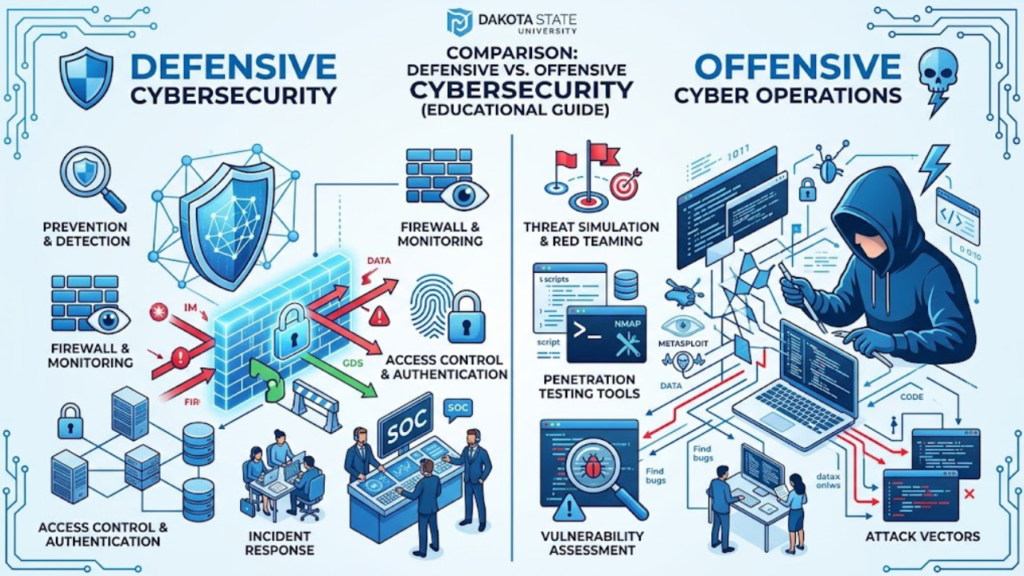
Think of it this way: if Cyber Operations teaches you how attackers break into systems, Cyber Defense teaches you how to build walls, detect intruders, and respond when breaches happen. The curriculum blends technical depth with policy and management skills, making it ideal for future security architects, incident responders, and CISOs.
Real-world example: A graduate might work as a security analyst at a financial institution, designing threat detection systems, conducting vulnerability assessments, and leading incident response teams during cyberattacks.
Why Does DSU Masters in Cyber Defense Matter?
Cybersecurity isn’t just a tech issue—it’s a national security and business continuity priority. Here’s why the DSU masters in cyber defense stands out:
-
NSA Designation: DSU is one of only 10 U.S. universities with all three NSA Centers of Academic Excellence (Cyber Defense, Cyber Operations, and Cyber Research). This signals rigorous, government-validated curriculum quality.
-
Affordability: Cybersecurity Guide ranked DSU’s online PhD cybersecurity programs as #1 most affordable in 2026, with master’s programs also recognized for value.
-
Flexible Delivery: Choose on-campus in Madison, SD, or 100% online—ideal for working professionals and military learners.
-
Career Versatility: Graduates pursue roles in security management, compliance, technical defense, and incident response across government, finance, healthcare, and tech sectors.
-
Industry Partnerships: DSU collaborates with organizations like AI Sweden and offers immersive programs at MadLabs®, giving you real-world project experience.
-
Accelerated Pathways: Through partnerships (e.g., with NSU), eligible students can complete a bachelor’s + master’s in ~5 years with up to 12 shared credits.
Statistic: The U.S. Bureau of Labor Statistics projects 32% growth in information security analyst roles from 2022–2032—far faster than average.
DSU Masters in Cyber Defense — Key Facts and Specializations
Program Structure and Credit Requirements
The MS in Cyber Defense requires 30 credit hours beyond a bachelor’s degree. Full-time students typically finish in 2 years, though part-time options extend this timeline. You must complete the program within 5 years of admission.
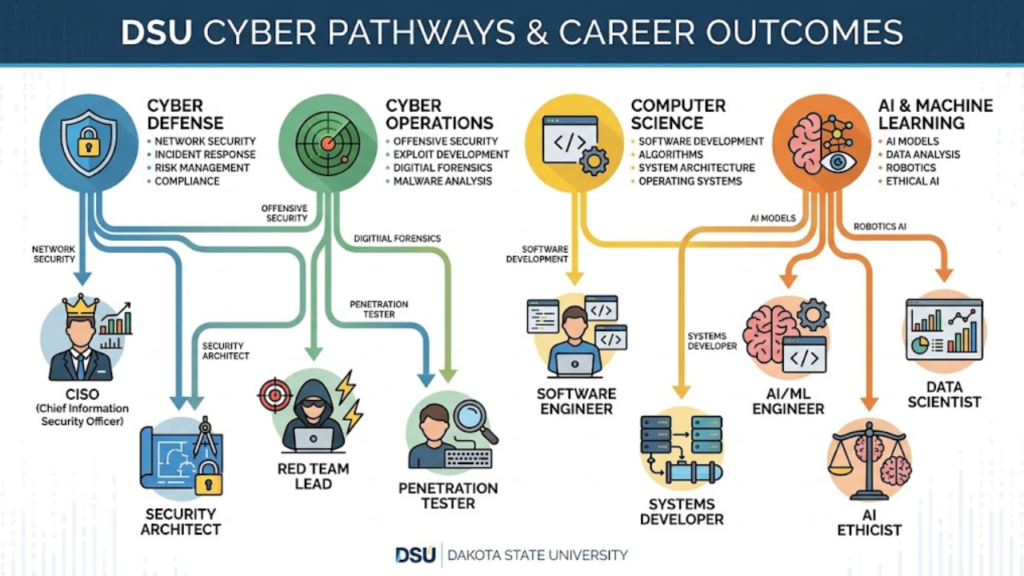
Specialization Tracks
DSU offers two primary specializations within the MSCD program:
Technical Cybersecurity Specialization
Focuses on hands-on defensive technologies:
-
Network security architecture
-
Threat detection and monitoring
-
Digital forensics and incident response
-
Cryptography and secure systems
-
Wireless and OT/SCADA security
Ideal for roles like security engineer, forensics analyst, or SOC manager.
Security Management and Compliance Specialization
Blends technical knowledge with policy and governance:
-
Risk management frameworks
-
Security auditing and compliance (e.g., NIST, ISO 27001)
-
Cybersecurity law and ethics
-
Security program development
-
Decision support and metrics
Prepares you for CISO, security consultant, or compliance officer paths.
Related DSU Cyber Degrees
DSU offers multiple cyber-focused master’s degrees. Here’s how they compare:
Tuition and Costs
Estimated cost: $3,365.10 per semester (on-campus or online). Total program cost (~4 semesters): ~$13,500. International students may face higher fees.
How To Get Into DSU Masters in Cyber Defense
Follow these steps to secure admission into the DSU masters in cyber defense program:

-
Verify Your Bachelor’s Degree Eligibility
You need a regionally accredited bachelor’s degree in networking, computer engineering, computer science, IT, information assurance, or a closely related field. If your degree isn’t directly aligned, you may need to complete prerequisite coursework in areas like data structures or networking. -
Check Your GPA
DSU requires a minimum 3.0 GPA on a 4.0 scale (or equivalent). Competitive applicants often exceed this threshold, especially for assistantship consideration. -
Prepare Transcripts and English Proficiency Proof
Submit official transcripts from all prior institutions. International applicants must provide certified translations and demonstrate English proficiency (e.g., TOEFL/IELTS). -
Submit Your Application by the Deadline
Deadlines vary by term:-
Fall: August 15 (April 15 for international students)
-
Spring: November 30 (November 1 for international students)
-
Summer: April 30
Apply via DSU’s graduate admissions portal.
-
-
Optional: Strengthen Your Profile
While not always required, relevant work experience, certifications (e.g., Security+, CISSP), or cyber competitions (e.g., CCDC, NCL) can boost your application. Consider reaching out to faculty or current students for insights. -
Explore Funding and Assistantships
DSU offers graduate assistantships that provide tuition support and stipends in exchange for teaching or research work.
Common Mistakes and Myths to Avoid
-
“I need a computer science degree to apply.”
False. DSU accepts degrees in networking, IT, information assurance, and related fields. Non-CS backgrounds may require prerequisites, but you’re not disqualified. -
“Online programs are less respected.”
Myth. DSU’s online MSCD carries the same NSA designation and curriculum as on-campus. Employers value the NSA CAE accreditation, not delivery mode. -
“I must choose a specialization immediately.”
Not true. You can often explore core courses before declaring your track (Technical vs. Management). Use electives to test your interests. -
“Graduate assistantships are only for on-campus students.”
Incorrect. While many assistantships are campus-based, DSU offers remote research opportunities and industry partnerships (e.g., AI Sweden program) that provide stipends and credits. -
“Cyber Defense is only for defensive roles.”
Misleading. Understanding defense makes you a better offensive operator, and vice versa. Many graduates work in hybrid roles or transition between red/blue teams.
Expert Tips for Best Results
-
Start prerequisites early if your bachelor’s isn’t in a core cyber field—this speeds up admission.
-
Apply for assistantships in your first semester to reduce costs and gain research experience.
-
Leverage DSU’s NSA designation on your resume—it signals rigorous, government-validated training.
-
Join MadLabs® projects or the AI Sweden exchange for real-world portfolio pieces.
-
Network with Beacom College faculty—they often have industry ties that lead to internships and jobs.
Frequently Asked Questions
Q1: Can I complete the DSU masters in cyber defense 100% online?
Yes. DSU offers the MS in Cyber Defense fully online, with the same curriculum and NSA designation as the on-campus program. You can choose between Technical Cybersecurity or Security Management and Compliance specializations.
Q2: How does DSU MS Cyber Defense compare to MS Cyber Operations?
MSCD focuses on defensive strategies (risk management, forensics, compliance), while MSCO emphasizes offensive skills (malware analysis, reverse engineering, penetration testing). Choose MSCD for security architect or CISO paths; MSCO for red team or exploit development roles.
Q3: Are graduate assistantships available for cyber defense students?
Yes. DSU offers graduate assistantships that provide tuition support and stipends in exchange for teaching or research work. Competitive applicants with strong GPAs and relevant experience have the best chances.
Conclusion
The DSU masters in cyber defense delivers a NSA-accredited, affordable, and flexible pathway into cybersecurity leadership. You’ll gain technical depth in threat detection and forensics, plus management skills for compliance and risk governance. With online options, industry partnerships, and assistantship opportunities, DSU positions you for high-growth roles in a booming field.
Start today: Review admission requirements, gather transcripts, and apply by the next deadline. Which specialization aligns with your career goals—Technical Cybersecurity or Security Management?