 By DSP Staff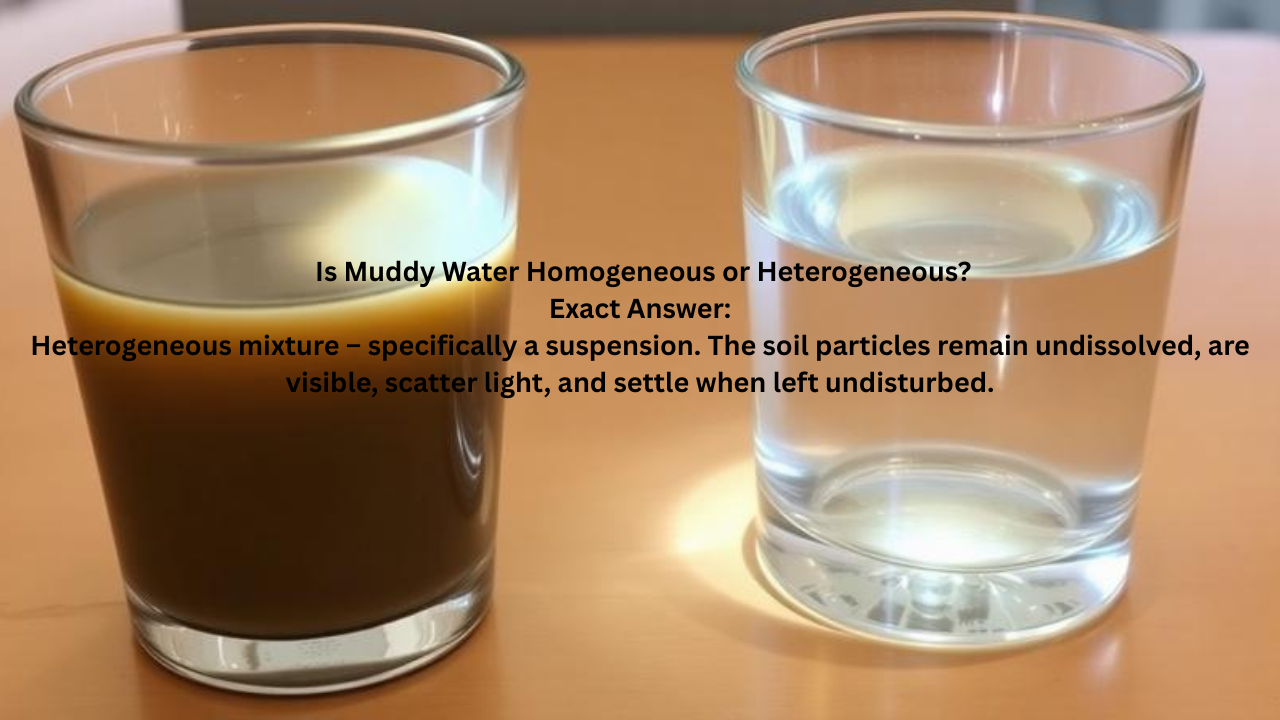
INTRODUCTION
You take a glass of muddy river water and stir it vigorously. For a moment, it looks the same throughout — no chunks, just brown liquid. So, is muddy water homogeneous or heterogeneous? Most students guess “homogeneous” right after stirring, and that guess almost always costs them marks on a chemistry test. The truth is simpler than you think, and once you see it with your own eyes, you’ll never get it wrong again.
In this article, you’ll learn the one clear answer to this classic mixture question. You’ll discover what makes a mixture homogeneous or heterogeneous, why muddy water falls where it does, and how you can quickly classify any mixture in your syllabus. We’ll bust the most common myths, give you an easy 5‑step identification method, and answer the questions that real students type into Google late at night. No jargon, no confusion — just the explanation you wish your textbook gave you.
TABLE OF CONTENTS
-
What Is Muddy Water — Homogeneous or Heterogeneous?
-
Why Does Classifying Mixtures Matter?
-
Types of Mixtures — Key Facts and How They Work
-
How To Identify Homogeneous vs Heterogeneous Mixtures — Step by Step
-
Common Mistakes When Classifying Muddy Water
-
Expert Tips for Best Results
-
Frequently Asked Questions
-
Conclusion
What Is Muddy Water — Homogeneous or Heterogeneous?
Muddy water is a heterogeneous mixture. Even when you stir it until it looks uniform, it remains non‑uniform at the particle level. The soil, silt, and tiny rock fragments floating in the water do not dissolve. They stay as separate solid particles suspended in the liquid. Over time, gravity pulls those particles to the bottom — they settle. That settling is your biggest clue that you’re looking at a heterogeneous mixture.
Think of a snow globe. Shake it hard, and the white flakes spread evenly through the liquid. But you wouldn’t call the snow globe “one thing.” You know the flakes and the liquid are still separate. Muddy water works exactly the same way. The soil particles are the “flakes,” and the water is the liquid. Stirring only delays the moment when they separate again.
In scientific terms, muddy water is a suspension — a type of heterogeneous mixture where solid particles are large enough to eventually settle out. You can often see those particles with your naked eye, and you can certainly separate them using filter paper. That’s why the answer to “Is muddy water homogeneous or heterogeneous?” is always heterogeneous, whether you stir it or not.
Key takeaway: Homogeneous mixtures look the same throughout and never settle. Heterogeneous mixtures show visible layers or particles that can separate. Muddy water shows visible particles and separates on standing — clear proof it’s heterogeneous.
Why Does Classifying Mixtures Matter?
You might wonder, “Why do I need to label every mixture?” The answer: classification predicts behavior, and chemistry is all about prediction.
-
Separation method: If you know a mixture is heterogeneous, you already know you can filter it or let it settle. If it’s homogeneous, you’ll need distillation or evaporation. This saves time in the lab and marks on exams.
-
Environmental science: Real‑world muddy water — from construction sites to rivers — carries pollutants. Understanding it as a suspension helps engineers design water treatment plants that remove solids efficiently.
-
Pharmaceuticals: Medicines like antacids are often suspensions. Knowing they’re heterogeneous ensures you shake the bottle before use so that the active ingredient distributes evenly.
-
Everyday life: Salad dressing, orange juice with pulp, and even the air with dust are heterogeneous mixtures. Recognizing them helps you make sense of the world.
-
Exam readiness: A 2022 study in Chemistry Education Research and Practice found that over 60% of middle‑grade students misclassify suspensions like muddy water because they trust the “stirred” look. Grasping this one concept instantly sets your answers apart.
The moment you stop seeing muddy water as a dirty trick question and start seeing it as a predictable suspension, you’re thinking like a chemist.
Types of Mixtures — Key Facts and How They Work
Every mixture fits into one of two boxes: homogeneous or heterogeneous. Understanding the box tells you how the mixture behaves.
Homogeneous Mixtures (Solutions)
A homogeneous mixture has a uniform composition throughout. You can’t see the individual parts, even with a microscope. The particles are at the molecular or ionic level and completely dissolved.
-
Examples: Saltwater, vinegar, air, sugar dissolved in tea.
-
Properties: They don’t settle on standing, light passes through without scattering (no Tyndall effect), and you can’t filter out the components with ordinary filter paper.
Heterogeneous Mixtures
A heterogeneous mixture has a non‑uniform composition. You can often see the distinct parts, or they separate over time. The particles are large enough to scatter light or settle.
-
Examples: Muddy water, sand in water, oil and water, cereal in milk.
-
Sub‑types:
-
Suspensions: Solid particles in a liquid that settle over time (muddy water, chalk powder in water).
-
Colloids: Tiny particles that don’t settle but scatter light (milk, fog).
-
Why Muddy Water Lands in the Heterogeneous Box
Muddy water contains soil particles with sizes from 0.002 mm (clay) to 2 mm (sand). These particles are insoluble in water. They are physically dispersed, not chemically bonded. On standing, gravity wins — particles larger than about 0.001 mm settle out, leaving clear water above. Stirring hides this settling temporarily, but the mixture never becomes uniform at the particle level. That’s the textbook definition of a heterogeneous mixture.
| Feature | Homogeneous Mixture | Heterogeneous Mixture (Muddy Water) |
|---|---|---|
| Uniformity | Same composition throughout | Different layers or particles visible |
| Particle size | Ions/molecules (<1 nm) | Often >1000 nm (suspended solids) |
| Settling on standing | Never settles | Particles settle over time |
| Filtration | Cannot be separated by filter paper | Solids can be filtered out |
| Light scattering (Tyndall effect) | No | Yes (suspensions and colloids) |
| Examples | Saltwater, air | Muddy water, sand in water |
Once you memorize this table, you can classify any mixture in seconds.
How To Identify Homogeneous vs Heterogeneous Mixtures — Step by Step
Use this 5‑step check the next time a mixture question stumps you. It works for muddy water and everything else.
-
Let the mixture stand for two minutes.
Grab a clear container and pour your mixture in. Watch the bottom. If you see particles gathering or the color changing from bottom to top, you have a heterogeneous mixture. Muddy water will show a dark layer at the bottom very quickly. -
Shine a flashlight through the liquid.
In a dark room, pass a beam of light through the mixture. If the beam scatters and becomes visible (Tyndall effect), the mixture contains suspended particles. Muddy water shows a strong, cloudy beam — a signature of suspensions and colloids, both heterogeneous. -
Try to filter it with a coffee filter or lab paper.
Pour the mixture through a filter. If a solid collects on the paper and the liquid that passes through looks clear, you’ve just proved it’s heterogeneous. Muddy water will leave a layer of soil on the filter while clear water drips below. -
Check for uniformity under a microscope.
Place a drop on a slide. If you can see distinct particles swimming in the liquid, the mixture is heterogeneous. Even if it looks smooth to your eye, the microscope reveals the truth. -
Ask: “Would it look the same in every drop if I took a sample without shaking?”
This is the ultimate homogeneity test. Scoop a sample from the top of muddy water without stirring — it will be much clearer than a sample scooped from the bottom. Homogeneous mixtures would be identical everywhere. Muddy water fails this test completely.
Run these five steps once on real muddy water, and your brain will never confuse homogeneous and heterogeneous again.
Common Mistakes When Classifying Muddy Water
Even sharp students slip up on this topic. Here are the top traps and how to avoid them.
-
Mistake: “It looks uniform when I stir it, so it’s homogeneous.”
Truth: Homogeneous means uniform at the particle level, not just after shaking. Shaking a snow globe makes it look uniform too, but the separate parts remain. Muddy water’s particles never dissolve, so it stays heterogeneous. -
Mistake: “If the particles are very tiny, it’s a solution.”
Truth: Even clay‑sized particles (0.002 mm) are still insoluble solids that will eventually settle or be caught by a filter. Dissolving means the substance breaks into individual ions or molecules. Clay does not dissolve; it disperses. -
Mistake: “Brown liquid = chocolate milk, so it must be a colloid and homogeneous.”
Truth: The color can fool you. Muddy water is a suspension, not a colloid. Its particles are generally larger and settle fast, unlike colloid particles that stay suspended indefinitely. -
Mistake: “All liquids are homogeneous mixtures.”
Truth: Pure liquids like water are compounds, not mixtures at all. And muddy water is clearly not a pure liquid. The presence of visible, settleable solids makes it heterogeneous. -
Mistake: “If I can’t see particles with my naked eye, it’s homogeneous.”
Truth: Your eye is not the test. Many suspensions appear smooth until you use light or a microscope. The Tyndall effect and settling remain the real judges.
Steer clear of these five pitfalls, and you’ll outscore most of your classmates on mixture classification.
Expert Tips for Best Results
-
Label muddy water as “heterogeneous suspension” on tests, not just “heterogeneous.” This extra detail shows you know the sub‑category and often earns full marks.
-
Keep a small settling jar on your study desk. Stir dirt in water and watch it separate. The visual memory will stick better than any textbook diagram.
-
Use the “filter paper rule”: If filter paper can separate it, it’s heterogeneous. This one‑line rule works for every mixture in your syllabus.
-
Draw the particle picture. Heterogeneous = large, separate circles in liquid. Homogeneous = tiny, evenly scattered dots. Drawing the difference cements the concept.
-
When in doubt, trust settling over appearance. If anything collects at the bottom, the mixture is heterogeneous — no exceptions.
Frequently Asked Questions
Is muddy water a colloid or a suspension?
Muddy water is a suspension because the solid particles are large enough (usually over 1000 nm) to settle under gravity and be filtered out. Colloids like milk have much smaller particles (1–1000 nm) that don’t settle and pass through ordinary filter paper. Muddy water fails both the settling and filtration tests, so it’s firmly a suspension — a type of heterogeneous mixture.
What is the difference between muddy water and saltwater?
Saltwater is a homogeneous solution; salt dissolves into sodium and chloride ions that spread evenly and never settle. Muddy water is a heterogeneous suspension; soil particles do not dissolve, remain as separate solids, and settle over time. You can filter mud from water, but you can’t filter salt out of saltwater — that’s the fundamental difference.
Can muddy water ever be homogeneous?
No. Even if you grind the particles extremely fine, they still do not dissolve in water. They remain suspended solids. A mixture is homogeneous only when components mix at the molecular or ionic level and form a single phase. Muddy water always consists of at least two phases — solid and liquid — so it stays heterogeneous regardless of particle size.
Conclusion
Muddy water is a heterogeneous suspension — a classic example that trips up students every year. Remember these three anchors: it settles, it scatters light, and you can filter it. If you lock those facts in your mind, no mixture question will confuse you again.
Now that you have the simple 5‑step test and the comparison table, try classifying five mixtures in your kitchen today — milk, orange juice with pulp, tea, saltwater, and a spoonful of dirt in a glass. Leave a comment below telling us which one surprised you most, and share this article with a friend who still thinks stirring changes everything.
Also See Our Guide On