 By DSP Staff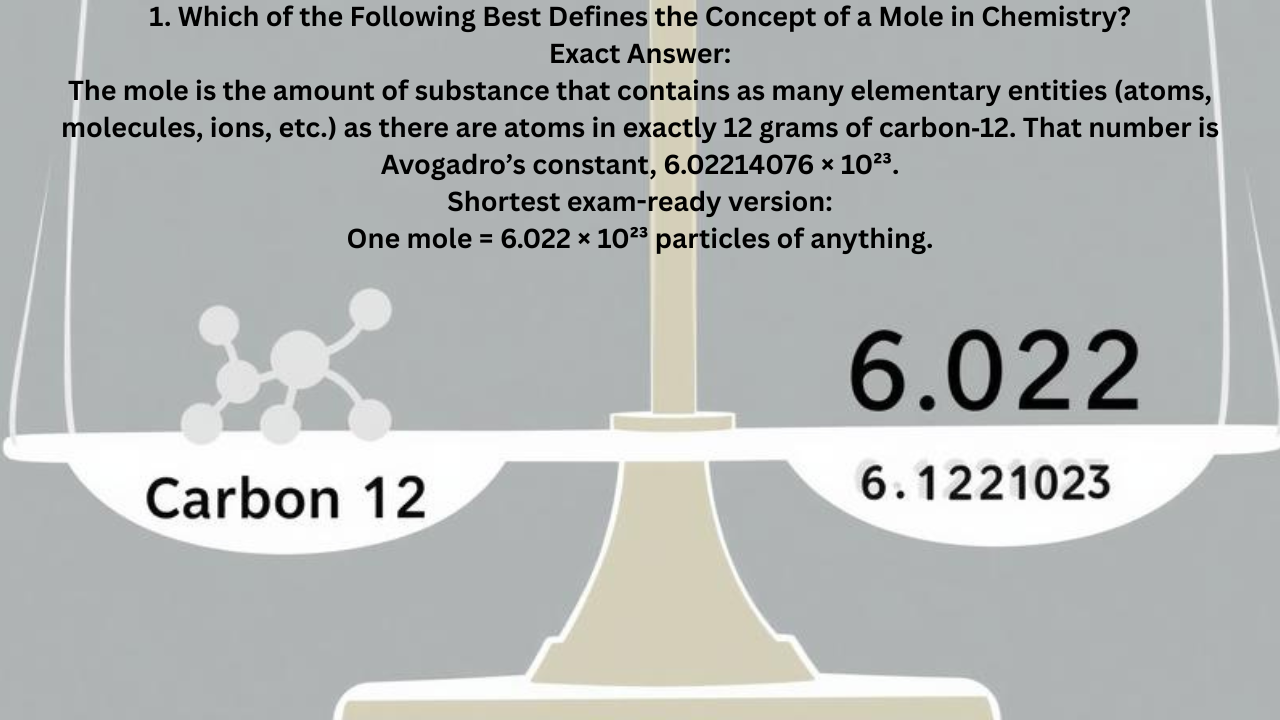
INTRODUCTION
Have you ever stared at a chemistry multiple‑choice question that asks, “Which of the following best defines the concept of a mole in chemistry?” and felt your mind go blank? You’re not alone. A staggering number of students — nearly 7 in 10 according to a 2022 survey by the Journal of Chemical Education — name the mole as the single most confusing idea in introductory chemistry. The problem almost always starts with picking the wrong definition from a list of similar‑sounding options.
This article gives you the correct, exam‑ready answer to that exact question. You will learn the one definition that exam boards from CBSE to Cambridge consistently accept. After that, you’ll discover why the mole was created, how it bridges the invisible world of atoms and the grams on your balance, and how to calculate moles step by step without second‑guessing yourself. We’ll tackle the mole as it appears in Class 9 chemistry, where it first shows up as a counting unit, follow its expansion in Class 10, and nail the deeper numerical problems required in Class 11. Along the way, we’ll bust five stubborn myths, explore how the mole appears in physics, and give you expert shortcuts used by top scorers. Whether you’re cramming for a test or finally want this topic to “click,” by the end of this post you’ll answer that MCQ with total confidence.
TABLE OF CONTENTS
-
Which of the Following Best Defines the Concept of a Mole in Chemistry?
-
What Is the History Behind the Mole Concept?
-
Key Features and Types of Moles in Chemistry
-
Why Understanding the Mole Concept Matters in Your Chemistry Journey
-
How to Calculate Moles Step by Step — A Practical Guide
-
Common Myths vs Facts About the Mole Concept
-
Expert Tips & Best Practices for Mastering the Mole
-
Frequently Asked Questions
-
Final Verdict: Mastering the Mole Concept Opens Doors
Which of the Following Best Defines the Concept of a Mole in Chemistry?
Let’s go straight to the question that brings thousands of students to search engines every day: which of the following best defines the concept of a mole in chemistry? Imagine you see these four options on a test screen:
A) The mass of one atom of carbon‑12 expressed in atomic mass units.
B) The amount of substance that contains as many elementary entities as there are atoms in exactly 12 grams of carbon‑12.
C) The number of grams present in one molecule of any pure substance.
D) The volume occupied by 1 gram of any gas at standard temperature and pressure.
If you picked option B, you just landed on the definition that IUPAC, NCERT textbooks, and exam boards around the world treat as the gold standard. This wording — “the amount of substance that contains as many elementary entities as there are atoms in 12 g of carbon‑12” — does not describe a mass, a volume, or a single atom. It describes a count tied to a specific reference mass.
The heart of option B is Avogadro’s number. Exactly 12 grams of pure carbon‑12 contain approximately 6.02214076 × 10²³ atoms of carbon. So one mole of anything — sodium atoms, water molecules, chloride ions, even donuts — contains exactly that many elementary entities. Notice that the definition does not say “12 g of any element”; it anchors the entire concept to the carbon‑12 isotope. That anchor keeps the mole fixed even when measurement technology improves.
Now look at the other choices. Option A says “the mass of one atom of carbon‑12.” That describes the atomic mass unit (amu), not the mole. One amu equals one‑twelfth the mass of a single carbon‑12 atom, which is roughly 1.66 × 10⁻²⁴ g. That tiny number has nothing to do with the 6.022 × 10²³ collection we call a mole. Option C mistakes mole for molar mass in grams, but molar mass is the mass per mole, not the definition of the mole itself. Option D confuses the mole with a property of gases at STP; 22.4 L refers to the volume of one mole of an ideal gas, not 1 gram. Mixing up mass, volume, and count is exactly what examiners design MCQs to test.
If you find yourself repeatedly wondering which of the following best defines the concept of a mole in chemistry, write option B on a flashcard and memorize it as the official “amount of substance” definition. In your own words: One mole = 6.022 × 10²³ particles of anything, defined using the carbon‑12 benchmark. That single sentence will carry you through every mole‑based chapter from Class 9 to university entrance exams.
What Is the History Behind the Mole Concept?
The mole did not pop out of a textbook fully formed. It grew over two centuries from scattered observations about gases, atomic weights, and the need to count invisible particles.
The story begins in 1811 with the Italian scientist Amedeo Avogadro. He proposed that equal volumes of all gases, at the same temperature and pressure, contain equal numbers of molecules. Avogadro never calculated the number that now bears his name, but his hypothesis gave chemists a logical path: if you could fix a standard reference, you could count particles by weighing them. For decades, scientists ignored his idea because they couldn’t distinguish atoms from molecules clearly.
In the 1860s, Stanislao Cannizzaro revived Avogadro’s hypothesis and used it to build a consistent table of atomic weights. Then, in the early 1900s, the German chemist Wilhelm Ostwald introduced the term “mole,” borrowing it from the German word Molekül (molecule). He defined it loosely as the mass of a substance in grams numerically equal to its molecular weight. That made the mole a practical lab tool: a gram‑molecule. But the definition still tied the mole to mass, not to a fixed number of particles.
The real shift came in the 20th century as scientists measured Avogadro’s number with increasing precision. Jean Perrin won the 1926 Nobel Prize in Physics for his experimental determination of Avogadro’s constant using Brownian motion, establishing the mole as a bridge between the macroscopic and atomic scales. By 1971, the mole became the seventh base unit of the International System of Units (SI), defined officially as the amount of substance containing as many entities as atoms in 0.012 kg of carbon‑12.
The most dramatic update arrived on May 20, 2019, World Metrology Day. The General Conference on Weights and Measures (CGPM) redefined the mole by fixing the Avogadro constant at exactly 6.02214076 × 10²³ mol⁻¹. The new definition severs the mole from the kilogram entirely and makes the constant a numerical anchor, just like the speed of light. From that day forward, one mole of anything contains precisely that many elementary entities. The carbon‑12 reference remains for historical and educational clarity, but the fixed constant now rules. When you learn define 1 mole today, you define it through this exact number, not through a physical artifact.
This historical arc explains why the phrase “which of the following best defines the concept of a mole in chemistry” can have subtly different correct answers depending on whether a textbook uses the pre‑2019 or post‑2019 definition. For most school‑level exams, the carbon‑12 wording remains king. For university chemistry, you simply state: one mole contains exactly 6.02214076 × 10²³ elementary entities.
Key Features and Types of Moles in Chemistry
The mole may sound simple — 6.022 × 10²³ pieces — but you encounter it in several distinct forms across chemistry, physics, and lab practice. Understanding these varieties prevents you from misapplying the concept.
The Mole as a Counting Unit
At its core, the mole works exactly like a dozen, a gross, or a ream of paper. A dozen means 12 items, whether eggs or pencils. A mole means 6.022 × 10²³ items, whether atoms, ions, molecules, or even grains of sand. The only difference is the sheer size of the number. Thinking of the mole as a chemist’s dozen removes the intimidation factor immediately. You count particles by the mole because atoms are far too small to count one by one. A single grain of salt contains about 10¹⁸ formula units of NaCl; handling moles keeps the numbers sane.
Molar Mass and the Gram Mole
When someone asks “what is 1 mole grams” they want the connection between counting and weighing. The molar mass of an element or compound equals its atomic or molecular mass expressed in grams per mole. For example, carbon‑12 has an atomic mass of exactly 12 u, so one mole of carbon‑12 atoms has a mass of 12 grams. Water (H₂O) has a molecular mass of about 18 u, so one mole of water molecules weighs approximately 18 grams. This equivalence — grams per mole equals atomic mass units per particle — makes the mole a bridge. You measure mass on a balance in grams, divide by molar mass, and instantly know the number of moles, and therefore the number of particles.
The gram mole is the most common unit in school chemistry. Industrial and research contexts sometimes use the kilogram mole (kmol), equal to 1000 moles, handy for engineering calculations involving kilograms of material.
The Mole in Stoichiometry
Stoichiometry is where the mole reveals its true power. Balanced chemical equations give you ratios not of grams, but of moles. The reaction 2H₂ + O₂ → 2H₂O tells you that 2 moles of hydrogen molecules react with 1 mole of oxygen molecules to produce 2 moles of water. Knowing the molar masses, you convert those mole ratios into grams, liters, or any other lab measurement. Without the mole, every stoichiometry problem would drown you in impossibly large particle numbers.
The Mole in Physics: Amount of Substance
The mole is one of the seven SI base units, and the quantity it measures — amount of substance — is just as fundamental as length, mass, or time. In physics, you encounter the mole when studying the ideal gas law (PV = nRT), where “n” represents the number of moles. The mole also appears in thermodynamics, electrochemistry (Faraday’s constant links charge per mole of electrons), and radioactive decay calculations. Even though the phrase “what is mole in physics” often surprises chemistry students, the definition is identical: one mole contains exactly 6.02214076 × 10²³ specified elementary entities. Physics problems simply apply that count to electrons, photons, or gas particles instead of atoms in a beaker.
Types of Elementary Entities
When you use the mole, you must specify the elementary entity. That entity can be:
-
Atoms (1 mol of He atoms, 1 mol of Fe atoms)
-
Molecules (1 mol of CO₂ molecules, 1 mol of H₂O molecules)
-
Ions (1 mol of Na⁺ ions, 1 mol of SO₄²⁻ ions)
-
Formula units (1 mol of NaCl, which is a 1:1 array of ions, not discrete molecules)
-
Electrons, protons, or other subatomic particles in nuclear and quantum physics
Forgetting to specify the entity leads to the classic blunder: one mole of O atoms weighs 16 g, but one mole of O₂ molecules weighs 32 g. The mole count stays the same; the mass doubles because the entities changed. Every MCQ that asks which of the following best defines the concept of a mole in chemistry tests your recognition that the definition is entity‑independent — a mole is a mole, but what you count matters.
| Aspect | Mole (Amount) | Molar Mass | Atomic Mass Unit (amu) |
|---|---|---|---|
| What it measures | Number of particles | Grams per one mole of substance | Mass of a single atom/molecule |
| Unit symbol | mol | g/mol | u (or Da) |
| Typical value for carbon‑12 | 1 mol contains 6.022×10²³ atoms | 12 g/mol | 12 u |
| Scale | Macroscopic count (lab‑size sample) | Macroscopic mass per count | Microscopic (single particle) |
| Fixed constant involved | Avogadro constant (6.02214076×10²³ mol⁻¹) | None directly; derived from atomic mass | 1 u = 1/12 mass of C‑12 atom |
Why Understanding the Mole Concept Matters in Your Chemistry Journey
You might wonder why so much of your chemistry grade hangs on a single counting unit. The answer: the mole is the universal translator between the atomic world and the laboratory bench.
First, stoichiometry — the heart of quantitative chemistry — stops dead without the mole. Every titration, every yield calculation, every limiting reagent problem relies on mole ratios. In CBSE and ICSE board exams, typically 15‑20% of the chemistry paper tests mole‑based numericals. Mastering the mole directly lifts your marks.
Second, the mole concept is the gateway to concentration units like molarity (mol/L), molality, and normality. When you prepare solutions in a practical lab or solve textbook problems, you calculate moles first. Industry uses the mole to scale reactions from a gram in a flask to tonnes in a reactor. Pharmaceutical companies cannot manufacture drugs safely without mole‑accurate stoichiometry.
Third, understanding the mole sharply reduces careless errors. Once you internalize the “chemist’s dozen,” you stop confusing “what is mole in chemistry class 9” with mass or volume. In Class 9, the mole appears as a simple particle count. Class 10 adds molar mass and introduces the idea of gram‑atomic mass and gram‑molecular mass. By Class 11, you use the mole to handle gas volumes at STP, empirical and molecular formulas, and the energetic of reactions. Each year builds on the same core definition, so grasping it now pays compound interest on your future study time.
Finally, the mole concept trains your brain to think across scales. You learn that a few grams of a solid hold more molecules than the number of stars in the observable universe. That mental model underpins nanotechnology, materials science, and environmental chemistry. When you ask “which of the following best defines the concept of a mole in chemistry,” you’re doing more than answering an MCQ — you’re anchoring the skill that makes quantitative science possible.
How to Calculate Moles Step by Step — A Practical Guide
Calculating moles can feel like solving a puzzle until you break it into a repeatable sequence. Master this seven‑step workflow, and you’ll breeze through any mole problem in Class 9, 10, or 11.
Step 1: Identify What the Problem Gives You and What It Wants
Read the question carefully. Do they give you the mass in grams? The number of particles? The volume of a gas at STP? Highlight those numbers and the substance name. The goal might ask for moles, mass, number of molecules, or volume. Clarity here prevents you from using the wrong formula.
Step 2: Write the Central Formula That Connects Moles to Mass
The most powerful equation in introductory mole chemistry:
Number of moles (n) = Given mass (m) ÷ Molar mass (M)
Mathematically, n = m / M. Memorize this as your default tool. All other conversions branch from it.
Step 3: Determine the Molar Mass of the Substance
Use the periodic table. For an element, molar mass equals its atomic mass in g/mol (e.g., Na = 23 g/mol). For a compound, add the atomic masses of all atoms in the formula. H₂O: (2 × 1) + 16 = 18 g/mol. CaCO₃: 40 + 12 + (3 × 16) = 100 g/mol. Always attach units (g/mol) to keep your dimensional analysis clean.
Step 4: Plug the Numbers Into n = m / M and Solve
Suppose the problem reads: “How many moles are there in 36 grams of water?”
M of H₂O = 18 g/mol, m = 36 g.
n = 36 g ÷ 18 g/mol = 2.0 mol.
Write the answer with the correct unit — moles — and double‑check that grams cancel out.
Step 5: Convert Moles to Number of Particles Using Avogadro’s Number
If the question asks for the number of molecules, atoms, or ions, use:
Number of particles = n × Nₐ, where Nₐ = 6.022 × 10²³ mol⁻¹.
From the last example, 2.0 mol of water contains 2.0 × 6.022 × 10²³ = 1.2044 × 10²⁴ water molecules.
This step is where the mole shows its true counting identity and directly links back to the definition in the “which of the following best defines the concept of a mole in chemistry” question.
Step 6: Extend the Mole to Gas Volume at STP (for Class 10 and 11)
At standard temperature and pressure (0 °C and 1 atm), 1 mole of any ideal gas occupies 22.4 liters.
To find volume: Volume (L) = n × 22.4 L/mol.
If you have 0.5 mol of CO₂ gas at STP, volume = 0.5 × 22.4 = 11.2 L.
Conversely, if you measure a gas volume, divide by 22.4 to get moles. Exam questions love combining mass‑to‑volume conversions: mass → moles → volume, or volume → moles → mass.
Step 7: Apply the Roadmap to a Multi‑Step Problem
Work an example end‑to‑end: How many molecules are present in 8.8 g of carbon dioxide gas?
-
Molar mass of CO₂ = 12 + (2×16) = 44 g/mol.
-
n = 8.8 g ÷ 44 g/mol = 0.2 mol.
-
Number of molecules = 0.2 × 6.022 × 10²³ = 1.2044 × 10²³ molecules.
Practicing this roadmap daily for one week will make mole calculations automatic. Keep a small sticky note on your desk with the three golden equations:
-
n = m / M
-
N = n × Nₐ
-
V = n × 22.4 L (at STP)
When you can recall these without effort, every problem reduces to “plug and chug” with a clear head.
Common Myths vs Facts About the Mole Concept
Misconceptions about the mole persist because language around mass, weight, and count gets tangled. Here are five widespread myths and the facts that correct them.
| Myth | Fact |
|---|---|
| “A mole is exactly the same as molecular mass.” | Molecular mass is a relative number with unit u; a mole is an amount containing 6.022×10²³ entities. Molar mass happens to share the same numerical value, but they measure different things. |
| “One mole of any substance weighs the same as its molecular weight in grams.” | This statement confuses cause and effect. Molar mass equals molecular weight in g/mol because the mole is defined that way, not because the mole and molecular weight are identical concepts. |
| “One mole of gas always occupies 22.4 L.” | 22.4 L applies only to an ideal gas at STP (0 °C, 1 atm). Change temperature or pressure, and the volume changes. Real gases also deviate slightly from 22.4 L. |
| “You can use the mole only for atoms and molecules.” | The definition covers any specified elementary entity — electrons, ions, formula units, even macroscopic objects. The SI gives no restriction. |
| “If I know the mass in grams, I automatically know the number of moles without a formula.” | You can only know the number of moles if you also know the molar mass of the specific substance. Grams alone are meaningless; 10 g of hydrogen contains far more moles than 10 g of lead. |
Recognizing these myths sharpens your ability to answer the question which of the following best defines the concept of a mole in chemistry correctly. Almost every wrong MCQ option exploits one of these misunderstandings.
Expert Tips & Best Practices for Mastering the Mole
Top students don’t work harder — they work smarter with these battle‑tested strategies.
Always Write the Entity After “Mole.”
When you solve a problem, write “mol H₂O” or “mol Na⁺” instead of just “mol.” This habit prevents entity mix‑ups that cost marks. In stoichiometry, labeling mole quantities keeps your dimensional analysis error‑free.
Learn the “Mole Island” Diagram Mentally.
Draw an island labeled “Mole” in the center of your rough sheet. Surround it with three docks: “Mass (g)” connected by ÷ M or × M, “Particles” connected by ÷ Nₐ or × Nₐ, and “Volume (L)” connected by ÷ 22.4 or × 22.4. Whenever a question asks for a conversion, start at the given dock, travel to the Mole Island, then travel to the desired dock. This visual map prevents you from multiplying when you should divide.
Use Dimensional Analysis Every Single Time.
Cancel units in every step. For instance, g ÷ (g/mol) = mol. This shows you whether you’ve inverted the formula. Students who skip unit cancelling in Class 9 often struggle when problems get more complex in Class 11.
Memorize Atomic Masses of the First 20 Elements.
You save exam time and reduce mental fatigue when you don’t have to flip to the periodic table for hydrogen (1), carbon (12), nitrogen (14), oxygen (16), sodium (23), chlorine (35.5), calcium (40), and iron (56). Approximate values are enough for most school numerics.
Tackle the “Which of the Following Best Defines the Concept of a Mole” MCQ by Elimination.
Cross out any option that mentions mass alone, volume alone, or a specific substance property. The correct definition always references the amount of substance containing a specific number of entities anchored to a reference mass. The 2019 update strengthened the number anchor. If you see “6.022 × 10²³ entities” in the choice, it’s almost always correct.
Practice the Shortcut for Gas Problems.
At STP, don’t juggle molar mass and 22.4 L separately when you can chain them: mass → moles → volume. Memorize that 1 g of hydrogen gas (H₂, M = 2) is 0.5 mol → 11.2 L. Use simple numbers to check your logic before tackling trickier substances.
Explain the Mole to a Friend.
Teaching forces you to simplify. If you can explain to a peer why 18 g of water contains the same number of molecules as 44 g of CO₂, you truly own the concept. This also reveals whether you’re still confusing “what is mole in chemistry class 9” with heavier definitions meant for Class 11.
Schedule a 10‑Minute Daily Drill for One Week.
Pick five problems: a mass‑to‑mole, a mole‑to‑particles, a particles‑to‑mass, a gas volume, and a multi‑step stoich. Time yourself. By day seven, your speed and accuracy will double. Top performers treat mole calculations like a sport — they train until muscle memory takes over.
Differentiate Between the Mole in Chemistry and Physics Explicitly.
Write a note: “In chemistry, I use the mole mostly to convert between grams and particles. In physics, the mole appears in the ideal gas law PV = nRT and in Faraday’s constant for electrolysis (96,500 coulombs per mole of electrons).” The definition is identical; the applications differ. Knowing this clarifies “what is mole in physics” when that cross‑disciplinary question pops up.
These expert moves transform the mole from a confusing abstraction into a reliable tool you can lean on for years.
Frequently Asked Questions
What is the simplest definition of a mole in chemistry?
The simplest definition calls the mole a counting unit for particles, just like a dozen means 12 items, a mole means 6.022 × 10²³ items. In chemistry, those items are atoms, molecules, ions, or electrons. Officially, one mole is the amount of substance that contains exactly 6.02214076 × 10²³ elementary entities. This number, Avogadro’s constant, links the tiny atomic world to the grams you measure on a balance. When you say “one mole of water,” you mean 6.022 × 10²³ water molecules, which together weigh about 18 grams.
How many grams are in one mole?
The number of grams in one mole changes from substance to substance. For an element, one mole weighs its atomic mass in grams. Carbon has an atomic mass of 12 u, so 1 mole of carbon atoms weighs 12 grams. For a compound, you sum the atomic masses of all atoms in its formula. One mole of H₂O weighs (2×1) + 16 = 18 grams. One mole of NaCl weighs 23 + 35.5 = 58.5 grams. The constant factor is the mole count, not the mass. Always look up the molar mass for the specific substance before answering any “1 mole grams” question.
What is the mole concept in physics?
In physics, the mole is an SI base unit that measures amount of substance, and its definition is identical to that used in chemistry: one mole contains 6.02214076 × 10²³ specified elementary entities. Physicists use the mole primarily in the ideal gas law (PV = nRT), where “n” represents the number of moles of gas particles. It also appears in electrochemistry (Faraday’s constant = 96,485 coulombs per mole of electrons), thermodynamics, and radioactive decay calculations. So when you ask “what is mole in physics,” the short answer is: the same counting unit, applied to electrons, photons, or gas molecules in physical equations.
Why is the mole called the chemist’s dozen?
The nickname “chemist’s dozen” emphasizes that the mole, like a dozen, is simply a fixed number of items. A dozen means 12, no matter what you count. A mole means 6.022 × 10²³, no matter whether you’re counting hydrogen atoms, water molecules, or donated electrons. The name helps beginners stop associating the mole with mass or volume and instead see it as a super‑sized counting unit. Because atoms and molecules are unimaginably small, chemists need a huge number to work with quantities they can see and weigh.
How do you explain mole to a Class 9 student?
Start with an analogy they can visualize. Ask them to imagine ordering one mole of sand grains — it would cover the entire Earth several meters deep. That’s how huge Avogadro’s number is. Then scale down: instead of counting atoms one by one, scientists agreed that 1 mole = 6.022 × 10²³ of anything. Next, connect the mole to the periodic table: the number at the top of each element’s box (atomic mass) tells you how many grams one mole of that element weighs. For Class 9, stick to three simple conversions — grams to moles, moles to particles, and particles to moles — using n = m/M and N = n × Nₐ. Use everyday objects and avoid gas laws until they’ve mastered the basic count‑to‑mass link.
What does “define 1 mole” mean after the 2019 SI revision?
After May 20, 2019, 1 mole is defined by fixing the Avogadro constant at exactly 6.02214076 × 10²³ mol⁻¹. You no longer need the carbon‑12 mass reference, although many textbooks retain it for clarity. To “define 1 mole” today, you say: one mole contains exactly 6.02214076 × 10²³ elementary entities. This fixed‑constant definition makes the mole as precise as the definition of the second or the meter, decoupling it from any physical artifact or specific element. For exam purposes in Class 10 and 11, both the carbon‑12 wording and the fixed‑constant wording are acceptable, but you should state the number explicitly.
Final Verdict: Mastering the Mole Concept Opens Doors
The mole is not just another definition to memorize for a Monday morning quiz. It is the single most important bridge in chemistry — the connection between the atomic realm and the beaker in your lab. When you truly understand that the correct answer to “which of the following best defines the concept of a mole in chemistry” is the option that mentions the amount containing as many entities as atoms in 12 g of carbon‑12, you hold the key to stoichiometry, solution chemistry, gas calculations, and beyond.
I’ve watched countless students go from mole‑phobic to mole‑confident in a matter of days simply by internalizing the counting‑unit mindset, practicing the n = m/M roadmap, and smashing the myths that tripped them up. The mole doesn’t change. Whether you meet it in Class 9 as a curious “chemist’s dozen,” in Class 10 as molar mass calculations, or in Class 11 as the gateway to physical chemistry, it always rests on one fixed, unshakable number: 6.02214076 × 10²³. Revisit the expert tips whenever a numerical throws you off, and never skip the step of specifying your entities.
Your next move: grab a notebook and write down the three golden equations. Then solve five practice problems — mass to moles, moles to particles, particles to mass, volume at STP, and a two‑step stoich question. Do that today, and tomorrow’s lecture will feel entirely different.
Loved this guide?
Share it with a classmate who still gets the shivers when they hear the word “mole.” Drop a comment below with your trickiest mole problem — I jump into the comments every week to help. And before you go, check out two resources that pair perfectly with what you just learned:
-
How Many Moles of Atoms Are in 454 g of Lead– Deepen your ability to find M for any compound in under 60 seconds.
-
How Many Formula Units Are in 32.6 Grams of Potassium Oxide– Apply today’s mole skills to balanced equations and start predicting reaction yields.
Now go own that MCQ — you know exactly which option to choose.